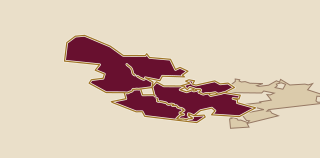
Libournais is the group of Right Bank vineyards around Libourne, east of Bordeaux and close to the Dordogne and Isle rivers. Merlot is the main grape, supported chiefly by Cabernet Franc and then Cabernet Sauvignon. The Médoc across the estuary is more strongly associated with Cabernet Sauvignon. Limestone, clay, gravel and sand appear in different combinations, across these vineyards.
All of the main appellations make red wine. Many bottles are generous when young, yet the more structured wines can develop for decades. The producer, vintage and exact appellation are better guides than the idea that every Right Bank wine is soft.
Ground and grape balance change quickly
What changes here
Saint-Émilion is a large, varied area. Its limestone plateau and slopes, clay-rich ground, gravel and sand create many expressions of the same broad Merlot and Cabernet Franc partnership. Pomerol is much smaller. Its plateau contains important clay and gravel soils, and Merlot normally has the central role. Fronsac and Canon-Fronsac lie on hills west of Libourne, with limestone and clay-limestone sites overlooking the rivers.
Cabernet Franc becomes especially valuable where it ripens well, bringing fragrance, freshness and firmness alongside Merlot's fuller texture. Cabernet Sauvignon appears less widely than it does in the Médoc. The blend is rarely printed on the front label, so the producer's information is useful when you want to understand a particular bottle.
Read the appellation before the château
Names to know
Saint-Émilion and Saint-Émilion Grand Cru cover the same general territory but follow different production rules. The four satellite appellations place Lussac, Montagne, Puisseguin or Saint-Georges before the Saint-Émilion name. Pomerol and Lalande-de-Pomerol are distinct appellations. Fronsac and Canon-Fronsac form another pair, while Castillon Côtes de Bordeaux and Francs Côtes de Bordeaux lie farther east.
Classification language needs care here. Saint-Émilion has a classification that is revised periodically and applies within Saint-Émilion Grand Cru. Pomerol has no official château classification. Grand Cru on a Saint-Émilion label therefore carries a different meaning from a classed growth in the Médoc.
Choosing a Merlot-led red
First bottle
For a Merlot-led red, look for a Saint-Émilion satellite appellation, Fronsac or Lalande-de-Pomerol. These often cost less than wines from the most famous estates. To compare places, choose two bottles of a similar age from these areas, Saint-Émilion or Pomerol. Notice their ripe fruit, freshness and tannin, the drying grip in your mouth.
A Cabernet-led Médoc from the same vintage offers a different blend to compare with the Merlot-led wines.
Continue through the region
Elsewhere in Bordeaux
- Bourg & Blaye22 producersBourg & Blaye is Bordeaux's Right Bank estuary country, centred on Merlot-led reds from Côtes de Bourg and Blaye Côtes de Bordeaux.
- Entre-Deux-Mers11 producersBetween the Garonne and Dordogne, Entre-Deux-Mers is known mainly for crisp dry whites and broadly priced Bordeaux wines.
- Graves & Pessac-Léognan20 producersSouth of Bordeaux, Graves and Pessac-Léognan place structured reds and ageworthy dry whites on the same gravel ground.
- Médoc59 producersThe Médoc is Bordeaux’s peninsula between the Atlantic and the Gironde estuary. Cabernet Sauvignon often leads its red blends, especially on the gravel ridges near the estuary. Margaux, Saint-Julien, Pauillac and Saint-Estèphe are four of its eight appellations, each with a defined area and wine-making rules.
- Sauternes & Sweet Wines19 producersMorning mist, afternoon sun and noble rot turn Sémillon into Bordeaux's most concentrated sweet wines around Sauternes and Barsac.
Producers in Libournais
Start with these
- Château AngélusSaint Émilion château making Merlot and Cabernet Franc wines, from Château Angélus to the younger Tempo d’Angélus.
- Château AusoneSaint-Émilion estate named for Ausonius, with limestone minerality and a Grand Vin raised in new French oak.
- Château FigeacSaint-Émilion estate on three gravel knolls, making red wines from Cabernet Franc, Cabernet Sauvignon and Merlot.
- Château LafleurChâteau Lafleur comes from Bordeaux, France.
- Château de SalesNorthwest Pomerol château with a two wine range and smooth, refined wines marked by silky tannins.
Browse 28 more
- Château Beau-Séjour BécotA Saint-Émilion Grand Cru Classé estate on the Saint-Martin de Mazerat limestone plateau, shaped by Merlot-led vineyards and deep cellar history.
- Château Belair-MonangeChâteau Belair-Monange is a Saint-Émilion estate with medieval origins and vineyard evidence reaching back to the Roman era.
- Château Bellefont-BelcierSaint Émilion château on the Côte Pavie slopes, making a Merlot led red from three Bordeaux grape varieties.
- Château Certan de MayPomerol estate with one block of vines, deep clay and gravel, and a Merlot led red.
- Chateau DalemChâteau Dalem is a Saillans estate with vines planted in 1610, a Merlot-led Fronsac red, limestone and clay parcels, and a cellar rebuilt in 2019.
- Château de ParenchèreEastern Bordeaux estate with 60 hectares under vine, clay limestone soils, organic certification, and red, white, and rosé wines.
- Château FaizeauMontagne-Saint-Émilion château with Merlot led reds, an old vine Merlot grand vin, and Château Chants de Faizeau as second wine.
- Château Grand Corbin-DespagneA Saint-Émilion château with Merlot led red wine, 53 parcels and French oak élevage.
- Château La CabanneMerlot led Pomerol red wine from blue clay soils, aged in French oak.
- Château La ConfessionSaint-Émilion Grand Cru red from Merlot, Cabernet Franc and Cabernet Sauvignon, aged in 100% new French oak.
- Château La Croix Saint-VincentFamily owned Pomerol producer making Château La Croix Saint-Vincent, an organic Merlot and Cabernet Franc second wine.
- Château La CroizilleSaint Émilion Grand Cru Classé château with 4.5 hectares, low yields, drastic selection, and high Cabernet Sauvignon content.
- Château LaroqueSaint-Emilion Grand Cru Classé château with a 61 hectare holding, a Grand Vin, and Les Tours de Laroque as its secondary wine.
- Château LassègueSaint Émilion château making red Bordeaux from clay, chalk and limestone, with stainless steel fermentation and French oak ageing.
- Chateau MélinLibourne estate producing Saint-Émilion Grand Cru, including the Merlot Cuvée ReVinTho aged in French oak.
- Chateau Pierrail EarlDemonchaux family Bordeaux estate with red, white and rosé wines, named releases and a related Château Arnaud property.
- Chateau Puy-RazacSaint-Émilion family estate with a 7 hectare sandy clay block and red wines from Merlot and Cabernet Franc.
- Château Rocheyron SARL.Château Rocheyron is a Saint-Émilion estate co managed by Silvio Denz and Peter Sisseck, with Merlot, Cabernet Franc and concrete vat vinification.
- Château Tour BaladozChâteau Tour Baladoz crafts Saint-Émilion red wines through hand harvesting, mixed-vat fermentation and extended French oak ageing.
- Château Vieux MougnacFounded in 1870 by Félix Milhard, Château Vieux Mougnac remains with the same family and makes Bordeaux Supérieur reds from Merlot and Cabernet varieties, with natural yeast, concrete maturation, and extended château ageing.
- Clos CantenacClos Cantenac presents a 2023 Saint-Émilion Grand Cru red wine noted by several leading critics.
- Établissements Jean-Pierre MoueixBordeaux Right Bank merchant and producer with holdings in Pomerol and Saint-Émilion.
- SCEA du Château de LussacA Merlot-led Lussac-Saint-Émilion estate where clay and clay-limestone soils meet French-oak-aged red with blackberry fruit, fresh acidity and ripe tannin.
- ThunevinSaint-Émilion reds from the Thunevin family, led by Château Valandraud: clay-and-limestone fruit, close vineyard work and long ageing in new French oak.
- Vignoble HermouetChâteau Roc Meynard spans Bordeaux Supérieur, Clairet and two white bottlings under Vignoble Hermouet.
- VIGNOBLES DAVID BEAULIEUVIGNOBLES DAVID BEAULIEU comes from Bordeaux, France.
- Vignobles Jean-Pierre EstagerChâteau La Cabanne is the Estager family’s Pomerol estate, producing dark-fruited reds shaped by clay-rich soils and extended French-oak ageing.
- Vignobles ThomasA family-run Listrac-Médoc estate where Petit Verdot-rich Château Reverdi sits beside the Merlot-led, barrel-aged Château l’Ermitage.