Who makes it
SCEA du Château de Lussac is the estate behind Château de Lussac, founded in 1876 and working under the Lussac-Saint-Émilion appellation in Bordeaux. Its Merlot-led planting puts the grape associated with dark fruit and body at the centre of the wine, while Cabernet Franc supplies a smaller but material part of the vineyard and the finished red.
The estate passed through an ownership chapter when Griet and Hervé Laviale took over in 2000. A later takeover by Sarments Vignobles brought a stated change in direction toward softer, less heavily structured wines, linking a change in stewardship to how the estate wanted its Lussac-Saint-Émilion to feel on the palate.
Where it grows
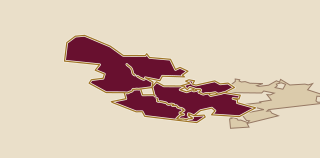
Lussac-Saint-Émilion is the appellation carried by Château de Lussac, locating the bottle in Bordeaux’s right-bank red-wine country rather than in a generic regional category. The label therefore names both a bounded source and a Merlot-and-Cabernet-Franc wine: the appellation tells where the red comes from, while the estate’s planting explains why Merlot leads its fruit and body.
The 28 hectares are described as clay and clay-limestone, with vines planted at 6,000 to 8,200 per hectare and averaging 32 years old. Clay can retain water through dry periods, while limestone is part of the site’s physical framework; alongside the relatively dense planting and mature vines, those facts put the estate’s Merlot and Cabernet Franc on a closely worked, established vineyard base.
How it is made
The cellar
The vines are trained in double Guyot and harvested mechanically. Double Guyot establishes a repeatable framework for the canopy and crop, while mechanical harvesting brings the grapes in efficiently; both are practical decisions before fermentation that shape how fruit reaches the cellar.
Alcoholic fermentation takes place in temperature-controlled stainless-steel vats holding 90 to 120 hectolitres. Stainless steel and temperature control allow the ferment to be managed closely, a cellar setting consistent with preserving the blackberry fruit and fresh acidity described in the 2016. French-oak maturation then adds another stage: the documented wine carries oak character alongside ripe tannin, rather than presenting fruit alone.
What they make
Its architecture begins in the vineyard: 75% Merlot establishes a dark-fruited, fuller-bodied centre, while 25% Cabernet Franc supports the blend’s aromatic and structural lift. The 2016 provides the clearest taste reference, with blackberry fruit, medium-to-full body, ripe tannins and a long finish.
French oak is an important part of that documented vintage’s shape. It brings oak character to the fruit and tannin, while fresh acidity stops the wine from reading as only broad or sweet-fruited. The supplied evidence indicates further estate wines but does not safely provide enough named cuvées to turn them into a catalogue.
Wines to try
First bottle
It is a Lussac-Saint-Émilion red from the estate’s Merlot-and-Cabernet-Franc context, with blackberry fruit, fresh acidity, ripe tannins, medium-to-full body, French oak and length.