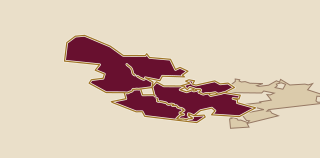
Graves runs south from Bordeaux along the Left Bank of the Garonne. Its name comes from the gravel and pebbles deposited by the river, mixed in places with sand, clay and limestone. Pessac-Léognan occupies the northern end, where vineyards reach the edge of the city. Both areas make red and dry white wine.
Cabernet and Merlot for red; Sauvignon and Sémillon for white
What changes here
Cabernet Sauvignon and Merlot lead the reds. Sauvignon Blanc and Sémillon lead the dry whites, with other permitted grapes playing smaller roles. The gravel drains readily and forms low rises across the landscape. Pessac-Léognan became a separate appellation in 1987, but its estates and the wider Graves tradition reach much farther back.
Pessac-Léognan occupies northern Graves
Names to know
Pessac-Léognan is the urban, northern name and contains all fourteen current Crus Classés de Graves, the estates in the Graves classification, including Haut-Brion, the sole estate outside the Médoc among the red first growths, the highest group in the 1855 classification. Graves continues south through a much larger area. Graves Supérieures and Cérons add sweet-wine names to a map otherwise known for reds and dry whites.
Start with a dry white
First bottle
For a dry white, choose Graves or Pessac-Léognan. Sauvignon Blanc brings freshness and Sémillon adds breadth. A red from the same appellation gives you a comparison of fruit and texture, with tannin adding the drying grip you feel in your mouth.
Continue through the region
Elsewhere in Bordeaux
- Bourg & Blaye22 producersBourg & Blaye is Bordeaux's Right Bank estuary country, centred on Merlot-led reds from Côtes de Bourg and Blaye Côtes de Bordeaux.
- Entre-Deux-Mers11 producersBetween the Garonne and Dordogne, Entre-Deux-Mers is known mainly for crisp dry whites and broadly priced Bordeaux wines.
- Libournais36 producersLibournais brings together Saint-Émilion, Pomerol, Fronsac and their neighbours on Bordeaux’s Merlot-led Right Bank.
- Médoc59 producersThe Médoc is Bordeaux’s peninsula between the Atlantic and the Gironde estuary. Cabernet Sauvignon often leads its red blends, especially on the gravel ridges near the estuary. Margaux, Saint-Julien, Pauillac and Saint-Estèphe are four of its eight appellations, each with a defined area and wine-making rules.
- Sauternes & Sweet Wines19 producersMorning mist, afternoon sun and noble rot turn Sémillon into Bordeaux's most concentrated sweet wines around Sauternes and Barsac.
Producers in Graves & Pessac-Léognan
Start with these
- Château Haut-BrionPessac-Léognan château with a Merlot-led 2022 red blend and a white wine named Haut-Brion Blanc.
- Château La Mission Haut-BrionChâteau La Mission Haut-Brion is a Talence producer of Graves red wines, known for a style described as bigger and more tannic than Château Haut-Brion.
- Domaine de ChevalierLéognan estate with Grand Cru Classé de Graves status in red and white, making Cabernet Sauvignon led reds and Sauvignon Blanc Sémillon whites.
- Château Smith Haut LafitteMartillac château with a gravel plateau, certified organic farming, Grand Cru Classé red status, and Cabernet Sauvignon and Sauvignon Blanc flagships.
- Chateau CarbonnieuxBordeaux château making sustainable red and white wines, including Château Carbonnieux Blanc and La Croix de Carbonnieux.
Browse 15 more
- Château CouhinsPessac Léognan estate classified exclusively for dry white wine, with red and white wines from gravel, clay and limestone soils.
- Château de FieuzalLéognan Grand Cru Classé estate making red and white Bordeaux from gravel, sand, clay and small white stones.
- Château Haut-BaillyCru Classé Pessac-Léognan estate on a rise above Léognan, with Cabernet led red Bordeaux aged in oak.
- Château Haut-BergeyPessac-Léognan estate with biodynamic certification, Merlot and Cabernet Sauvignon led reds, and Sauvignon Blanc based whites.
- Château Larrivet Haut-BrionLéognan château with gravel and sandy soils, Cabernet led reds, and Sauvignon Blanc and Sémillon whites.
- Château Les Carmes Haut-BrionBordeaux classified growth inside the city, making red wines from Merlot, Cabernet Franc and Cabernet Sauvignon.
- Château Mons La GraveyreCambes estate making an organic IGP Atlantique red from Merlot and Cabernet Sauvignon, aged in oak barrels and clay amphoras.
- Château Picque-CaillouBordeaux estate making Graves red and white wines from a 1755 château.
- Maison CalvetRhône founded Maison Calvet expanded into Bordeaux and now sources regional wines from more than seven French regions.
- Maison GinestetBordeaux wine merchant founded in 1897, based in Carignan-de-Bordeaux, with an appellation portfolio and sustainable farming partnerships.
- Maison SichelBordeaux family négociant with named château holdings and a Merlot led Château Argadens red.
- Producta VignoblesA Bordeaux cooperative network founded in 1949, linking 2,500 winegrowers to bottles from 50 appellations.
- Vignobles André LurtonA Bordeaux family group whose Château Bonnet wines sit alongside restored Pessac-Léognan estates, including Château de Rochemorin and Château de Cruzeau.
- Vignobles DourtheVignobles Dourthe in Bordeaux works with Merlot, Cabernet Sauvignon, Petit Verdot, Sémillon, and Sauvignon Blanc plantings.
- Vins et Vignobles DourtheA Bordeaux house spanning château bottlings, Sauvignon Blanc and concentrated red wines.