Who makes it
The Perrin family owns and manages Château Carbonnieux, and has done so for four generations. The estate covers around 100 hectares under cultivation around the château. Its history reaches back to the thirteenth century, when Benedictine monks of the Abbaye de Sainte Croix founded it.
After World War II, Marc Perrin led the family's acquisition of the property and extensive renovation of the entire estate. The vines are cultivated with respect for the environment under sustainable practices. Château Carbonnieux makes both red and white Bordeaux wines from its estate vineyards.
Where it grows
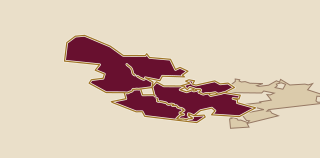
Graves is a Bordeaux appellation for red and white wines. La Croix de Carbonnieux carries minerality characteristic of Carbonnieux and the Pessac-Léognan terroir.
What they make
The range divides between red and white plantings. The red vineyard totals 55 hectares, planted 50% Cabernet Sauvignon, 40% Merlot, 5% Cabernet Franc and 5% Petit Verdot. The white vineyard totals 45 hectares, planted 65% Sauvignon Blanc and 35% Sémillon.
The white range includes Château Carbonnieux Blanc and La Croix de Carbonnieux. Château Carbonnieux Blanc is drinkable after four years of bottle age. La Croix de Carbonnieux is made from Sauvignon and Sémillon, with a pale yellow colour, freshness, and aromas of exotic fruits or grapefruit. It spends six months in barrels and large casks before release. La Croix is slightly less powerful than Carbonnieux and can be enjoyed younger.