
A place name on a label can tell you which grapes to expect, how the wine was made or where to look for a comparison. Start with the translation table, then follow a region that interests you. You can return to the others when you meet their names on a bottle.
The translation table
read producer and classification togetherMany European labels lead with a place name whose rules specify the grapes. Chablis, for example, is made from Chardonnay. Others, including Alsace wines, can name the grape on the label. So here is the cheat sheet I wish someone had slipped me at nineteen:
| The label says | Grapes to recognise |
|---|---|
| Chablis, Pouilly-Fuissé | Chardonnay |
| White Sancerre, Pouilly-Fumé | Sauvignon Blanc |
| Vouvray | Chenin Blanc |
| Muscadet | Melon de Bourgogne |
| Soave | Garganega-led |
| Red Burgundy | Pinot Noir |
| Red Côte-Rôtie, Hermitage | Syrah-led |
| Red Châteauneuf-du-Pape | Often Grenache-led blends |
| Chinon, Bourgueil | Cabernet Franc |
| Chianti, Brunello | Sangiovese-led Chianti; pure Sangiovese for Brunello |
| Barolo, Barbaresco | Nebbiolo |
| Red Rioja | Often led by Tempranillo |
Two rules of thumb travel with the table. First: a more specific place name can narrow the expected style, but producer and vintage still matter. "Bourgogne" can cover a huge region; a named vineyard identifies a particular site. Second: producer and classification are both useful clues, alongside vintage, style and price.
France
France's regions connect many of the grapes and winemaking terms used throughout this course. Start with the differences between Bordeaux, Burgundy, Champagne, the Rhône, the Loire and Alsace.
Bordeaux
Start in Bordeaux, where the Left Bank and Right Bank introduce different balances of grapes. Cabernet Sauvignon is particularly important on the Left Bank, where gravel is common; Merlot is prominent on the Right Bank, where clay is common. Left Bank reds often have firmer tannin and blackcurrant or cedar notes; Right Bank reds often feel rounder, with plum fruit. Soil, growing conditions and winemaking all contribute. Neither bank tells you on its own whether a bottle is ready to drink.
The 1855 classification ranked châteaux using the prices their wines fetched at the time, for a Paris trade fair. It remains influential, but Bordeaux production extends far beyond those classified estates. Read the classification alongside the producer, vintage and style.
Bordeaux's 1855 ranking drew on wine prices for a Paris trade fair. It remains influential today.
read the classification alongside the wineCru bourgeois, second labels and the Côtes de Bordeaux offer other Bordeaux wines to explore. Cru bourgeois is a Left Bank classification involving assessment by tasting. A second label is another wine from an estate, with its own selection and style; compare it with the main wine without assuming it comes only from younger vines. The Côtes de Bordeaux include hilly Right Bank areas such as Castillon. Ask about the blend and drinking window of the bottle you choose.
One more fact that surprises people at my tastings: Bordeaux makes white wine. The dry Sauvignon Blanc–Sémillon blends are grassy, waxy and often worth comparing. And at the sweet end sits Sauternes: golden wine from grapes shrivelled by a friendly fungus called noble rot, honeyed but bright with acidity, sometimes made for long ageing. Yes, some of the world's greatest sweet wine is made from mouldy grapes. Nobody said wine was glamorous up close.
Burgundy
climat: a named vineyard parcelBurgundy labels distinguish regional, village, premier cru and grand cru wines. Regional wines cover the broadest areas; the other names identify more specific origins. A climat is a named vineyard parcel. Centuries of work in these vineyards, including by the Cistercians, helped establish distinctions between neighbouring plots. The classification tells you where the grapes grew, while the grower and vintage help explain the wine.
Inheritance over generations divided many Burgundy vineyards among multiple owners. Some grand cru vineyards now have dozens, each farming part of the same named site. This makes wines from different producers in the same vineyard a revealing comparison: a shared origin can still give different results. Read the producer's name alongside the vineyard and vintage.
Chablis is in northern Burgundy and makes wine from Chardonnay. Many vineyards have fossil-rich ground associated with an ancient seabed. The wines often have fresh acidity and citrus flavours, with oak use varying by producer. If buttery Chardonnay has put you off the grape, compare it with a leaner Chablis.
The Mâconnais in southern Burgundy includes Pouilly-Fuissé, Saint-Véran and Mâcon-Villages, names to explore for riper, rounder Chardonnay. Nearby, Beaujolais centres on Gamay. Its ten named crus include Morgon, Fleurie and Moulin-à-Vent. Compare these with Beaujolais Nouveau to explore how much variety one grape can offer, from youthful fruit to firmer wines.
Champagne
Champagne has three main grapes: Chardonnay and the dark-skinned Pinot Noir and Meunier. Gentle pressing limits colour extraction, allowing dark grapes to make white wine. Rosé Champagne may also be made by blending red and white base wines, a method closely associated with the region.
The region is cool, but Champagne’s chalk affects drainage and water availability within a wider climate, site and farming system. Grapes with high acidity can suit sparkling wine. Most bottles are non-vintage: a house blend of base wines from different years and vineyards, built toward a familiar house style. Vintage Champagne is declared when a producer chooses to show one year on its own, and it is usually priced accordingly.
look for the tiny RM near the small printGrower Champagne is made by growers from their own grapes. Find the two tiny letters near the edge of the label: NM means a house that buys grapes from many farmers; RM means the person who grew the grapes also made the wine. Grower Champagne can show a more site-specific style; price and cellar approach vary by producer.
The Rhône
The Rhône has a northern area known for Syrah reds, including wines from steep granite terraces: Côte-Rôtie, the "roasted slope", and Hermitage, small and serious, all black pepper, olives, bacon and violets. A local eccentricity I adore: some Côte-Rôtie ferments a splash of white Viognier in with the Syrah, and the red somehow comes out both darker and more perfumed. The south relaxes into sun-baked Grenache-led blends grown among the galets, fist-sized rounded stones that soak up heat all day and radiate it back at the vines all night. Châteauneuf-du-Pape permits a range of grapes; producers choose different blends.
"villages" has tighter production rulesIn the south, compare Côtes-du-Rhône with Côtes-du-Rhône Villages, which has tighter production rules. Then try a cru such as Gigondas or Vacqueyras alongside Châteauneuf-du-Pape. These appellations share important grapes, but their sites, blends and producers give you more to compare than a price ladder.
The Loire
One river, a thousand kilometres, and the whole white-wine syllabus laid out in order. At the Atlantic mouth: Muscadet, from the Melon de Bourgogne grape: bone-dry, faintly salty, a familiar wine to serve with oysters. The words sur lie indicate time on the lees, the spent yeast sediment, which can change texture. Mid-river is Chenin Blanc country: Vouvray runs from properly dry (sec) through off-dry (demi-sec) to honeyed and sweet (moelleux) depending on the year, so check for that word before you buy. Nearby, Chinon and Bourgueil make Cabernet Franc reds with crunchy red fruit and a pencil-shaving edge, wonderful lightly chilled. Far inland: Sancerre and Pouilly-Fumé, Sauvignon Blanc on limestone and flint, often with citrus, herbal or smoky notes to compare with New Zealand examples.
compare the Loire by grape and sweetnessAcross the Loire, check the grape and sweetness before choosing. Muscadet, a dry Vouvray and Sancerre make a comparison of three different white grapes, while Chinon introduces Cabernet Franc in red wine.
Alsace
Alsace often names the grape on its tall bottles. Sheltered by the Vosges mountains, it has relatively dry, sunny growing conditions. Its whites include Riesling, Gewurztraminer, Pinot Gris and Muscat, with aromatic character and a range of textures. Check sweetness separately; dry does not mean better. Its Grand Cru system names 51 vineyards, and Crémant d'Alsace offers sparkling wine to compare with Champagne.

Italy
Italy makes wine in all twenty of its regions and officially recognises hundreds of grape varieties. Labels may name a grape (Pinot Grigio), a place (Chianti), or combine a local grape name with its place (Brunello di Montalcino). Read the full wine name: it may combine a grape with a place, or use a local name for a grape you know. The regions below give you examples to recognise.
Piedmont
In Piedmont, at the foot of the Alps, Nebbiolo makes Barolo and Barbaresco. Both use only Nebbiolo and can combine pale colour with firm tannin and aromas of roses and tar. Their style and readiness vary by producer and vintage. For a different red from the region, compare Barbera, often tangy with softer tannin, or Dolcetto, with plum fruit and a bitter-chocolate edge. They teach you different grapes from the same region.
Veneto
Prosecco is a protected wine name; its main grape is called Glera. Most Prosecco gets its bubbles through a second fermentation in tank, often giving fresh, fruity wine. Soave, from the Garganega grape in the hills east of Verona, is the white to relearn. From the original Classico hills it's saline, almondy and far better than its jug-wine reputation from the seventies.
same grapes, four different winesAnd then there's the Valpolicella ladder, my favourite piece of winemaking logic in Italy. One zone, one blend of grapes (Corvina and friends) and four wines, where post-harvest treatment is a major distinction alongside vineyard and cellar choices. Fresh grapes make Valpolicella: light, sour-cherry, happy slightly chilled. Dry the grapes on racks for months before pressing and you get Amarone: dark, dry, powerful, 15% and up, all raisin and bitter chocolate. Referment young Valpolicella over Amarone's leftover skins and you get ripasso, a middleweight with borrowed muscle. Stop the dried-grape wine before it ferments fully dry and you have sweet recioto, the ancestor of the whole line.
Tuscany
the black rooster identifies Chianti ClassicoSangiovese leads many Tuscan reds. Chianti and Chianti Classico are separate appellations; Classico comes from the historic hills between Florence and Siena and uses the black rooster emblem. Brunello di Montalcino is made entirely from Sangiovese around Montalcino and follows long ageing requirements. Compare it with Rosso di Montalcino, which can be released earlier. Vino Nobile di Montepulciano is also led by Sangiovese and takes its name from the Tuscan town, not the Montepulciano grape.
The term Super Tuscan became associated with wines that departed from traditional local production rules, including Bordeaux-style reds. Some were sold as table wine despite high prices. IGT later offered a geographical category with more flexible rules. Super Tuscan itself is not a legal classification or a guarantee of a particular blend.
The South
Campania introduces Aglianico, the grape of Taurasi, which can make firm reds suited to ageing. Fiano and Greco give you white wines to explore for texture and savoury flavours. Puglia, in the heel, grows Primitivo, the same grape as California's Zinfandel, often with ripe fruit. On Sicily's Mount Etna, Nerello Mascalese reds and Carricante whites come from vineyards on volcanic slopes. Compare their colour, acidity and texture without treating the geology as a tasting note.
The letters on Italian labels, decoded honestly: DOC is the controlled-origin tier; DOCG adds a G for "guaranteed", a government tasting and a numbered paper strip over the cork; IGT is the loose tier the Super Tuscans made respectable. Now the honest part: DOCG does not mean better. There are dull DOCGs and magnificent IGTs. The letters tell you the wine followed its local rules; Classico tells you it came from the original heartland; the producer's name identifies who made it.
Walk southern Italy on the map
Spain & Portugal
Spain
ageing terms follow each appellation’s rulesSpain uses ageing terms such as Crianza, Reserva and Gran Reserva. Their requirements depend on the appellation and wine colour. This table introduces red Rioja examples; the terms describe minimum ageing, not a guaranteed flavour or drinking window:
| The label says | Ageing requirement | Translation |
|---|---|---|
| Joven / Cosecha | Check the producer's ageing information | These words alone do not establish oak use |
| Crianza | 1 year in oak, 1 more in bottle | Oak may contribute flavour; the barrel and producer matter |
| Reserva | 1+ year in oak, 3 years total | Minimum ageing met; check the drinking advice |
| Gran Reserva | 2 years in oak, 5 years total | Longer minimum ageing before release |
Rioja itself, Tempranillo's home turf, splits into two schools. The traditionalists age long in American oak and release pale, silky wines that taste of dried cherry, vanilla and old libraries. The modernists pick riper and use French oak for something darker and plusher. Ask about oak and ageing when you want one of these styles; label artwork cannot establish how the wine was made.
check oak use in the wine descriptionBeyond Rioja: Ribera del Duero, a high plateau north of Madrid, is Tempranillo with the volume up: hot days, cold nights, darker fruit, more muscle. Priorat grows old Garnacha and Cariñena on slate slopes; many wines are dense and firm, but soil alone does not explain their flavour. Rías Baixas, on the green Atlantic coast, is Albariño: peach and sea spray, the seafood white. And Jerez in three sentences: sherry includes dry and sweet styles, so check the full style name. Fino ages under flor, a living veil of yeast, and comes out bone-dry, saline and brilliant with anything salty. Try it beside a sweet Sherry to see how widely the family varies.
Portugal
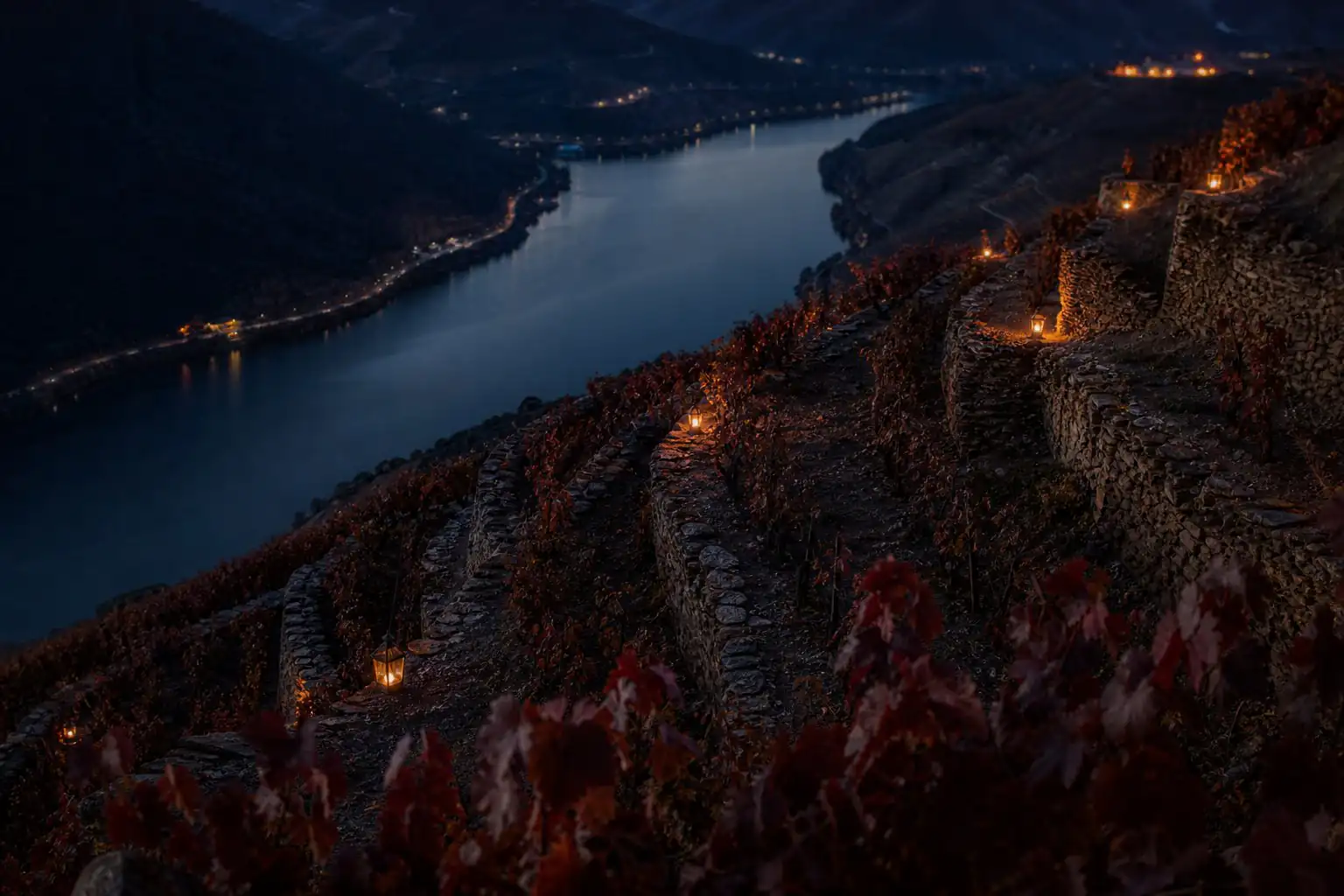
Portugal is known for Port, from the Douro's stone terraces, steep farmland. An age statement on tawny Port describes the expected character of the blend. A 20-year tawny is a blend judged to taste twenty years old. The country also makes dry wine. The same Douro grapes that go into Port, Touriga Nacional in the lead, also make dark, firm table reds: a comparison to try if you enjoy Cabernet.
Vinho Verde, from the rainy north-west, includes light, fresh whites, some with a faint spritz. Alentejo, in the warm south, is known for rounder reds to compare with Malbec. Portugal's many native grapes offer a broad range of blends. Read the region and producer as well as the price.
Germany & Austria
Germany grows Riesling at the 50th parallel, a cool setting for vineyards, on slate slopes above the Mosel that reach a 70% grade, where pickers genuinely rope themselves in. The classic labels rank ripeness at harvest, climbing from Kabinett through Spätlese and Auslese up to Beerenauslese, Eiswein and Trockenbeerenauslese. Note what that ladder measures: how ripe the grapes were when picked, not how sweet the wine ended up.
Germany makes dry Riesling as well as sweet styles. The word trocken means dry. Grosses Gewächs, often shortened to "GG", identifies dry wine within a growers' vineyard classification. Read that separately from the Prädikat terms above, which describe the grapes at harvest. Neither system makes all German Riesling sweet.
check the abv before you chill itCan't decode a label? Alcohol can offer clues in German Riesling, but use the sweetness term, producer information and your palate too. And the regions in a line each: Mosel is the ethereal one: slate, low alcohol, wines that seem to float. Rheingau is the stately one, firmer and drier, with twelve centuries of paperwork. Pfalz is the sunny one, just over the hills from Alsace, and full of useful bottles to explore.
Austria is known for dry whites, including Grüner Veltliner, all white pepper, green lentil and citrus, with asparagus or artichokes offering food comparisons to try. The Wachau, a stretch of terraced Danube bank west of Vienna, grows both Grüner and Riesling. And the reds, Blaufränkisch above all, are often peppery with fresh acidity.
Other European regions, Lebanon and Georgia
Greece has a long history of wine growing. Start on Santorini, where Assyrtiko grows in baskets coiled against the wind on volcanic ash and tastes of lemon, salt and struck stone. Then go north to Naoussa for Xinomavro, pale but fiercely tannic, all dried cherry, tomato and olive. For Xinomavro, ask about the drinking window and compare the tannin with food.
Nemea in the Peloponnese grows Agiorgitiko for reds with plum fruit, spice and dried-herb notes. Crete offers both white and red wines from local grapes. Retsina is flavoured with pine resin; ask how prominent it is in the bottle you are considering. A Greek wine specialist can help you compare regions and styles.
retsina: wine flavoured with pine resinHungary makes sweet Tokaji wines from grapes affected by noble rot, including Furmint. Look for apricot or honey aromas alongside the acidity. The puttonyos term relates to sweetness in Tokaji Aszú. Check the full wine name, since Tokaj also makes dry wine. A half-bottle can be a practical choice for a dessert-wine comparison.
Tokaj's modern movement is dry Furmint, a taut, smoky white with pear, lime and fresh acidity that can sit comfortably beside dry Riesling at dinner. Down south, warm Villány makes plush, paprika-edged reds, especially Cabernet Franc, often labelled Villányi Franc. Compare dry Furmint with Riesling for acidity and texture; with Villány reds, ask about fruit, tannin and oak.
England makes sparkling wine in a cool climate. Sussex includes chalk soils, a geological connection often discussed alongside Champagne. English sparkling wines have performed strongly in some comparative tastings; compare the wines themselves for acidity, fruit and lees-aged aromas.
Switzerland keeps most of its wine close to home. In Valais, Chasselas is called Fendant and comes out delicate, stony and faintly herbal, a quiet white for melted cheese rather than a wine that shouts across the table. Around Lake Geneva, Lavaux has steep vineyard terraces above the lake. Exports are rare because the Swiss drink almost all of it, so ask about the producer and style when you find a bottle.
Croatia and the Balkans begin on Croatia's Dingač slopes, where Plavac Mali clings above the Adriatic and makes dark, sun-warmed reds with fig, cherry and a salty, rugged grip. It is a child of Tribidrag, also called Crljenak Kaštelanski, the Croatian root in Zinfandel's family tree. Across Slovenia's border with Friuli, long skin contact gives white grapes amber colour, tannin and tea-like savour. Serbia and North Macedonia also make local reds to explore. Ask about fruit, acidity and tannin when choosing a style.
Lebanon grows wine in the high Bekaa Valley, with sunny days and cooler mountain nights. Start with a younger Bekaa red led by Cinsault. If you try a more mature red from the valley later, notice how the fruit and tannin feel, and whether other aromas have developed. Ask about the grapes, bottle age and condition when choosing.
Almost every bottle Switzerland makes stays in Switzerland. The Swiss drink their own cellar.
most Swiss wine is drunk at homeGeorgia has a long tradition of wine growing. In the traditional qvevri method, crushed grapes, skins, pips and sometimes stems ferment together in beeswax-lined clay vessels buried to the neck, where the earth steadies the temperature. Whites emerge amber, tannic and savoury, with dried apricot, tea, walnut and herbs. The method offers a comparison with white wines fermented without their skins.
qvevri: the cellar is buried in the floorGeorgia also makes wine in other vessels: crisp Tsolikouri whites and dark, juicy Saperavi reds, often made in steel. For qvevri amber wine, start with a glass or a restaurant recommendation, because months on skins can be thrilling or stern and the producer matters enormously. If you like grip, dried fruit and savoury edges, buy the bottle. If you want a familiar white, start with the same country in steel.
Wine regions beyond Europe
Outside Europe, many labels put the grape name prominently on the front. Read the place name too: it tells you where those grapes were grown.
United States
California makes most of the wine in the USA. A turning point in its international reputation came in Paris. In 1976 a British wine merchant staged a blind tasting: California against the best of France, judged by French experts. California won both the red and white flights, and the result brought international attention to California wine.
Paris, 1976: French judges blind-tasted California against Bordeaux and Burgundy. California won both the red and white flights.
the judgment of paris brought international attentionNapa is known for Cabernet Sauvignon. Fog from San Pablo Bay helps moderate parts of the valley, while mountain and valley-floor vineyards have differing conditions. Some wines are firm and tannic; others feel plusher. The place name cannot tell you the bottle's quality or readiness on its own. Check the producer, vintage and wine description.
"Napa" on a label is an address, not a promise. Read it alongside the producer, vintage and style.
read place, producer, vintage and style togetherNext to Napa, Sonoma has cooler coastal areas, including the Russian River Valley, known for Pinot Noir and Chardonnay. Farther north, Oregon's Willamette Valley is another region to explore for Pinot Noir. Much of Washington's wine growing lies east of the Cascades in dry conditions, with Syrah and Cabernet among its reds. New York's Finger Lakes offers a Riesling comparison, with deep lakes helping moderate winter cold.
Walk the United States on the map
Canada
Canada makes ice wine from grapes naturally frozen on the vine, including in Niagara; the result is intensely sweet, all apricot, marmalade and clean acid. Across the country, the dry Okanagan Valley gives dark, ripe reds from its warm southern desert and cool-climate Chardonnay further north, with apple, citrus and a restrained hand on oak. Buy Canadian ice wine in a half-bottle from a named estate, and seek Okanagan reds by sub-region rather than assuming the whole valley is cold.
Argentina
Argentina offers many high-elevation vineyards. Mendoza lies in the rain shadow of the Andes, where warm days and cool nights help shape growing conditions for Malbec. The Uco Valley includes high sites, with wines that can show floral aromas and fresh acidity alongside dark fruit. Compare sub-regions, while checking producer and vintage too. Farther north, Cafayate in Salta is known for Torrontés, a white grape that can combine floral aromas with a dry taste.
Uruguay
Uruguay has rainy, Atlantic growing conditions that differ from Mendoza's dry, high-elevation sites. Tannat is a key grape, making wines that can combine blackberry, plum or cocoa notes with firm tannin. Garzón, east of Montevideo, is one coastal area to explore. Try a Tannat with food and notice how its grip feels beside the dish.
Chile
the louse never crossed the AndesChile is a natural fortress, with desert to the north, Andes to the east and Pacific to the west, and phylloxera, the louse that ate the world's vineyards, never got in. Chilean vines still grow on their own roots, although own-rooted vineyards exist elsewhere too. My favourite Chilean fact: some vines long thought to be "Merlot" were identified in the 1990s as Carmenère, a Bordeaux grape. Carmenère is now strongly associated with Chile.
Some Chilean vines long thought to be Merlot were identified as Carmenère, a Bordeaux grape.
Carmenère was long mistaken for MerlotThe map reads west to east: coast, valley, mountains. The cold Humboldt current drags fog into coastal valleys like Casablanca and Leyda, which make sharp grapefruit-and-herb Sauvignon Blanc and nervy Pinot Noir. The Maipo Valley, in the Andes foothills behind Santiago, is Cabernet country: blackcurrant with a signature minty edge. And in the dry-farmed south, old bush vines of País, the humble grape the conquistadors brought and dismissed for centuries, are being revived into light, thirst-quenching reds by a young generation with excellent taste in old vineyards. Chile offers a broad range of styles and prices, so the producer and region on the label are useful guides.
Australia
Australia also dodged the louse in places, which is why Barossa has very old Shiraz vines: gnarled survivors planted in the 1840s, still producing dark, chocolatey, generous wine. But the range runs far beyond sunshine. Clare and Eden Valleys make Riesling so dry it squeaks, all lime juice and slate in youth, toast and honey with age. Coonawarra grows Cabernet on a cigar-shaped strip of red terra rossa soil over limestone: cassis, eucalyptus, cool composure. Margaret River, on the Indian Ocean with water on three sides, is Bordeaux-blend country; compare its blends led by Cabernet with wines from other Australian regions. The cool south (Yarra Valley, Mornington Peninsula, Tasmania) has turned to Pinot Noir, Chardonnay and sparkling wine with a precision that startles anyone still filing Australia under "sunshine in a bottle".
And Hunter Valley Semillon can develop toasty, honeyed flavours with age even when it has not been aged in oak. Young examples can be lean and low in alcohol. Compare a young and a mature bottle from the same producer to explore how the wine changes.
New Zealand
New Zealand is particularly known for Marlborough Sauvignon Blanc, often with gooseberry, passionfruit and grassy aromas. On the South Island, Central Otago has a continental climate with hot summers and cold winters, and is known for Pinot Noir with dark fruit. On the North Island, Hawke's Bay makes peppery Syrah, including wines from the Gimblett Gravels, an area of old riverbed soils. Read the region as well as the grape when comparing these wines.
South Africa
South Africa offers Cabernet and Bordeaux-style blends from Stellenbosch, often with dark fruit, tobacco or graphite notes. Swartland is known for Syrah and Chenin, including wines from old, dry-farmed bush vines. Chenin Blanc is particularly important across the country, with styles ranging from crisp whites to fuller wines with honeyed aromas. Compare young and older-vine examples without assuming vine age determines quality.
Then there's pinotage, the local red created by crossing Pinot Noir with Cinsault. It divides people, and I'll be honest about which side I'm on: at its best it's smoky, plummy and characterful; at its worst it tastes of burnt rubber and regret, with quality and style varying by producer. Taste before you commit to a case.
The small print, decoded
rules guarantee origin, not pleasureThese terms describe origin and production rules:
- EU "PDO" (appearing locally as AOP/AOC in France, DOC/DOCG in Italy, DO/DOCa in Spain) means strict rules on place, grapes and style: the wine must taste typical of its home.
- "PGI" (IGT in Italy, IGP in France) is the looser tier: real geography, far more freedom. Some of it is dull; some of it is a rule-breaking bargain, as the Super Tuscans proved.
- Italy's DOCG adds a government tasting and a numbered paper strip over the cork. A guarantee of typicality, not of excellence.
- Spain's cellar terms (Crianza, Reserva, Gran Reserva) describe ageing requirements. Read them within the rules of the appellation and wine colour.
- A US AVA identifies an American winegrowing area; at least 85% of the grapes must come from the named area. It says nothing about style or quality: Napa on the label is an address, not a promise.
- Varietal thresholds vary by country and category; check the applicable local labelling rule. The remainder may include other grapes.
These systems describe origin and production rules. They help you understand a label, but cannot guarantee that you will enjoy the wine.
Reading three wine labels
place → grape → level → producerTheory is lovely; shelves are real. Here are three bottles, decoded the way I'd do it standing in the shop.
"Sancerre 2023." Sancerre names a place at the eastern end of the Loire. For a white Sancerre, the grape is Sauvignon Blanc. Citrus, herbal and flinty descriptions are familiar, but check the producer's wine information for oak use and drinking advice. The vintage identifies the harvest year. Goat's cheese is one pairing to try.
read the place first, then trust the producer"Barossa Shiraz 2021." Barossa names the place and Shiraz names the grape; the grape name alone would not tell you the country. Warm growing conditions often favour ripe fruit and fuller wine. The alcohol percentage can suggest warmth and body, but cannot confirm aromas or quality. Read the producer and vintage, then compare your expectations with the glass.
"Rioja Reserva 2018." Rioja names a Spanish wine region where Tempranillo is an important red grape. For a red Rioja, Reserva includes at least a year in oak and three years of total ageing before release. That gives you information about time in the cellar, but does not guarantee a drinking window or flavour. Ask about the producer's style and the bottle's condition; label artwork cannot tell you whether it is pale and silky or dark and full.
Keep the translation table nearby when reading unfamiliar labels. Start with the place and grape, then check the producer, vintage and any ageing terms. The worked examples show which questions the label can answer and which need the wine description or a taste.
Test yourself
Five questions, no geography exam
0 of 5.
What to keep
- Labels can name the place, grape or both. Use the translation table for common place-and-grape connections.
- The same grape can taste different in another climate; read the place as well as the grape.
- Classifications describe origin and production rules. Use them alongside the producer, vintage and style.
- Use the atlas to see where a wine region lies and which places surround it.
Words you metAppellation AOC / AOP DOC / DOCG Prädikat Grand Cru Typicity
last one: bringing it all to the table