
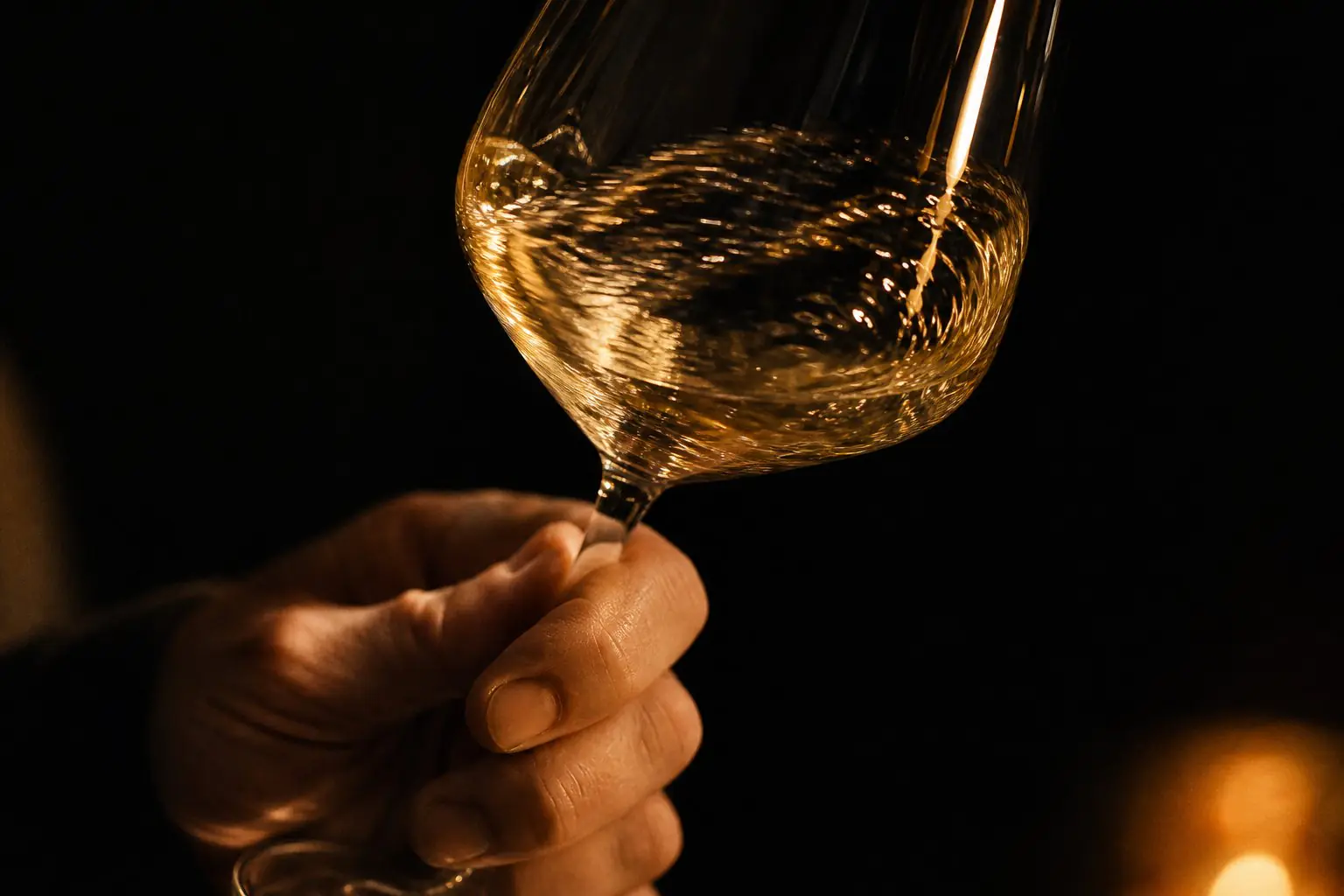
You can learn to taste by giving each part of a sip your attention: the colour, the smell, the sensations in your mouth and what stays afterwards. I've watched hundreds of people discover in one evening that they were tasters all along; they'd simply never been shown where to point their attention. This chapter is the long version of what I teach at my tastings in Stockholm: the four steps in full, then how to train your nose between bottles, and finally how to run a blind tasting of your own. Pour yourself something before you read on. Homework goes better with props.
Step one: look
compare the rim with the centrePour about 75 ml into a roomy wine glass. You need room to swirl. Tilt the glass to 45 degrees against something white: a napkin, a menu, your shirt if you're feeling brave. (If you ever pay for a tasting and the venue has laid black tablecloths, ask for a white napkin. I have made scenes over this.) Compare the colour at the thin rim with the centre. Note the shade and how pale or deep it is. Grape variety, winemaking and age all affect colour, so keep your description separate from a guess about the bottle’s age or quality.
Explore the colours of white and red wine
The white ladder
White wines often deepen in colour as they age. Read these shades from left to right, keeping winemaking and grape variety in mind:
- Platinum, almost water-white: a very pale white. Colour alone cannot confirm its age, climate or fermentation vessel. Muscadet, Pinot Grigio, most young Riesling. Look for citrus aromas and check the acidity when you taste.
- Green glints at the rim: a tint that can appear in young whites. Sauvignon Blanc and Grüner Veltliner can show this green tint; check their acidity on the palate.
- Straw: the default resting state of dry white wine. On its own it tells you little; wait for the nose.
- Gold: several explanations are possible: grape variety, winemaking, oxidation or a few years in bottle. An oaked Californian Chardonnay and a Sauternes can both look gold; compare their aromas rather than treating the colour as an answer.
- Brass and amber: maturity, an oxidative style such as sherry or old white Rioja, or skin contact in an "orange" wine. In a young white that was meant to be fresh and pale, it may suggest oxidation. Check the aroma before drawing a conclusion.
The red ladder
Red wines often lose colour as they age. Pigment can bind with tannin and fall out as sediment. Read these shades from left to right, remembering that grape variety and winemaking also affect the starting colour:
- Purple-magenta: often associated with youth. Beaujolais Nouveau and young Malbec glow almost neon at the rim. Check the acidity when you taste.
- Ruby: the classic youthful red, from Rioja to Margaux. Ruby alone gives you little certainty about age.
- Garnet: an orange tint at the rim that can suggest age. Grape variety matters too: Nebbiolo and Sangiovese can show garnet tones while young.
- Brick and tawny: ageing, including time in contact with oxygen. Tawny port and old-school Rioja Gran Reserva are walked to this colour deliberately, over years in barrel.
And intensity: pale reds are not weak reds. Pinot Noir, Gamay and Grenache can make relatively pale wines. Pigment content and extraction both matter; skin thickness alone does not explain the result. Deep colour cannot identify a grape, and pale colour need not mean little flavour or tannin. Check tannin and body on the palate.
Understand sediment, crystals and wine legs
Floaters, haze and false alarms
wine diamonds are harmlessAppearance can help you notice changes in a wine, though sediment and crystals are often harmless. Small crystals in the bottom of a white are tartrates, "wine diamonds": salts of tartaric acid, commonly potassium bitartrate, that can crystallise as wine cools. They are harmless and do not establish quality. Sediment in an older red is also common: pigment and tannin bind together over the years and drop out of the liquid, one part of the changes in red wine colour with age. Stand the bottle upright the day before, pour gently, sacrifice the last centimetre. An unfiltered wine may also have a light haze. Check its smell and taste rather than judging by clarity alone.
Unexpected cloudiness, fizz in a wine meant to be still, or browning in a young wine can warrant a closer look. Fizz may suggest fermentation has restarted in the bottle; a raised cork may suggest heat exposure. These signs need context, so ask the retailer or restaurant if the bottle seems wrong.
legs are physics, not a quality testThen everyone asks about the legs, those slow tears sliding down the inside of the glass. They're real physics. Evaporation changes the alcohol concentration and temperature of the thin film on the glass. The resulting surface-tension differences draw liquid upwards; gravity brings droplets back down. This movement is called the Marangoni effect. Alcohol, temperature and the glass surface affect the pattern. Use the label for alcohol and your palate for sweetness; legs measure neither reliably and are not a quality test.
Step two: smell
doggy sniffs. really.Much of what you call flavour arrives through aroma. Taste receptors respond to sweet, sour, salty, bitter and umami; smell supplies much of the detail we call flavour. When people say a wine "tastes of cherry", their nose did that. Swirl for about ten seconds to release aromas, then bring your nose towards the glass.
Take short, gentle sniffs. Repeated smelling can make aromas harder to notice, so pause if they seem to fade. I call them doggy sniffs, because that's exactly what a dog does, and dogs are the professionals here. If your nose goes blank mid-tasting, take a break before returning to the glass.
Move your nose around the glass. Distance and swirling can change which aromas you notice, and a small shift can reveal something new.
What you're smelling sorts into three layers. Primary aromas are the fruit, floral and herbal characters associated with the grape and alcoholic fermentation. Secondary aromas are associated with later winemaking processes, such as malolactic fermentation, lees ageing and oak use. Tertiary aromas come from time: nuts, leather, dried fruit, forest floor. These groups help you consider whether an aroma may come from the grape, winemaking or ageing. They are a starting point for comparison, rather than proof of a particular method or age.
The fruit aisle
describe the fruit before deciding its causeStart with a fruit family you recognise. Red berries, citrus or stone fruit is enough if a more precise name does not come to mind. You can add detail as you become familiar with the aromas; there is no need to force a raspberry–strawberry distinction.
For whites, compare citrus (lime, lemon, grapefruit), orchard fruit (green apple, pear, quince), stone fruit (peach, apricot, nectarine) and tropical fruit (pineapple, mango, passion fruit). Warmer growing conditions can move a grape’s aromas towards riper fruit families. Chardonnay smells of lemon and oyster shell in Chablis, of ripe peach in a warm Mâcon vintage, and of grilled pineapple in South Australia. These are examples to compare, rather than fixed aromas for every bottle from each place.
For reds, start with red fruit or black: cranberry, red cherry and raspberry beside blackcurrant, blackberry and black plum. A Pinot Noir and a Barossa Shiraz can make an interesting comparison. Grape variety, ripeness and winemaking all matter, so describe the fruit first and assess acidity and body separately.
Next, describe the condition of the fruit. Fresh-picked aromas may suggest youth or cooler growing conditions; cooked or jammy aromas can suggest riper grapes. Dried fig, prune or raisin may relate to ageing, deliberate grape drying, as in Amarone, or heat damage. Consider the style and condition of the bottle before choosing an explanation.
Green things, flowers and the outdoors
Green aromas can be as recognisable as fruit. Methoxypyrazines are a family of compounds associated with bell-pepper and leafy notes in grapes including Cabernet Franc and Sauvignon Blanc. Their concentration and the surrounding aromas affect the impression. A green note alone cannot tell you whether the grapes were underripe.
Methoxypyrazines can be detected at very low concentrations, which is why their green notes are recognisable.
the green family, up closeAustralian Cabernet often carries a whiff of mint or eucalyptus. Eucalyptus notes are reported in some Australian wines, and their exact vineyard and fermentation causes can vary. Southern French reds can smell of the sun-dried thyme-and-rosemary scrub the vines grow among. The locals call it garrigue, and once you've sniffed a Gigondas next to a jar of herbes de Provence the word stops being poetry and becomes reporting.
Flowers can be fleeting: rose in Nebbiolo and Gewürztraminer, violet in Malbec and Syrah, elderflower in Sauvignon Blanc, orange blossom in Muscat, Viognier and Torrontés. Then comes the outdoor shelf, my favourite: wet stone after rain in Chablis and Sancerre; forest floor, that damp autumn-walk smell, in mature Burgundy; warm roadside dust in Tempranillo; something near sea spray in Albariño. These descriptions help you name aromas beyond fruit; they do not establish where a wine comes from or how good it is.
The winemaker's fingerprints
coconut can suggest American oakSome aromas can suggest what happened during winemaking. Vanilla, clove, cedar and toast can suggest oak. French oak is associated with baking spice and cedar; American oak with coconut, dill and vanilla, aromas you may notice in traditional Rioja. New barrels generally contribute more flavour than used ones.
A buttery aroma can come from diacetyl, often produced by bacteria during malolactic fermentation. The conversion of malic acid to softer lactic acid reduces acidity; butter aroma is a separate result and need not be noticeable. Bread and brioche can develop during ageing on lees, the spent yeast, as in Champagne. Petrol in Riesling is associated with TDN, a compound that develops from grape-derived precursors and often increases during ageing. It can also appear in young wines. A faint struck-match note may involve volatile sulphur compounds, but cannot establish how much air the wine encountered. Swirl and see whether it changes.
| You smell | Possible source | What to consider |
|---|---|---|
| Vanilla, clove, cedar, toast | Oak barrels, including French oak | Compare any spice and toast with the fruit aromas |
| Coconut, dill, vanilla ice cream | Often associated with American oak | Classic Rioja and old-school Australian Shiraz territory |
| Butter, cream | Diacetyl, which bacteria can produce during malolactic fermentation | Acidity may feel softer; check the texture when you taste |
| Bread, brioche, biscuit | Months or years on spent yeast | Aromas found in Champagne and lees-aged whites |
| Petrol | TDN, from grape-derived precursors | An aroma that can develop in Riesling; not a quality test |
| Faint struck match | Volatile sulphur compounds; several possible origins | Swirl and see whether the aroma fades |
Practise with familiar fruit, herbs and spices. Repeated comparisons can help you recognise an aroma and find a name for it.
homework: go smell your spice rackYou can practise recognising aromas with fruit, herbs and spices from your kitchen. The exercises later in this chapter give you familiar smells to compare.

Step three: taste
notice which flavours lingerTake a small sip and let it move around your mouth. Notice the sensations in order: the attack (the first impression, usually fruit and sweetness), the mid-palate (body, acid, texture, the part that arrives just before you swallow, when the wine warms and opens), and the finish (whatever stays after it's gone). Some wines feel full at first, then lose flavour or weight before the finish. Notice that change alongside the balance of fruit, acidity and tannin, and how pleasantly the flavours linger. One sensation does not tell you what the bottle cost.
Notice the sensations separately. Sweetness can be assessed across the mouth, and if you're unsure whether a wine is truly sweet or just smells sweet from ripe fruit, pinch your nose and sip; notice whether sweetness remains when the aroma is reduced. Acidity makes you salivate: notice how much your mouth waters alongside the overall taste. Tannin is that drying, tea-bag grip on your gums and cheeks, a texture, not a taste. And alcohol shows up as warmth at the back of your throat on the way down.
Fruity aroma or actual sweetness?
Smell the fruit
Ripe fruit can smell sweet. That aroma alone does not tell you whether the wine will taste sweet.
Taste the sweetness
If you are unsure, pinch your nose and take a small sip. Notice whether sweetness remains when the fruit aroma is reduced.
Texture describes how the wine feels in your mouth. These words can help you describe it more precisely: Silky is the cool-skinned glide of fine Pinot Noir. Velvety is the same idea with more weight, like classic Merlot. Chalky is tannin that dries you finely and evenly, the ghost of blackboard dust; Sangiovese does this. Grippy is coarser: the firmer drying feel you may notice in Nebbiolo. Oily is a viscous, olive-oil slide across the tongue, the signature of Alsace Pinot Gris. And spritzy, a faint prickle of trapped carbon dioxide in a very young white, can be deliberate in wines such as Vinho Verde. Unexpected fizz in a still wine deserves a closer check. These are descriptions of sensations, rather than precise measurements.
finish is one clueAfter swallowing or spitting, sit still and notice what lingers. This is the finish. You can time it, but describe it too: does the fruit carry on, do other flavours appear, or does it fade quickly? Length is one part of assessing a wine alongside its balance and character.
Some people are especially sensitive to bitterness and texture, and biology plays a part. The same wine can genuinely feel louder in one mouth than another.
biology, not snobberyPeople differ in their sensitivity to bitterness and texture. If you find a wine harsh and your friend finds it gentle, you may both be describing it accurately. Use your own sensations when deciding which styles you enjoy.
Step four: conclude
"why" is the whole exerciseNow the step almost everyone skips: form an opinion on purpose. Professionals lean on three questions. Balance: did any one element (sweetness, acid, tannin, alcohol) overwhelm the others? Complexity: did you notice different aromas or flavours as you returned to the glass? Typicity: does it taste like what the label claims? An unexpected aroma is a reason to consider the producer, vintage and style, rather than reject the wine on that detail alone. Also consider flavour intensity and how long pleasant flavours last. These observations help you explain your judgement; typicity is a separate question about how well a wine fits an expected style.
Then the personal layer. Give the wine a memory hook. Not "notes of cassis with a mineral undertow" but something you'll actually retrieve later: "the one that smelled like my grandmother's plum jam". Absurd hooks stick; polished ones evaporate. And rate it simply. My scale runs from "bleh" to "last meal on earth", and it outperforms the 100-point kind because it forces the only question that matters: did you like it, and why? "I liked it because the acid made me hungry" teaches you something about yourself that no critic's score ever will.
Write a note you'll actually reread
Write a tasting note you can use later in a wine shop, when you want to remember whether you enjoyed the bottle and why. My template takes thirty seconds and five lines:
- The wine and the scene: producer, grape, vintage, price, who you drank it with.
- One line of looks.
- Three smells, maximum, plus one personal hook, however silly.
- The structure dials (acid, tannin, body, finish), each marked low, medium or high.
- Verdict: buy again? For which dinner?
A worked example, straight from my notebook: Marlborough Sauvignon Blanc 2024, 139 kronor, Tuesday, prawns. Pale straw with a green flash. Passion fruit, cut grass, tomato leaf, smells like mowing a lawn inside a fruit shop. Acid high, tannin none, body light, finish medium and pure citrus. Verdict: an electric fence, in the best way. Buy again for anything involving lemon and shellfish.
A familiar image such as "mowing a lawn inside a fruit shop" can help you remember the aromas. Choose words you recognise and will understand when you return to the note.
The one-sentence cheat script
And for the moment someone at a dinner turns to you (word spreads fast once people suspect you know wine), here's a script that describes any bottle on Earth. Screenshot this one:
Watch it work twice:
- "A deep gold white with tropical fruit, medium acidity, full body and a long buttery finish." That could describe an oaked Chardonnay; it gives a shop assistant a style to look for without proving the grape or climate.
- "A pale ruby red with fresh red-cherry fruit, high acidity, light body and a short clean finish." A Beaujolais or Pinot Noir might fit; the description gives a shop something specific to work with.
Compose your tasting imprint
Start with these sample selections, then change the colour, aroma family, body and finish to match what you notice. The card describes those four choices; it does not assess the wine for you.
Your tasting imprint
Colour and aroma
Dominant aroma family- Citrus
Body and finish
- Body
- Finish
From the current selections: a light gold wine, citrus on the nose, medium-bodied with a medium finish.
For a shop assistant, "high acid, light body, red fruit" gives practical details to match. Keep personal associations in your own note too, if they help you remember the wine.
Recognising possible wine faults
some aromas change with airLearn to distinguish a possible fault from a style you dislike. If you suspect a fault, ask the restaurant or retailer to check the bottle.
| The fault | What you'll notice | What to do |
|---|---|---|
| Corked (TCA) | Wet cardboard, musty cellar; the fruit sounds muffled. TCA can affect a bottle through winery materials or the cork | Use smell and taste before deciding |
| Oxidised | Browner than it should be, smells of bruised apple and stale sherry, tastes flat and tired | Ask about the bottle if these aromas are unexpected for its style |
| Volatile acidity | Vinegar suggests acetic acid; nail-polish remover suggests ethyl acetate. Yeasts and bacteria can produce them | A small amount can lift the aroma; ask about the bottle if it smells unpleasantly strong |
| Brettanomyces | Sticking plaster, barnyard, horse sweat, all from a rogue yeast at work | Preferences differ; see below. Notice whether these aromas overwhelm the fruit |
| Reduction | Rotten egg, cabbage, garlic or rubber: volatile sulphur compounds with several possible fermentation and ageing origins | Wait. Some reduction may lift with air, so swirl and give it ten minutes before deciding |
| Heat damage | Cooked, stewed fruit; sometimes a cork pushed proud of the neck. Damage depends on temperature and duration; there is no single cooking threshold | Nothing can be done. Never leave wine in a hot car |
Two rows deserve footnotes. Brettanomyces, or brett to its frenemies, is wine's politest civil war. Half the trade calls it a fault, full stop; the other half quietly enjoys a whisper of it in southern Rhône and old-school Bordeaux, where a little leather and stable reads as character and a sense of place. My ruling, for what it's worth: if you can still hear the fruit underneath, it's a style. If all you smell is the barn, it's a fault, whatever the price tag says.
not every funky smell is a fault“Reduction” is tasting shorthand for several sulphur-related smells, not a single diagnosis. Hydrogen sulphide is associated with rotten egg; other compounds can smell of cabbage, garlic or rubber. Some aromas lessen with air, while others persist. Sulphur dioxide, used to protect wine from oxidation and microbial spoilage, is different again and can smell pungent at excessive levels. If an unpleasant smell remains, ask the retailer or restaurant about the bottle.
Train your nose without opening a bottle
say the smell out loudThe smell library gets built between bottles, and the drills are free.
Second, the fruit bowl. Smell the apple before you bite it, the lemon before you zest it, the coffee before you drink it. Naming those familiar smells gives you words to use at the next tasting.
Third, and this one is my favourite homework to assign: put a jar of raspberry jam next to a punnet of fresh raspberries and smell back and forth. That comparison gives you words for fresh and cooked fruit. Try them with a Pinot Noir beside a Zinfandel, without treating either impression as proof of climate.
Fourth, go and bag some earth. A handful of damp potting soil in a freezer bag, sniffed next to a glass of Bordeaux, will teach you what "earthy" means better than any book, this one included. Dry, dusty garden soil does the same for Tempranillo. Yes, you'll be the person at the table smelling a sandwich bag of dirt. My guests have survived worse.
Try naming each aroma aloud, then check what you were smelling. Familiar smells can be surprisingly hard to name. Repeated practice with the object and its name gives you something concrete to recall at the next tasting.
Recognising an aroma and naming it are different skills. Practise both with familiar things before reaching for an elaborate tasting note.
the tip-of-the-nose problemHost a blind tasting
a clean sock is professional equipmentLabels hypnotise. In a well-known brain-scanning study, drinkers given the identical wine twice enjoyed it measurably more when told it was expensive. Not pretended to, enjoyed: the pleasure regions of their brains lit up harder for the dearer price tag. Covering the label removes that particular cue, and doing that turns an ordinary bottle-share into the best parlour game I know. Here's how I run them at home in Stockholm.
Bag the bottles. Foil, paper bags or clean socks all work; number them, and let someone who isn't guessing do the shuffling, or bag for each other in pairs. Four wines maximum. Palates fatigue faster than enthusiasm, and by wine six it may be harder to give each glass the same attention. Pour light before bold and dry before sweet, whites generally ahead of reds, because strong flavours can make a lighter wine harder to assess afterwards. Water and plain crackers on the table, perfume left at home, and a spittoon for anyone sensible enough to use one.
Then hand every guest the one-sentence script from step four and one job: fill in the blanks for each wine, on paper, before anyone speaks. Writing first gives everyone time to form their own impression: one confident voice says "oaky" and suddenly the whole table tastes oak. After years of hosting these I can report that the quietest guest beats the most confident one about half the time, and watching it happen never stops being delicious.
practise recognising and naming aromasTry one of these comparisons, remembering that two bottles can differ in several ways:
- Same grape, two regions: a Chablis next to an Australian Chardonnay. Compare fruit, acidity, body and oak aromas. The bottles differ in more than climate, so check their winemaking details before assigning a cause.
- Same wine, two vintages: the same producer, same label, different years. Compare the results of two growing seasons, remembering that bottle age and cellar choices differ too; a good wine shop will help you hunt down the pair, and they'll enjoy the mission.
- Same style, two prices: a 100-kronor bottle against a 300-kronor one. Compare them before looking at the prices. You may prefer either one; write down which and why.
Reveal the labels after each pair and compare your notes. Discuss what led you to your answers, especially where your impressions differed.
Look, smell, taste, conclude. Practise for a month, giving each glass thirty seconds of attention. Compare your notes as you go: which aromas come to mind more easily, and which sensations can you now describe?
Further reading: tasting, aromas and faults
Test yourself
Five questions, no tasting exam
0 of 5.
What to keep
- Follow four steps: look, smell, taste, conclude.
- Aroma is a large part of flavour. Give your nose attention as well as your palate.
- Legs are physics, not a reliable measure of alcohol, sugar or quality.
- Acidity makes your mouth water; tannin dries your gums. Two signals, two different traits.
- Write a short note you can understand when you return to it.
next: the six things you're actually feeling