
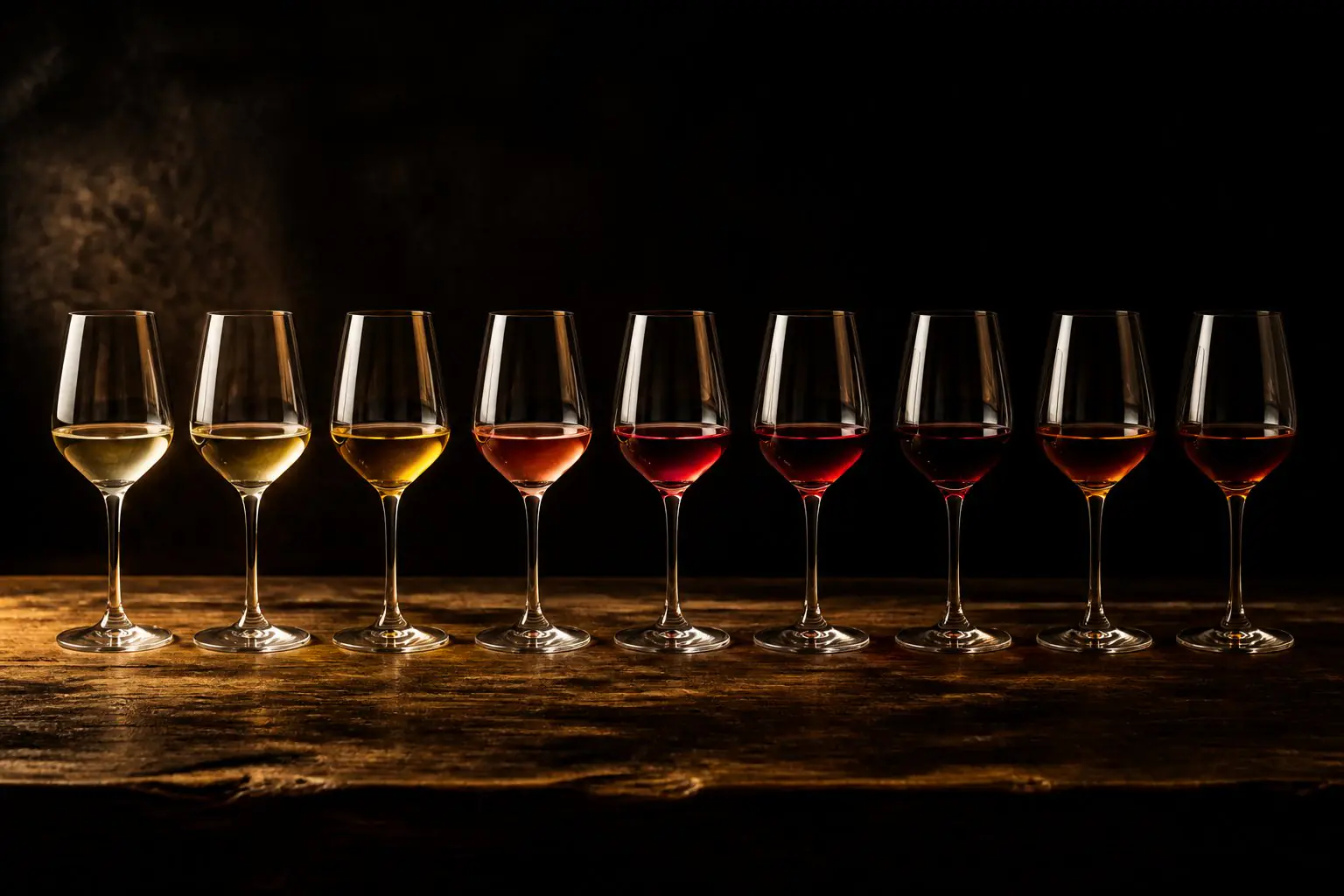
Nine broad styles help you compare wines by colour, body and sweetness. Some bottles sit between the groups. Use a style you already enjoy to describe what you want in a shop or restaurant, then ask about the particular bottle.
We'll walk the map in order, from sparkling wine to dessert and fortified styles. For each style I'll give you the grapes that matter, food comparisons to try and a sentence you can use when ordering. The library has the full profile of every grape here; this chapter is the map, not the street atlas. Use the groups to connect a wine you know with another you would like to try.
Three questions that place any bottle
Start with colour and bubbles, then consider body and sweetness. These three questions help you describe most bottles.
First: does it sparkle, and what colour is it? That one glance splits the world into sparkling, white, pink and red before you've read a word of the label. Second: how much does it weigh? Notice the wine's weight in your mouth. Light wines feel like skimmed milk in the mouth, full ones like cream, and alcohol can offer a rough clue to body. Sugar and other dissolved substances also affect fullness; tannin gives a separate drying sensation, and temperature changes the overall impression. Third: dry or sweet? Look for sweetness wording on the label and taste the wine; alcohol alone cannot decide it. We will return to this with Riesling.
Those answers give you a broad description to use in a shop or restaurant. You can ask for "white, light, bone-dry, no oak" without remembering a grape name. Each style below includes an ordering sentence; add your budget and what you plan to eat.
Some wines cross these groups. Orange wine, made from white grapes fermented with their skins, can combine white-wine aromas with tannin. Fortified wine can be dry, even though it shares a group here with dessert wine. Use the groups for comparison, and check the particular bottle.
The whites & bubbles
1 · Sparkling
white champagne can come from black grapesChampagne can be white even when it is made from black grapes. Pinot Noir, Meunier and Chardonnay are its main varieties; the blend varies, and blanc de blancs can be entirely Chardonnay. Gentle pressing limits colour extraction from black grape skins. Time on the lees, the spent yeast cells in the bottle, can add brioche and toast aromas.
Cava also uses bottle fermentation, though its grapes, rules and ageing differ from Champagne. It is a fine place to look when you want traditional-method fizz from Spain. Most Prosecco takes a different route: the second fermentation happens in a big steel tank, which often preserves fresh pear and floral aromas. Lambrusco is a dark, fizzy Italian red to try with salami.
Fizz can work before, during and after a meal, depending on its sweetness, acidity and the food. Acidity can give a refreshing contrast to rich food, while bubbles add texture, so try Champagne with crisps and notice both. It is a handy option for a party where you know little about the guests.
To order it, say: "something sparkling and properly dry, I like that bready, toasty character." That suggests traditional-method wines such as Champagne, Cava or Crémant with some lees ageing. For "fresh and fruity", try Prosecco or a youthful bottle-fermented wine. Aroma alone cannot identify the method.
cava also uses a second fermentation in bottleCompare Champagne, Cava and Crémant when you want bubbles from a second fermentation in bottle. For fresher pear and floral aromas, try Prosecco, usually made with a second fermentation in tank. These are different styles to explore; time on the lees and other production choices affect how each tastes.
Start here:
- Cava brut or brut nature: compare dry sparkling styles; brut nature has a lower sugar limit.
- Crémant d'Alsace or Crémant de Loire: other regions using the traditional method.
- Grower Champagne: look for "RM" on the label to identify a grower who also makes the wine.
White Champagne can be made from black grapes: pressing limits colour extraction from the skins.
pinot noir & meunier, pressed pale2 · Light-bodied white
Sauvignon Blanc is a familiar light white, often smelling grassy or fruity. Compounds called methoxypyrazines contribute green-pepper and grassy notes; other compounds contribute its fruit aromas. Albariño, from Spain's Atlantic coast, carries a faint sea-salt edge. Grüner Veltliner, Austria's grape, finishes with a twist of white pepper. Muscadet, from the mouth of the Loire, is a familiar dry white to try with oysters. Pinot Grigio rounds out the drawer: light, neutral, and enormously popular for exactly those reasons.
Try a light white before a meal or with a lighter dish. Fresh acidity can suit seafood, but the sauce and seasoning matter: a creamy sauce asks something different from a squeeze of lemon. Explain the dish when asking for a recommendation.
To order it, say: "white, bone-dry, light, citrusy, no oak, and saline if you have it." If you use "saline", you mean a salty impression; the description gives the shop something specific to work with.
Compare Sauvignon Blanc from Sancerre and Touraine, two Loire names with different production areas. For Pinot Grigio drinkers, try the same grape labelled Pinot Gris from Alsace, where it can make fuller wines with smoky or honeyed aromas. The grape is the same, but site and winemaking can move it into another style group.
Start here:
- Muscadet sur lie: a dry white aged on its lees, to compare with oysters.
- Albariño from Rías Baixas: peach with a lick of sea salt.
- Grüner Veltliner: crisp first, white pepper on the way out.
Compare wines within your budget. A higher price does not guarantee that you will prefer the bottle.
choose by style as well as price3 · Full-bodied white
Chardonnay makes a wide range of white-wine styles. Chablis is Chardonnay from a particular part of Burgundy, often with fresh acidity and citrus flavours; some producers use oak. Oak can add toast or vanilla, while malolactic conversion changes sharper malic acid into softer lactic acid and can add buttery aromas. These are separate choices, and neither guarantees one flavour. If one Chardonnay style does not suit you, another may taste quite different. Viognier brings apricot and perfume to this drawer; Sémillon brings lanolin richness and, in Australia's Hunter Valley, an odd talent for ageing decades at low alcohol.
One name worth connecting with its grape: Chablis is Chardonnay. One hundred percent. If you dislike buttery Chardonnay, compare it with a leaner Chablis before deciding how you feel about the grape.
Try fuller whites with cream sauces, butter, roast chicken or lobster. Their weight can suit rich food, and they often show more aroma a few degrees warmer than fridge-cold.
To order it, say: "a white with weight and texture, oak is fine, richness is the point, but dry." If you want the leaner end, ask for fresh acidity and less richness, using Chablis as a reference.
Mâcon-Villages introduces Chardonnay from southern Burgundy; compare it with village Chablis to explore a different regional style. Meursault offers another Burgundy comparison. South Africa and Chile also make Chardonnay across a range of prices and oak choices, so ask about the particular bottle.
Start here:
- Mâcon-Villages: round, ripe, unpretentious white Burgundy.
- Village Chablis: a fresh, often citrus-led expression of the same grape.
- South African Chardonnay: compare oak use, acidity and body with a Burgundy example.
4 · Aromatic white
petrol in riesling: notice the intensityRiesling has pronounced acidity and ranges from bone-dry to honeyed and sweet. It can develop a petrol-like aroma associated with a compound called TDN. Its intensity varies with growing conditions, winemaking and storage; whether you enjoy it is personal. Gewürztraminer smells of lychee and rose water, unmistakable from across the room. Chenin Blanc is the shape-shifter, dry to sweet to sparkling depending on the Loire village. Muscat is distinctive for its recognisably grapey aroma. And Torrontés does the floral thing for Argentina, all blossom on the nose, dry on the tongue.
alcohol is a clue, not a verdictRiesling can be dry or sweet. Germany makes plenty of bone-dry Riesling, and alcohol can offer a clue in some bottles. Check the producer's wording, the rest of the label and the taste rather than treating the number as decisive. The word trocken on a German label means dry outright.
Aromatic whites are worth trying with dishes that include chilli, lemongrass or ginger. A touch of sweetness can soften perceived chilli heat; check alcohol too, since greater strength can make the heat feel stronger. It's also the drawer for people who claim not to like wine; a cold Gewürztraminer has converted more sceptics than any lecture of mine.
To order it, say: "something aromatic and floral, off-dry is fine, as long as the acidity is there." If you want it bone-dry, say exactly that. That helps distinguish sweetness from fruity aroma.
Riesling offers a range of sweetness to compare. Try a German Kabinett beside an Alsace example, checking whether each bottle is dry or sweet. Some bottles develop with age; follow the producer's advice for the wine you choose.
Start here:
- Mosel Kabinett Riesling: often light with bright acidity; check whether the bottle is dry or sweet.
- A dry Riesling: Alsace, Austria, or a German trocken.
- Gewürztraminer d'Alsace: lychee and rose; one sniff tells you if it's yours.
The pinks & reds
5 · Rosé
Rosé is not a grape. It is a colour and a family of styles. Winemakers can press black grapes directly, allow a short period of skin contact, or draw pink juice from a red-wine tank (the French call that saignée). Some rosés are blends of red and white wine, including many rosé Champagnes. The result runs from bone-dry, pale Provence, the colour of onion skin, to sweet, candied White Zinfandel. Many rosés are made for early drinking, but the producer, style and vintage can change how long one holds.
Rosé can be dry or sweet. White Zinfandel became associated with sweet pink wine in 1970s California, while Provence is a familiar reference for dry styles. If a sweet rosé did not suit you, try a dry one; colour alone will not tell you the difference.
Rosé can suit a mixed table, with dishes such as prawns, chicken and chips. Check sweetness and body when choosing; pale colour alone does not establish either.
pale colour does not prove drynessTo order it, say: "a pale, bone-dry rosé, Provence style." Ask for dryness explicitly; pale colour alone does not tell you the sugar level.
Provence offers familiar pale, dry rosés. Bandol, within Provence, uses Mourvèdre and can give firmer wines with more texture. Compare a Bandol with a Côtes de Provence rosé over food to explore the difference.
Start here:
- Côtes de Provence: a familiar reference point for pale, dry rosé.
- Spanish rosado from Navarra or Rioja: darker, fruitier, honest money.
- Bandol: compare its texture and firmness with a lighter Provence rosé.
6 · Light-bodied red
serve light reds cool; check as they chillPinot Noir is thin-skinned and sensitive to growing conditions. Cooler places can give cranberry and dried-herb aromas; warmer sites can give riper plum fruit. The producer and vintage also matter. Serve it cool, please. Too much warmth can make it seem less fresh.
Gamay is another light-red grape. In 1395 the Duke of Burgundy banished it from his lands by decree, calling it a "disloyal plant". It became the main grape of Beaujolais, to the south. Much of it is made by carbonic maceration, whole grapes fermenting from the inside out, which gives those juicy, almost bubble-gum wines that go down far too easily.
This is the red for white-wine weather and white-wine food: salmon, duck, charcuterie, mushrooms, roast chicken, and for any red craving in July. Low tannin and fresh acidity make this a useful style to compare with lighter dishes; protein is not a requirement for enjoying red wine. If you usually prefer white wine and want to try a red, a cool Gamay makes a useful comparison.
To order it, say: "a light red, low tannin, fresh, something I could serve slightly chilled." The word chilled tells a sommelier exactly which shelf you mean.
For light reds, compare Bourgogne rouge, a Burgundy Pinot Noir, with Gamay from cru Beaujolais such as Morgon, Fleurie or Moulin-à-Vent. The crus are ten named areas within Beaujolais. New Zealand and Chile provide further Pinot Noir comparisons, often with the grape named on the label.
Start here:
- Cru Beaujolais, Morgon or Fleurie: compare Gamay from two named areas.
- New Zealand Pinot Noir: cherry-bright and dependable.
- Bourgogne rouge: a regional introduction to Burgundy Pinot Noir.
7 · Medium-bodied red
My favourite drawer, and the one restaurants quietly live on: the food wines. Many combine noticeable acidity with moderate tannin, giving you plenty of dinner comparisons. Merlot is the plush, generous one: plum and softness. Sangiovese is Chianti's spine, high-acid and cherry-bitter, and it was born for tomatoes; its acidity makes it a familiar choice with pizza. Grenache often brings ripe raspberry fruit; that aroma does not mean the wine is sweet. Zinfandel is the same grape Italy calls Primitivo, jammy and cheerful under either passport. Barbera gives you dark fruit with almost no tannin. Cabernet Franc adds raspberry and pencil shavings. Carménère, Chile's signature, spent a century being mistaken for Merlot before anyone noticed. When in doubt at dinner, order from this shelf.
That's also exactly when you want it: dinner, most nights that call for red at all. It's the drawer to order for a whole table that chose four different mains, and the drawer I reach for with anything tomato-based, where a high-acid wine is a useful start because the sauce can make it seem less acidic. Pizza, pasta, sausages, a weekday stew: all filed here.
To order it, say: "a medium red with good acidity, a food wine, not a blockbuster." The phrase food wine can help, but naming acidity, body and the dish gives the sommelier more to work with.
montepulciano: a grape in abruzzo, a town in tuscanyCôtes-du-Rhône Villages, Rioja crianza, Chianti Classico and Montepulciano d'Abruzzo offer different medium-bodied reds to compare. One name needs care: Montepulciano d'Abruzzo uses the Montepulciano grape grown in Abruzzo. Vino Nobile di Montepulciano is led by Sangiovese around the Tuscan town of Montepulciano. Read the full name when ordering; these are different wines.
Start here:
- Côtes-du-Rhône Villages: warm, Grenache-led comfort.
- Chianti Classico: look for the black rooster seal; born for tomatoes.
- Rioja crianza: compare oak and developed aromas alongside the fruit.
8 · Full-bodied red
nebbiolo can be pale with firm tanninFull-bodied reds feel substantial in the mouth. Cabernet Sauvignon rules it, and here's a fact I love: it's literally the child of Cabernet Franc and Sauvignon Blanc, a chance vineyard crossing that conquered the world. Blackcurrant, cedar, tannin built for ageing. Syrah and Shiraz are names for the same grape. Syrah is often associated with peppery, savoury styles and Shiraz with riper, bolder ones, but the name alone does not guarantee either style. Malbec also comes from Bordeaux and is widely associated with Argentina, including high-elevation vineyards in Mendoza. Tempranillo carries Spain: leather, dried cherry, and dill from long naps in American oak.
And then Nebbiolo, a reminder to judge colour and tannin separately. It can smell of roses and tar and makes Barolo, whose readiness depends on producer, vintage and storage. It also carries this drawer's best lesson, so I've boxed it out below.
You want this drawer in winter, with steak and braises, and on evenings when the wine is the entertainment rather than the accompaniment. If you find the tannin too drying on its own, try it with food. You can also enjoy a full red before dinner if that is what you like.
To order it, say: "big, dark and structured, happy with oak and tannin." Add what you're eating so the sommelier can suggest a match.
Mendoza Malbec, Douro reds and Languedoc reds give you full-bodied styles to compare. Bordeaux and Barolo offer different grapes and production rules. For a Nebbiolo comparison before buying Barolo, try Langhe Nebbiolo; the same grape appears in wines with different vineyard selections and ageing choices.
Start here:
- Mendoza Malbec: a starting point for plush, dark fruit.
- Crozes-Hermitage, or any northern Rhône Syrah: pepper and smoked meat.
- Langhe Nebbiolo: a comparison with Barolo using the same grape.
Tannat, Nebbiolo and Cabernet Sauvignon are useful examples of grapes that can make tannic wines. Approach with food.
compare tannin with food · chapter three9 · Dessert & fortified
This drawer holds sweet wines and fortified wines, two overlapping groups. Fortification means adding spirit. Added during fermentation, it can stop the yeast and leave grape sugar, as in Port; added after a dry fermentation, it produces a dry fortified wine, as in fino sherry. Sauternes is sweet without being fortified. Port comes in two main houses: ruby (dark, fruity, youthful) and tawny (aged in barrel until it turns amber and tastes of caramel and walnut). Vintage Port comes from a single harvest and is made for bottle ageing; declarations vary by producer and year.
Sherry includes several styles: fino (bone-dry, saline, brilliant with almonds), amontillado (nutty), oloroso (dark and rich), and Pedro Ximénez (PX), which is essentially raisin syrup and belongs on vanilla ice cream. Madeira has its own grape ladder, dry to sweet: Sercial, Verdelho, Bual, Malmsey. It develops through warm ageing and oxygen exposure and can be long-lived, though storage and bottle condition still matter. Sauternes is France's golden dessert wine, made from grapes shrivelled by a friendly fungus, and Tokaji Aszú is a sweet Hungarian style; Tokaj also makes dry wines. A little of any of these goes a long way, which is the point.
fino is a dry style of sherryWhich brings us to a myth I take personally: sherry is not your grandmother's cream sherry. That sticky thing was a sweetened export style built for the British market. Fino is a bone-dry, pale style, about 15% alcohol, to try chilled with salted almonds or a plate of ham. Sweet and dry styles both belong to the sherry family.
When do you want this drawer? Cheese, pudding, deep winter, and, the underrated part, the weeks after opening. Opened life varies by style: aged tawny can keep much longer than delicate vintage Port. Reseal and keep it cool, follow the producer's guidance, and keep opened fino in the fridge.
To order it, you need two sentences for two moods. "Something fortified, nutty and completely dry" gets you fino or a dry Madeira. "Something sweet, for the cheese" gets you Port, Sauternes or PX, then name the cheese so the sommelier can suggest a match.
Check bottle size when comparing dessert and fortified wines: half-bottles are common. A 10-year tawny Port gives you a mature style to try, while fino is best bought fresh and kept cold. Sauternes offers sweetness without fortification. Vintage Port is made for bottle ageing, so ask about its drinking window.
Start here:
- Fino or manzanilla: a fresh bottle, fridge-cold, salted almonds alongside.
- 10-year tawny Port: the Sunday-cupboard bottle.
- PX over vanilla ice cream: pudding and sauce in a single pour.

Wines to try next
A wine you enjoy gives you a reference for a new comparison. Read each line from left to right, trying one pair at a time. Similarities may help you choose, while the differences give you something to describe:
- Pinot Grigio → Albariño → Chablis. Compare lightness, acidity and any salty or stony impressions.
- Marlborough Sauvignon Blanc → Sancerre → dry Riesling. Compare the herbal, citrus and other aromas across the three.
- Buttery Chardonnay → Mâcon-Villages → Meursault, or its cheaper neighbour Auxey-Duresses. Compare any butter and oak aromas, as well as acidity and texture.
- Prosecco → Crémant or Cava → grower Champagne. Compare fruit with bread and toast aromas, checking fermentation method and lees ageing.
- Sweet rosé → dry Provence → Bandol. Compare sweetness first, then body and drying texture.
- Beaujolais-Villages → cru Beaujolais → Bourgogne rouge. Compare the fruit and earthy aromas, as well as the price.
- Malbec → northern Rhône Syrah → Aglianico. Compare fruit, pepper aromas and tannin; Taurasi is one Aglianico wine to explore.
- Jammy Zinfandel or Primitivo → a Châteauneuf-style Grenache blend → Priorat. Compare ripe fruit with any herbal, liquorice or stony impressions.
Try one comparison at a time and notice what changes. There is no required destination: keep the styles you enjoy and revisit the others when you feel curious.
One glass, maybe two
One all-purpose glass, tulip-shaped and narrowing slightly at the rim, can cover many wines. Choose a bowl with enough room to swirl. Two additions earn their cupboard space. A big balloon bowl for Pinot Noir, Nebbiolo and the aromatic whites, because delicate perfume needs room and air to gather. And a narrower bowl for the high-alcohol bruisers, because a tighter opening keeps alcohol vapour from arriving ahead of the fruit.
And here's a hill I'm happy to die on: flutes can make it harder to notice the aroma in Champagne. They look lovely in photographs, but all that yeast-and-brioche complexity has to travel through an opening the width of two fingers. A white-wine glass may show more aroma than a flute for some sparkling wines; try both and see what you prefer.
One practical note before anyone spends real money: thin glass can feel pleasant to drink from, but sturdier glasses may suit everyday use. Buy six sturdy all-purpose glasses for everyday life and two good ones for the wines you've saved up for. Wine should survive contact with your actual kitchen. So should the glasses.
Serving temperature
Serving temperature changes the wine in your glass. Too cold mutes aroma and can make reds seem harsh; too warm can emphasise alcohol. These five bands are starting points:
| Band | Temperature | What goes there |
|---|---|---|
| Well chilled | 6–10 °C | Sparkling and sweet wines |
| Chilled | 7–10 °C | Light whites and rosé |
| Lightly chilled | 10–13 °C | Full-bodied whites |
| Cool | Around 13 °C | Light reds |
| Cool room | 15–18 °C | Medium- and full-bodied reds |
A room at 24 degrees is warmer than these serving ranges. Chill a warm red and check it as you go. Fortified wines need their own attention: fino sherry wants more chilling than a full-bodied Port. Follow the style and the producer's advice.
check the wine, not just the clockA short spell in the fridge can help a warm red; a muted white may show more aroma as it warms in the glass. The time needed depends on the bottle, starting temperature and surroundings.
Choosing by style
Next time you face unfamiliar labels, start with bubbles and colour, body, then sweetness. A Grüner Veltliner may fit the light-white group, while a Douro red may sit among fuller reds. Use those expectations to ask about the bottle, then check them when you taste.
Test yourself
Five questions, no flashcards
0 of 5.
What to keep
- Three questions help place a bottle: bubbles and colour, body, then sweetness.
- Nine broad styles run from sparkling to fortified. Some bottles sit between styles.
- A style you enjoy gives you a starting point for choosing another bottle.
- Compare a style you enjoy with something similar, noticing what changes.
Words you metRosé Varietal Crisp Fruit-forward Oaked Off-dry
Sources and further reading
next: reading europe's labels without a phrasebook