
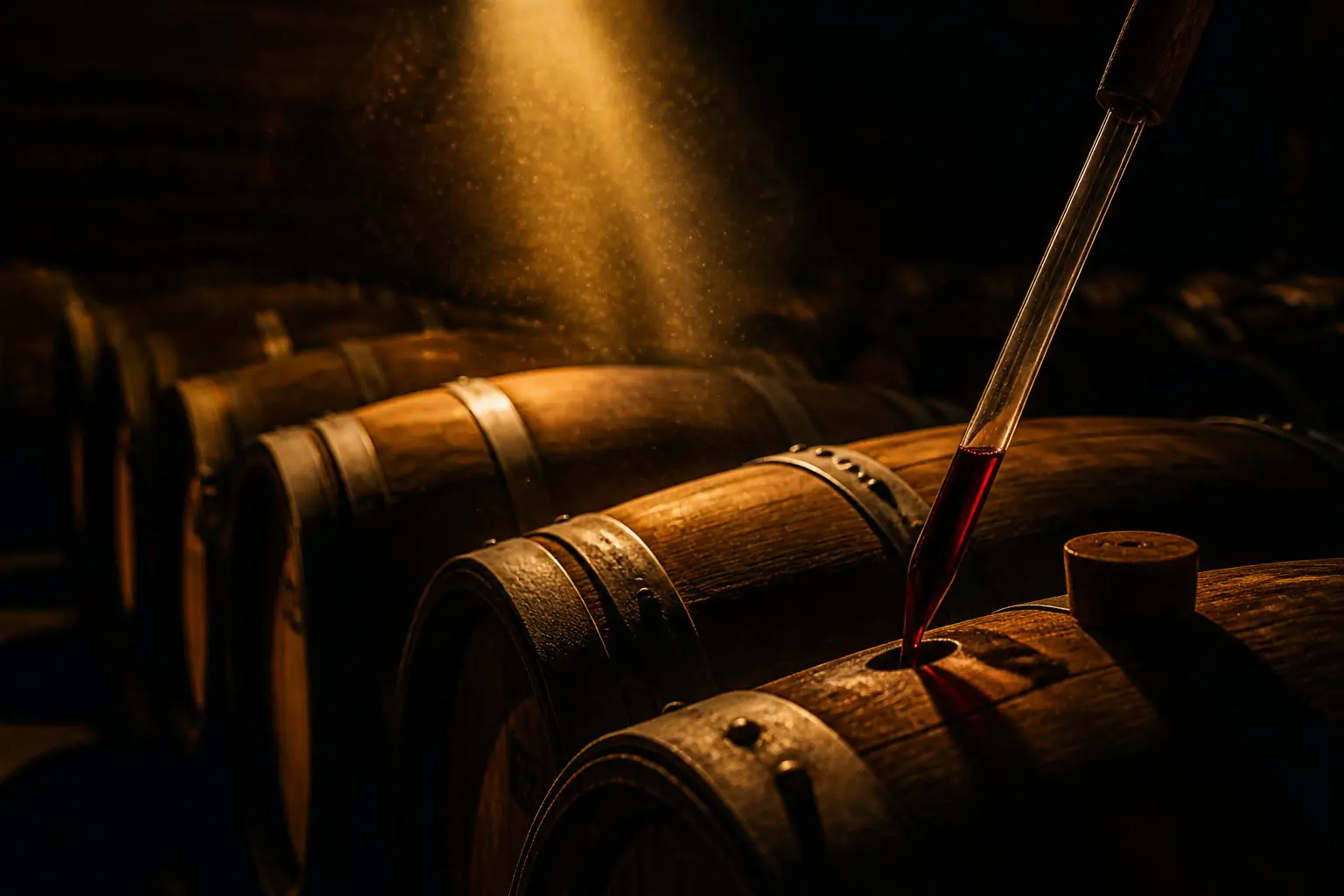
Making wine means managing fermentation and the changes that follow it. When to pick, whether to keep the skins, how to ferment and how long to age the wine all affect the result. This chapter follows those decisions so you can connect the work in the cellar with what you taste.
White, red and rosé
pink colour does not tell you sweetnessMost white wine is made by pressing the grapes before fermentation and fermenting the juice without the skins. Red wine normally ferments with its skins, which supply colour and tannin; seeds and sometimes stems contribute tannin too. Most dark-skinned grapes have pale juice. Skin contact is a key difference, although white grapes can also be fermented on their skins to make orange or amber wine.
Rosé gets its pink colour from dark-skinned grapes, often through brief skin contact or direct pressing. The amount extracted depends on the grapes and the process. Rosé can be dry or sweet: a word such as blush does not establish sweetness on its own. White Zinfandel often provides a sweeter comparison with dry rosé.
During fermentation, yeast converts sugar into alcohol and carbon dioxide, releasing heat. Riper grapes generally carry more sugar, which means more potential alcohol. That connection helps explain why picking date matters.
Compare when skins and juice are separated in these two processes. Both still depend on fermentation, and later choices about ageing and blending can overlap.
Six influences on the wine
These six headings cover the main influences introduced in this chapter. Start with the place where the grapes grow.
Place
Chapter one explains how climate and vineyard conditions affect the grapes that reach the cellar.
Grape
The variety supplies the starting material. Cabernet Sauvignon often gives deeper colour and firmer tannin than Pinot Noir, but growing conditions and extraction in the cellar also matter. Grape variety helps explain a wine; it does not fix its colour or texture.
Yeast
The winemaker can rely on yeasts already present on the grapes and in the cellar, or add a cultured strain. Ambient fermentation can be less predictable; selected strains help with consistency. Both approaches need careful management. After fermentation, the sediment known as lees consists largely of yeast cells, with other grape and wine solids. Time on the lees can change texture and aroma. Stirring them back through the wine is an optional choice, not something a brioche or hazelnut aroma proves.
Malolactic
a buttery aroma can come from diacetylMalolactic conversion is carried out by bacteria and can happen during or after alcoholic fermentation. They turn malic acid, also found in green apples, into lactic acid, reducing the wine’s acidity. It is common in red wine and often a style choice in white wine. The bacteria can also produce diacetyl, a compound with a buttery aroma. That can help explain a buttery Chardonnay, but malolactic conversion does not always leave an obvious butter note.
Two conversions, different jobs
Yeast transforms sugar
During alcoholic fermentation, yeast turns sugar into alcohol and carbon dioxide, releasing heat.
Bacteria transform acid
Sharp malic acid becomes softer lactic acid in malolactic conversion. In white wine, allowing it is often a style choice.
Oak
barrel sizes differ between regionsA new oak barrel can give wine vanilla, clove, toast and coconut aromas. The strength and character depend on the oak, seasoning, toast, barrel size and time in contact with the wine. Repeated use generally reduces the flavour a barrel contributes, but there is no fixed fill at which every barrel becomes neutral. Oxygen can also reach wine during barrel ageing, through the wood and during handling.
My favourite detail in all of this: Bordeaux ages its wine in a 225-litre barrique, Burgundy in a 228-litre pièce. Nobody can give you a real reason. Three litres of difference, defended for centuries, because the neighbours do it the other way.
Only part of a mature oak is suitable for barrel staves, and the yield varies with the tree and cooperage.
which is why new oak costs what it costsTime
Wine continues changing during ageing. Oxygen exposure is one influence, but bottle ageing also involves reactions that do not require a continuing supply of air. Tannin and pigment reactions can change colour and texture, while fresh fruit aromas may give way to notes of dried fruit, tobacco or forest floor. These changes do not guarantee improvement, and bottle age alone cannot tell you whether a wine is ready to enjoy.
Vineyard decisions
The vineyard determines the fruit available, and cellar choices shape what happens to it next.
a smaller crop does not guarantee better wineYield is the amount of fruit harvested from a vine or vineyard. Reducing an excessive crop can help a vine ripen what remains, but the right crop depends on its leaf area, water supply, variety and site. A green harvest removes bunches before they are ripe. It reduces the crop and may help in an overcropped vineyard; fewer grapes do not automatically mean more concentrated or better wine.
The canopy is the curtain of leaves around the fruit. Managing it changes light, temperature and airflow around the bunches. Leaf removal can reduce disease pressure and influence colour and aroma, but too much exposure in a hot site can overheat or sunburn grapes. Growers balance exposure and shade for their conditions. A green aroma alone cannot tell you which vineyard decision produced it.
Harvesting by machine is fast and can bring fruit in during the cool of the night. Hand-picking is needed when whole bunches must remain intact and is useful where terrain or vineyard layout prevents mechanisation. Both methods can produce good fruit. Sorting, by hand or machine, removes unwanted material and damaged grapes before processing.
In hot places, picking at night can bring grapes into the cellar at a lower temperature, reducing the cooling needed before processing. It helps manage fruit condition; it does not restore acidity already lost during ripening.
At the crush pad
At the crush pad, a destemmer can separate berries from their stalks. Whole-bunch fermentation keeps stems in the ferment, which can change tannin, colour and aroma, sometimes adding spicy or stalky notes. The result depends on the grapes, proportion of whole bunches and fermentation conditions. In Burgundy, growers take different approaches with Pinot Noir. Both make wine I'd happily drink. There's no answer, only house style.
Some red winemakers hold the fruit cold before fermentation: a cold soak. Skin compounds can be extracted before much alcohol is present, but the effects on finished colour and tannin vary. For whites, producers may crush before pressing or press whole bunches. The pressing programme and the fractions selected matter as well as whether the fruit was crushed. Champagne uses carefully controlled whole-bunch pressing.
Fermentation temperature and vessels
Temperature and the fermentation vessel affect how yeast works and how the wine develops.
fermentation temperature changes aroma and extractionFermentation temperature affects yeast activity, aroma and extraction. White wines are often fermented cooler to retain volatile aromas. Reds are commonly fermented warmer to help extract colour and tannin from the skins. The suitable temperature depends on the yeast, fruit and intended style; excessive heat can stress yeast and disrupt fermentation.
The fermentation vessel can affect temperature control, oxygen exposure and contact with materials such as wood. Compare the choices below, remembering that size, lining and cellar handling also matter.
| Vessel | What it gives | Air |
|---|---|---|
| Stainless steel | No wood flavour; often fitted with temperature control | Depends on handling and headspace |
| Concrete (eggs, tanks) | No oak flavour; shape and lining affect how it is used | Depends on lining and handling |
| Old oak foudre / large cask | Usually less oak flavour than a small new barrel | Variable |
| New oak barrique | Can add vanilla, clove, toast and oak tannin | Variable |
| Amphora / qvevri (clay) | No oak flavour; porosity depends on clay, firing and lining | Variable |
Concrete and clay offer alternatives to wood, but their names do not guarantee a particular texture or oxygen exposure. Linings, vessel shape, temperature control and cellar handling all matter. The Georgian qvevri is an example of a clay vessel used for fermentation and ageing.
During a red fermentation, carbon dioxide lifts skins into a floating cap. Winemakers can push it into the liquid (punching down) or pump liquid over it (pumping over). Both improve contact between liquid and solids and help manage extraction and temperature. Neither is always gentler: frequency, duration and force matter as much as the technique’s name.
Pressing matters
In red winemaking, liquid must eventually be separated from the skins. Wine that drains away without pressing is called free-run. Pressing the remaining solids releases a separate fraction, which can contain more tannin. The producer can keep the fractions apart and decide how much press wine to blend back for the texture wanted. Press wine is not automatically rough or inferior.
A basket press compresses grapes or fermented skins in a cage; a pneumatic press uses an inflatable membrane. Either needs careful operation: pressure, duration and the fruit itself affect what is extracted. Champagne separates pressing fractions called cuvée and taille, with limits on the juice extracted from each batch. These fractions have different compositions and uses in blending.

Élevage: developing the wine
élevage means “raising”; the wine is being brought upBetween fermentation and bottling comes élevage, the French term for developing the wine before bottling. Lees contact can change aroma and texture; stirring the sediment is called bâtonnage. It is associated with wines such as Chardonnay and Muscadet, but time on lees does not promise a particular richness. Racking separates wine from sediment by moving it to another vessel. Oxygen exposure during this transfer can be limited or encouraged. Micro-oxygenation is a separate technique that adds controlled small quantities of oxygen, often to red wine, to influence its development.
Blending brings together wines from different grapes, plots, vessels or years, within the rules of the wine being made. Non-vintage Champagne commonly combines years to help maintain a house style. Bordeaux blends can combine grapes with different ripening patterns and characteristics. The point is to choose components that work together; a blend and a single-vineyard wine can both be carefully made.
Bottling day decisions
Before bottling, the producer decides how to clarify, stabilise and protect the wine.
unfined & unfiltered describes the processFining adds a substance that binds unwanted material so it can be removed. Filtration physically separates particles and, with suitable filters, microorganisms. An unfined or unfiltered wine may carry sediment or haze, but the wording does not guarantee extra body, texture or quality. Cold stabilisation encourages harmless tartrate crystals to form before bottling, so they can be removed before the wine reaches you.
Sulphur dioxide, or SO2, helps protect wine from oxidation and unwanted microbial activity. The amount needed depends on the wine and how it is handled. “No added sulfites” describes additions, not a promise that the wine contains none: yeast can produce sulfites during fermentation. Organic wine rules differ between markets.
Last, the closure, and here's my honest verdict on a fight that gets weirdly heated. Natural cork is romance and tradition, but TCA can affect a bottle through winery materials or the cork and make the wine smell of wet cardboard. DIAM is a technical cork, ground up, cleaned and reassembled. A screwcap gives a tight seal and does not tell you what style or quality is inside. I'll take a screwcap on a crisp white every time and lose no sleep. Cork on a wine I mean to cellar for twenty years, and I'll accept the small gamble for the romance.
Bubbles
Several methods can give wine its bubbles. In the traditional method (Champagne's method) a still base wine is bottled with a little sugar and yeast, and a second fermentation happens inside the sealed bottle. The carbon dioxide has nowhere to go, so it dissolves into the wine. Then comes the cleanup: the bottles are riddled, tilted and turned until the dead yeast collects in the neck, the neck is frozen, and the plug of frozen sediment is fired out under pressure. After the sediment is removed, the producer may add wine and sugar, known as dosage. This helps determine the finished sweetness; the sweetness category describes the sugar in the final wine.

Non-vintage Champagne must mature for at least 15 months before release, including at least 12 months on its lees. Vintage Champagne must mature for at least three years. Many producers allow longer. Lees ageing can contribute bread and brioche notes. Most Prosecco takes a different approach: its second fermentation happens in a pressurised tank. This suits its fresh, fruity style, but the method alone does not determine every aroma or the quality.
Traditional-method sparkling wine develops in the bottle, then has its yeast sediment removed before the final closure.
fermentation, lees ageing, disgorgementTwo methods sit off to the side and are worth knowing. The transfer method starts like Champagne, with a second ferment in the bottle, but instead of the fiddly riddling and freezing, the wine is emptied under pressure into a big tank, filtered clear and rebottled. Less labour-intensive than handling each bottle separately, and it's how a lot of large-format sparkling and own-label fizz gets made. Another approach is méthode ancestrale, or pét-nat. Here the wine is bottled while it's still fermenting the first time, before all the sugar is gone, and finishes fermenting in the bottle. Some examples are cloudy or have cider-like flavours, but the appearance and finishing choices vary. Haze and a crown cap alone do not identify the method.
Compare the methods, their styles and the work involved:
| Method | Where | Tastes like | Price logic |
|---|---|---|---|
| Traditional (bottle) | Champagne, Cava, English fizz | Can develop toast and brioche with lees ageing | Bottle ageing and sediment removal add work |
| Tank (Charmat) | Prosecco, Lambrusco | Often fresh fruit; pressure and style vary | Tank fermentation can shorten production |
| Ancestral (pét-nat) | Limoux, natural-wine world | Can be cloudy or cider-like; styles vary | Finishes its first fermentation in bottle |
| Injection (carbonated) | Carbonated wine | Style and bubble persistence vary | Carbon dioxide added to the wine |
Sweet and fortified wines
sweetness depends on the sugar left in the wineSweet wine contains sugar that has not been fermented, or has been added through a permitted sweetening process. Concentrating grapes is one approach: Botrytis can develop as noble rot, causing water loss and changing grape composition in wines such as Sauternes and Tokaji. Ice wine is pressed from grapes that froze naturally on the vine, leaving much of the water behind as ice. Drying grapes also concentrates them, as for Vin Santo. Concentration does not always mean a sweet finished wine: Amarone is a dry wine made from dried grapes.
Fortification means adding spirit. In Port, spirit stops alcoholic fermentation while grape sugar remains; timing helps determine sweetness, and the finished wine is often around 20% alcohol. Dry Sherry begins with wine fermented dry, while sweet Sherry follows other paths, including dried grapes and blending. Many Sherries age in a solera system, where younger wine replenishes successive groups of older wine. The age of the system is not the age of every bottle.
Madeira develops through warm ageing, using heated tanks or the slower canteiro method in cask. This is part of its intended style. Madeira can keep well after opening, but storage and condition still matter.
Another group of sweet fortified wines is the vins doux naturels of southern France, which stop a ferment with spirit the way Port does but start from different grapes. Muscat de Beaumes-de-Venise catches the fragrant Muscat grape while it's still full of grapey, orange-blossom sweetness. Banyuls, from steep schist terraces on the Spanish border, does the same to Grenache and comes out tasting of figs, cocoa and dried cherry: a genuine rival to Port for a fraction of the fame. And if you want to taste the far end of the style, Rutherglen in Australia matures fortified Muscat in cask, blending wines of different ages to make styles ranging from fresh raisin fruit to richer, more developed flavours. Try a small pour to compare its rich flavours.
flor ageing and oxidative ageing develop different stylesSherry includes both dry and sweet wines. Flor is a living film of yeast that changes the wine while limiting its exposure to oxygen. Fino and Manzanilla develop under flor; Oloroso develops without it through oxidative ageing. Amontillado combines an initial period under flor with later oxidative ageing. Sweetness also depends on grapes and blending, so flor and air cannot explain the whole family on their own.
| Sherry | Ageing | Tastes like |
|---|---|---|
| Fino | Under flor | Pale, dry, saline, almond |
| Manzanilla | Under flor in Sanlúcar de Barrameda | As fino, with a briny tang |
| Amontillado | Flor, then air | Amber, dry, hazelnut |
| Palo cortado | Predominantly oxidative ageing | Poised between the two, savoury |
| Oloroso | Air, no flor | Dark, dry, walnut, warm |
| Pedro Ximénez (PX) | Air, from dried grapes | Black, sweet, raisins and treacle |
The dry styles are commonly based on Palomino, while Pedro Ximénez is a different grape used for intensely sweet wine. Grapes, fermentation, blending and ageing all contribute to the contrast between a pale Fino and a dark, sweet PX.
Other winemaking terms
A few processes you may see mentioned on a label:
- Many wines are clarified, or “fined”, with egg whites, milk casein or isinglass from fish bladders. The fining material is removed, although traces may remain. Animal-derived fining agents are one reason wine is not automatically vegan.
- Those glassy crystals on a cork are tartrates, the “wine diamonds”, completely harmless. Cold stabilisation is one way to encourage crystals to form before bottling.
- Adding sugar for fermentation to raise potential alcohol is called chaptalisation. The rules vary by place. When the yeast ferment that sugar, it contributes alcohol rather than remaining as sweetness.
- Big commercial brands blend across regions and tanks to hit the same taste every year. Blending can reduce variation, but the vintage still identifies a growing season and does not become irrelevant because of where you buy the bottle.
- Picking date strongly influences style, alongside the grape, site and cellar choices. Earlier picking often retains more acidity and less potential alcohol; later picking can bring more ripeness, depending on the season.
These decisions affect the wine and help explain the terms on its label.
Taking the alcohol out
Low-alcohol wine can begin in the vineyard or end in a machine, and those are different drinks. Earlier picking often gives grapes with less sugar and more acidity, though the flavour depends on the fruit and growing conditions. Less fermentable sugar means less potential alcohol. Most bottles labelled alcohol-free or dealcoholised start as fully fermented wine. The producer then removes the alcohol under conditions gentle enough to keep as much aroma as possible.
Vacuum distillation removes alcohol at reduced pressure and temperature. Spinning-cone systems can separate aroma fractions and alcohol in stages, while reverse osmosis uses membranes as part of an alcohol-removal process. These methods can also affect other components, so preserving aroma and balance takes care.
alcohol is texture, not just heatRemoving alcohol changes more than the number on the label. It can affect aroma, body, warmth and flavour balance. Producers may adjust sweetness, acidity or carbonation to help shape the result. Taste still and sparkling examples separately; the method does not establish which one you will prefer.
Why two bottles of the same grape cost 90 kr and 900 kr
Two wines from the same grape can cost very different amounts. Land, yields, labour, barrels and time all contribute, while scarcity and reputation can raise the price further.
Vineyard land varies greatly in price. A famous site in Burgundy or Napa can cost far more than land in a less sought-after region. Crop size matters too: a smaller harvest spreads growing costs over fewer litres. Lower yields can help in an overcropped vineyard, but do not guarantee quality.
Hand-picking, detailed sorting and repeated work with the ferment can add labour costs. Machine harvesting can bring fruit in quickly and at lower cost where the vineyard allows it. The method and expense alone do not tell you which wine will be better.
new barrels add cost before the wine is soldA new French barrique holds about 300 bottles, so its cost is shared across that wine. Reusing a barrel spreads the purchase cost across more batches and generally reduces the oak flavour it adds. Cellar time adds storage costs and ties up money before a bottle is sold. These choices help explain price differences between wines made from the same grape.
Land, labour, barrels and cellar time contribute to cost. Scarcity, reputation and scores can raise the selling price further.
where price stops tracking costAt high prices, scarcity, scores and reputation can become a large part of what you pay for. Compare wines from less famous regions or different labels from the same estate, while checking how each is made. Knowing the production choices helps you ask what the extra money pays for and whether it matters to you.
Sources and further reading
Test yourself
Five questions, no cellar coat required
0 of 5.
What to keep
- Six influences to consider in a bottle: place, grape, yeast, malolactic, oak, time.
- The vineyard, weather and cellar decisions all contribute to what you taste.
- Champagne gains its bubbles through a second fermentation in bottle, then ages on lees. Most Prosecco gains its bubbles in a pressurised tank.
- Sweetness depends on sugar remaining in the finished wine. Concentration, stopping fermentation and permitted sweetening are different ways to achieve it.
- Oak can contribute toast, vanilla and texture. Notice how those flavours sit alongside the fruit.
Words you metMalolactic fermentation Lees Élevage Dosage Botrytis Méthode traditionnelle
next: nine broad styles to compare