
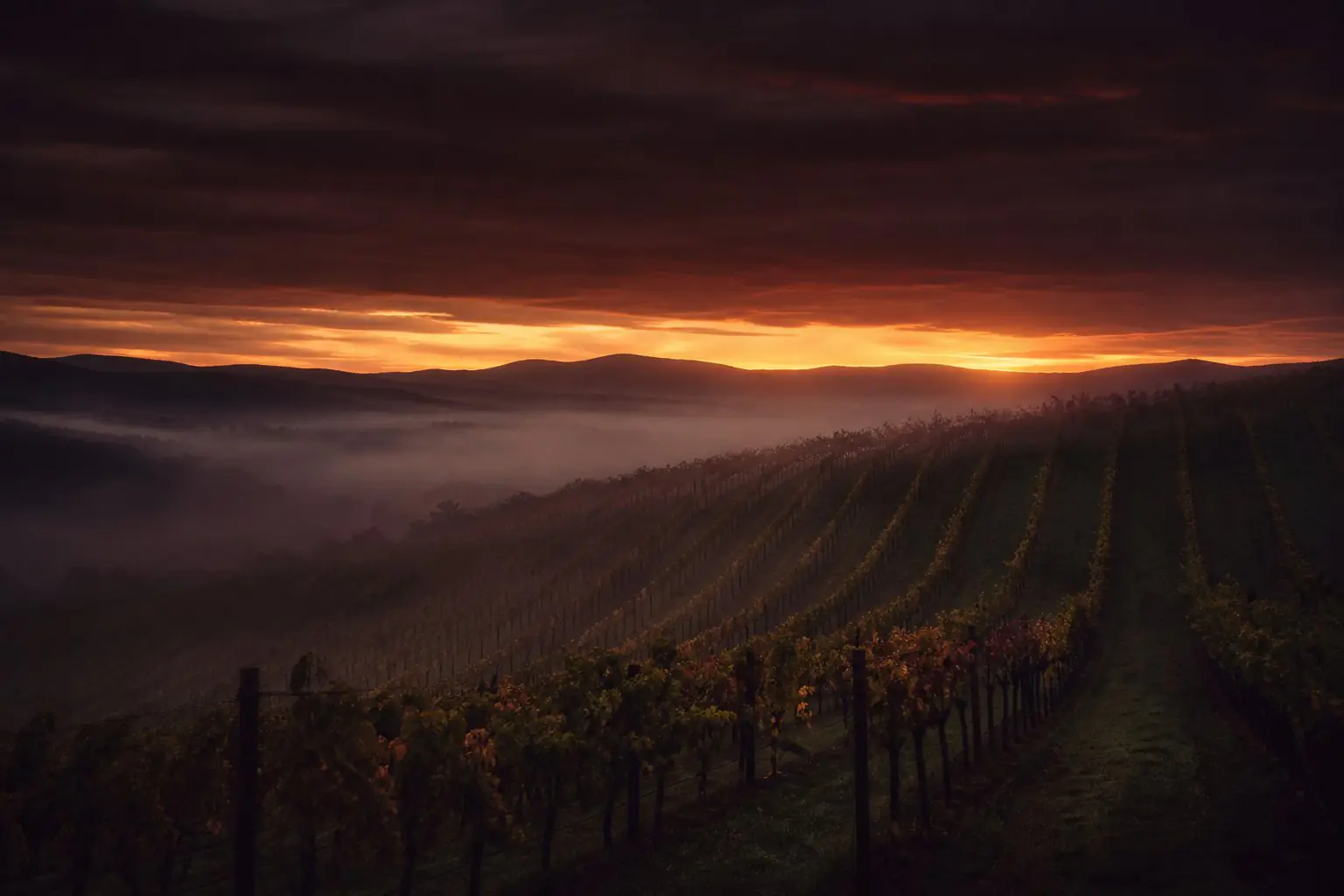
Wine is a farm product: yeast turns grape sugar into alcohol, while the grape, place and growing season shape the starting material. Follow a year in the vineyard and you can begin to connect those conditions with what you taste.
Grapes and fermentation
wine grapes ≠ the grapes in your fruit bowlMuch wine is made from Vitis vinifera, though other grape species and hybrids are used too. Grapes grown for wine are chosen for the sugar, acidity, colour and flavour they can bring to fermentation, rather than simply for eating fresh.
The pulp carries much of the grape’s sugar and acid. Skins supply important colour, tannin and aroma compounds, while seeds contain tannin too. During alcoholic fermentation, yeast converts sugar into alcohol and carbon dioxide and releases heat. The flavours of the finished wine come from the grapes, fermentation and later cellar choices; they are not all present in the fresh berry.
Weather helps explain why the same grape can taste different from year to year. Cooler conditions may favour sharper acidity, while heat can bring riper fruit and more potential alcohol. The vintage tells you which growing season to consider.
The vine's year
The vineyard follows a yearly cycle, from winter pruning to harvest. Here is an illustrative calendar for a temperate northern vineyard. Exact dates vary by region, variety and season.
During winter dormancy, growers prune the previous season’s growth and choose how many buds to leave. This helps set the potential crop and canopy for the coming year, although variety, fruit set and growing conditions will also determine the harvest.
In spring, buds open and new shoots emerge. This green growth is vulnerable to frost; damage depends on its stage, the temperature and how long the cold lasts. Where conditions suit them, growers use heaters, wind machines or carefully managed sprinklers to reduce losses.
The 2021 spring frosts caused major losses in parts of France, with the scale varying by region and measure.
young shoots are vulnerable to frostFlowering brings small, easily missed flowers, followed by fruit set as berries begin to form. Weather around flowering affects how many berries develop. Cold or wet conditions can reduce fruit set or leave uneven berry development. The interval from flowering to harvest varies; a calendar cannot replace checking the fruit.
During summer, growers manage the leaves around the bunches to balance light, shade and airflow. Some also remove unripe bunches in a green harvest to reduce an excessive crop. It can help a vine ripen what remains, but is not a quality badge. Every winemaker I know finds it painful. They do it anyway.
veraison: say “vay-ray-zon”, the colour turnAt veraison, berries begin softening and changing colour. Dark-skinned grapes change from green towards red or purple, while white varieties become more translucent. Berries on one bunch do not all change at once. It marks the beginning of ripening, rather than a fixed fortnight in every vineyard.
During ripening, sugar generally accumulates and acidity falls, while aroma and tannin development follow their own course. Picking earlier often gives less potential alcohol and more acidity; waiting can allow further ripening, but also brings weather and fruit-health risks. Even within one Zinfandel vineyard, harvest timing can make a substantial difference. It does not determine the finished style on its own.
As harvest approaches, growers assess sugar, acidity, flavour and fruit condition alongside the forecast. In hot regions, picking at night can bring cooler fruit into the cellar. Southern-hemisphere seasons fall roughly six months after northern ones, but actual harvest dates depend on region, variety and the wine being made.
Where vines grow
Many classic wine regions sit between roughly 30 and 50 degrees of latitude, but productive vineyards also grow beyond those bands. Fold the globe at the equator and the classic bands roughly mirror each other: Bordeaux lines up with Chile, Germany with New Zealand's far south.
Many northern vineyards harvest from August to October, while southern harvests often fall from February to April. Actual dates vary by region, variety and season.
Latitude shapes vine climate, but elevation, water and local weather allow productive vineyards beyond the classic bands. And the bands are on the move: a warming climate is expanding options farther poleward, which is why southern England now grows sparkling wine on the same chalk seam that surfaces in Champagne, with Swedish vineyards another example of wine growing beyond the classic bands.
The world produces billions of litres of wine each year; totals vary by vintage and reporting source.
Italy, France and Spain pour the mostHow climate affects ripening
same grape, different weather → different fruitCooler conditions tend to preserve acidity, while warmth helps grapes build sugar and develop riper fruit flavours. This spectrum shows a broad tendency to explore when comparing wines, rather than a fixed set of aromas for each climate:
Warm days and cool nights can help grapes ripen while retaining acidity. The difference between day and night temperatures is called diurnal swing. It contributes to growing conditions, but does not guarantee a balanced wine.
Latitude is only part of the climate picture. Higher sites are often cooler, while nearby water, ocean currents, wind and topography can modify local temperatures. These help explain why a warm country can produce wines with noticeable acidity. They do not let you predict a bottle from geography alone; Malbec from Mendoza, for example, comes from vineyards with differing elevations and growing conditions.
Vines need balanced growth
Excessive vigour can shade fruit, while balanced water and nutrient supply can support ripening; soil alone does not decide quality. In some sites, well-drained ground limits vigour and can lead to smaller berries with a higher share of skin to pulp.
And many vines grow on borrowed roots. In the late 1800s a sap-sucking louse called phylloxera devastated European vineyards before growers adopted grafting European vines onto resistant American rootstocks. It is now widespread, though notable own-rooted regions remain.
Phylloxera devastated vineyards and disrupted livelihoods. Its effects extended beyond the places where vines were lost.
vineyard losses changed wine communities
Soil and vine growth
soil affects water supply and vine growthSoils differ in how they drain, hold water and retain warmth. These examples show why growers pay attention to the ground, while the climate, site and farming also matter.
| Soil | Wine regions | What it does for the vine |
|---|---|---|
| Chalk & limestone | Champagne, Chablis, Sancerre | Water availability depends on soil depth, structure and the underlying rock |
| Slate | Mosel | Rock, slope, exposure and climate must be considered together |
| Gravel | Médoc, Bordeaux | Coarse material can support drainage; depth and other soil layers matter |
| Clay | Pomerol, Bordeaux | Fine particles can retain water; availability depends on the whole soil profile |
| Volcanic | Etna, Santorini | A broad geological origin, not one soil type or a guaranteed wine flavour |
These soil names are starting points, not tasting notes. Two vineyards described as limestone or volcanic can have different soil depths, drainage and water supplies. The same ground also behaves differently in a dry year and a wet one. In Champagne, as elsewhere, soil needs to be understood alongside climate, slope and vineyard management.
a tasting note cannot prove a soil connectionMinerality is a tasting term, not proof that rock flavours travelled from soil to grape. Roots take up water and dissolved nutrients, and soil conditions influence root growth and water supply. Those effects help shape the grapes, but a smoky or chalky description cannot establish the cause. So here is my truce in the minerality war: keep the tasting description separate from the explanation of what caused it.
When the weather turns
weather affects neighbouring vineyards differentlyFrost can damage shoots and reduce the crop; surviving or replacement growth may ripen differently. Hail can damage leaves and berries and increase disease risk. Severe heat and drought can disrupt growth or damage fruit, while rain near harvest can increase berry swelling and rot risk. The outcome depends on timing, severity, variety and farming decisions. None of these events gives every affected wine the same flavour.
Weather varies from year to year in every wine region. Cooler sites can face particular ripening challenges, while warm regions also experience heat, drought, rain and frost. The effect can differ between neighbouring vineyards and producers. A vintage report is most helpful when it describes the region and style you are actually buying.
For an everyday bottle under about fifteen euros, start with the producer, style and intended drinking window. Vintage becomes especially helpful when comparing years from a region with variable weather or buying a wine to keep. A date alone cannot tell you whether the bottle will suit you.
Old vines
check what the grower means by “old vine”A vine can outlive the person who planted it, but age alone tells you little about the crop or the wine. Root system, health, variety, soil, water supply and management all matter. Old vines can produce excellent wine; their age does not guarantee low yields, concentration or resilience to drought.
“Vieilles Vignes”, “alte Reben” and “Old Vine” deserve an age and a vineyard history behind them. The OIV defines an old grapevine as one with a documented age of at least 35 years; that recommendation does not make every label in every market equivalent. The Barossa’s voluntary Old Vine Charter starts at 35 years, followed by “survivor” at 70, “centenarian” at 100 and “ancestor” at 125. The region’s surviving old Shiraz vineyards have value as living history, without age being a shortcut to judging the wine.
Organic, biodynamic, natural
Demeter on a label = certified biodynamicThese terms refer to different approaches to farming and winemaking. Read them separately, and look for the certification or producer explanation behind each.
Organic refers to certified production rules, covering permitted farming inputs and, for organic wine, cellar practices too. The details differ by market. EU organic wine permits limited added sulfites; US wine labelled “organic” cannot have added sulfites, while “made with organic grapes” is a separate category.
Biodynamic combines organic farming with a broader set of preparations and practices. Rudolf Steiner sketched it in 1924: the farm as a single living organism, herbal preparations fermented in buried cow horns, pruning and picking timed to the phases of the moon. The claimed effects of the celestial calendar are unproven. The label describes the approach, but does not predict wine quality by itself. I don't buy the moon; I keep buying the wines.
Natural wine generally involves few additions and limited processing in the cellar. Producers may ferment with yeasts already present on the grapes and in the cellar, avoid fining or filtration, and use little or no added sulphur. Natural wine has no universal legal definition; France's voluntary “vin méthode nature” charter from 2020 is one attempt to define an approach. Check what the producer means by the term.
Low-intervention methods still require care. Oxygen exposure, volatile acidity and unwanted microbes can spoil a wine, regardless of the category on its label. Cloudiness or sediment alone does not establish quality. Judge the aromas and flavours of the bottle in front of you.
cloudiness alone does not establish qualityOrange wine belongs nearby but is not a synonym. It is made from white grapes fermented with their skins. Skin contact can give amber colour, drying tannin and flavours such as dried apricot, herbs and peel. Georgia has made it this way in buried clay qvevri for thousands of years; the colour is ancient, even if the bar menu is new. Buy natural wine where somebody has tasted that bottle and can tell you who made it: a trustworthy independent shop, wine bar or restaurant. Ask about the wine's style if you are unsure what to expect; haze alone cannot answer that.
What green actually means
Green claims on wine labels range from audited farming to a leaf drawn by the marketing department. Certified organic and biodynamic logos are the firm end: they come with published rules, inspections and paperwork. Sustainability schemes sit in the middle. Depending on the country or region, they may measure water, energy, worker welfare, habitat and carbon as well as spraying. Many are serious and useful, but the standards differ, so a bare word like “sustainable” without the scheme's name tells you very little. A green bottle, an unbleached label and a story about “respecting nature” tell you nothing at all.
The heaviest ingredient in wine's carbon footprint is often the empty bottle.
less glass, less fuel, same winePackaging and transport can be major parts of wine’s footprint; the balance varies by producer, route and package. A heavy bottle can take more energy to make and more fuel to move, without improving the wine. Lighter bottles can help. Bag-in-box can have a lower footprint per glass and keeps everyday wine fresh for weeks. “Local” is not an automatic answer either: wine moved in bulk or by sea can beat a nearby bottle hauled by road in heavy glass. Look for a real certification if farming matters to you, then favour lighter packaging and producers willing to give numbers rather than adjectives. Drink what you enjoy, waste less of it, and choose packaging on its practical merits.
Eight thousand years in two paragraphs
qvevri: buried clay vessels, still in use, UNESCO-listedWine has an ancient history in what is now Georgia. Qvevri are large clay vessels buried in the ground and still used by some Georgian families for fermentation and ageing; the traditional method is on UNESCO's heritage list. Phoenician and Greek traders carried wine around the Mediterranean in clay amphorae. Roman wine growing helped establish vineyards in regions including the Mosel, the Rhône and Bordeaux.
In Burgundy, medieval monastic communities, including the Cistercians, cultivated and recorded vineyard parcels over centuries. Later, phylloxera devastated European vineyards, and grafting onto resistant American roots helped growers recover. Clay vessels, grafted vines and modern cellar equipment can all appear in wine growing today; old and new methods often work alongside each other.
Reading a wine label
Many labels emphasise a grape, a place or a brand name. These examples help you recognise the difference:
| The label says | What it means | Where you'll see it |
|---|---|---|
| A grape | “Malbec”: what's in the bottle, stated plainly | The New World: the Americas, Australia, NZ, South Africa |
| A place | “Chablis”: its production rules specify Chardonnay | Old-World Europe: France, Italy, Spain |
| A made-up name | “Midnight Cuvée”: a name that does not identify the grapes by itself | Across wine regions |
A “varietal” label names a grape, but need not mean 100% of that grape. Varietal thresholds vary by country and category, so check the applicable local labelling rule. The remainder may include other grapes.
Bottle arithmetic
- A standard bottle is 750 ml. Five 150 ml pours use the whole bottle; smaller pours give you more servings.
- A vintage names the harvest year, but local rules may allow a proportion from other years. “NV” means no vintage is declared and often indicates a blend of years; in Champagne, that's a house style, not a shortcut.
Bottles also come in a ladder of sizes named, for reasons nobody can fully explain, after biblical kings.
| The bottle | Holds | In standard bottles |
|---|---|---|
| Half | 375 ml | ½ |
| Standard | 750 ml | 1 |
| Magnum | 1.5 litres | 2 |
| Jeroboam | 3 litres | 4 |
| Methuselah | 6 litres | 8 |
Larger bottles can develop differently from smaller ones, but there is no reliable half-speed rule for a magnum. Oxygen already dissolved in the wine, oxygen in the headspace and closure, and later oxygen entry all matter, alongside storage. Two bottle sizes do not necessarily start with the same amount of air or admit oxygen at the same rate.
When to drink or keep a bottle
Much wine is made for relatively early drinking, while some bottles are intended to develop longer. Ageing changes the wine, but does not automatically improve it. Check the producer’s advice for the particular bottle, and consider how it has been stored.
If you keep a few bottles, choose somewhere cool, dark and at a steady temperature. Avoid warm spots such as above the fridge.
Check whether the bottle is intended for early drinking or further ageing, then open it when it suits the wine and the occasion.
Sources and further reading
Test yourself
Five questions, no diploma
0 of 5.
What to keep
- Wine begins with farmed grapes. Variety, growing conditions and cellar decisions all shape it.
- The classic regions sit between roughly 30° and 50° of latitude, in both hemispheres.
- Cooler conditions often preserve acidity; warmer conditions can bring riper fruit and more potential alcohol. The grape and winemaking matter too.
- Balanced water and nutrient supply supports ripening; poor soil or severe drought does not guarantee quality.
- A vintage names a harvest year; it helps you consider the growing season alongside producer and style.
Words you metTerroir Vintage Vieilles vignes Organic Biodynamic Natural wine
next: your nose does much of the work