
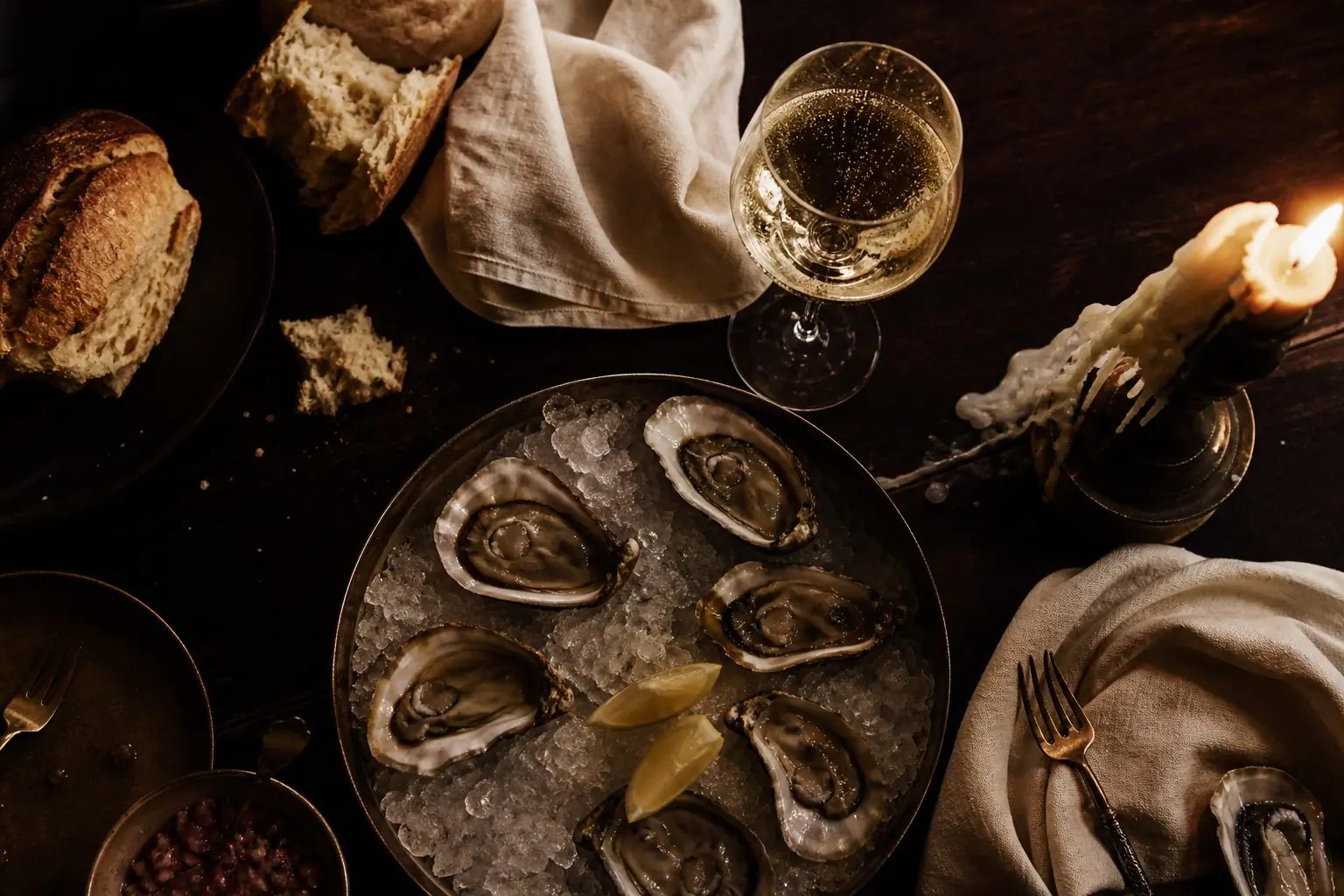
Six chapters of theory, and now the part it was all for: dinner. Start with a food-and-wine comparison in your own kitchen, using a bottle and something you already have. That's how I want you to learn it. It's also the longest chapter of the seven, because it's the one you'll live in.
How food changes wine
Food changes how a wine tastes, and wine changes how you experience the next bite. Acidity, sweetness, salt, richness and bitterness all play a part. Try these four comparisons and notice what happens with your particular food and bottle:
- Acid shifts the balance. Squeeze lemon on an oyster, then sip Champagne. Acid in food usually makes wine seem less acidic and more fruity. A low-acid wine may seem flat beside lemon.
- Sweet food changes dry wine. Take a bite of cake, then a sip of anything dry. The wine can turn thin and sour. Desserts often work best with a wine at least as sweet as the dish; match the pair rather than treating it as a law.
- Rich, salty food can soften the grip. Sip a firm young red, then try it after a bite of mature cheddar. The cheese combines fat, salt and savoury flavour, so this comparison shows the combined effect rather than isolating one ingredient.
- Compare wine with something salty. Taste a tannic red, then a crisp white, before and after a salted crisp. Salt often makes wine seem less bitter and less acidic, with more fruit. Notice whether that happens with these bottles.
Another player deserves a name: umami, the savoury depth in mushrooms, soy, parmesan, cured ham and anything slow-cooked. Umami-rich foods can make some tannic reds taste harsher, so compare the actual dish and bottle. Salt in the same food can soften that effect, which helps explain why salty parmesan and an unsalted mushroom need not behave alike. Try a wine with gentler tannin, and judge the whole dish. Chilli heat matters too: it can heighten the impression of alcohol and make wine seem less fruity. Lower alcohol and a little sweetness can help if you want a gentler combination.
Once you've tasted those four, the method is three steps. First, match the weight of the dish: delicate food, delicate wine; rich food, rich wine. A powerful Shiraz may overwhelm delicate fish; flavour intensity matters as well as weight. Second, check the structure interactions above: any sugar, salt, acid, umami, chilli heat or fat in the dish that will push the wine around? Third, pair to the dominant flavour, which is usually the sauce, not the protein. With steak au poivre, peppery Syrah is one comparison to try; the sauce, seasoning and your preferences still matter.
Local combinations can give you a starting point: goat cheese with Sancerre, tomatoes with Chianti, oysters with Muscadet. Taste the actual dish and bottle together, since origin alone does not guarantee a match. If you want to give a complex wine your attention, try it with simple food such as roast chicken or bread.
Read the dish in three steps
1. Match the weight
Delicate food with delicate wine; richer food with a wine that can carry its weight.
2. Check the structure
Notice sugar, acid, salt, umami, chilli and richness. Taste the food and wine together to see what changes.
3. Follow the sauce
Pair to the dominant flavour. A pepper sauce can matter more to the choice than the protein underneath.
Eight pairings to try
These eight familiar pairings give you comparisons to try. Notice the wine's weight, acidity and tannin alongside the strongest flavours in the food, then use what you observe when choosing for another dish:
| Pairing | Why it works |
|---|---|
| Oysters + Champagne | Salt and a lemon dressing can soften the impression of acidity in the wine |
| Steak + Cabernet | A salted, rich steak can make a firm red seem less drying; the seasoning matters too |
| Blue cheese + Sauternes | Sweetness contrasts with salty blue cheese; choose a wine with enough flavour intensity |
| Thai or Indian heat + off-dry Riesling | A little sweetness can soften perceived heat; lower alcohol is worth trying if you want less burn |
| Tomato sauce + Chianti | Tomato acidity can make the wine seem less acidic, so a fresh, high-acid red is a useful starting point |
| Goat cheese + Sancerre | Fresh cheese and a high-acid white make a tangy combination to compare |
| Fried food + Champagne | High acidity gives a refreshing contrast to oily food; bubbles add texture |
| Port + Stilton or chocolate | Try the sweet wine against salty cheese, or match its sweetness and intensity to the chocolate |
Pairing by cuisine
Structure is the engine, but nobody stands at the stove thinking "I have prepared a high-acid, moderately salty dish tonight." You've made pad thai. So here is the map I actually cook and drink by, for the dinners that happen in real kitchens rather than in pairing manuals. Notice how often the answer is white, fizzy or faintly sweet. Choose for the actual dish; no wine colour has a fixed share of dinners.
| The dinner | What pushes the wine | Open this |
|---|---|---|
| Italian, tomato-based | Tomato acid, olive oil, herbs | Chianti or Barbera: bright acidity helps the wine stay fresh beside tomato sauce. Pesto is a different country: Vermentino, from the same Ligurian coast as the basil |
| Thai & Vietnamese | Chilli, lime, fish-sauce salt | Off-dry Riesling or Vouvray. Choose an off-dry style with lower alcohol if you want to soften the heat; acidity helps beside the lime |
| Indian | Cream, layered spice, heat | Gewürztraminer for korma and butter chicken; dry rosé or Cabernet Franc for tandoori, where the char wants a little red fruit |
| Japanese | Umami, soy salt, delicacy | Champagne, fino sherry or Chablis. Umami can make tannin seem harsher; compare these less tannic options with the dish |
| Mexican | Chilli, corn, lime, coriander | Albariño with fish tacos; cold Lambrusco with al pastor, where the fizz and the pork fat adore each other |
| Burgers & barbecue | Char, fat, sweet sauce | Zinfandel or Shiraz. Ripe fruit is not sugar: a very sweet glaze can make a dry red seem harsher. Taste with the sauce before choosing |
| Pizza | Its own food group | Barbera, Montepulciano d'Abruzzo or dry Lambrusco. Juicy, cheap, acid to burn |
Choose the dinner. I’ll give you the structure first and a few bottles that fit it.
Use the table as a starting point for the dish in front of you. With chilli and lime, consider sweetness and acidity; with savoury, umami-rich food, try bubbles or gentler tannin; with smoke and rich food, consider fuller fruit. Taste the combination, since a sauce or seasoning can change the match.
The Swedish table
My home turf, and the questions I'm asked most often, usually in December, usually with mild panic in the voice. The traditional answer to pickled herring is snaps and beer, and I won't argue with four centuries of field testing. But wine belongs on this table too, and it behaves far better than the old wisdom claims:
- Sill. Vinegar, sugar and raw onion: on paper, a wine assassin. Try Riesling with good acidity and some sweetness if the cure is sweet. Fruity aroma alone does not supply sugar. Pour it next to the snaps and judge for yourself.
- Gravlax with mustard sauce. Blanc de blancs Champagne. Compare the wine's acidity and bubbles with the salmon, dill and sweet mustard; the sauce can change the match.
- Västerbotten. Our answer to parmesan, and it drinks like one: aged white Burgundy or a glass of oloroso sherry. The same goes for the midsummer Västerbotten pie.
- Köttbullar with lingon. Beaujolais cru, Morgon or Fleurie. The lingonberries already do the acid work, the wine matches them fruit for fruit, and it takes a light chill without complaint.
- The julbord. With fifteen dishes, choose a versatile bottle rather than finding a separate match for each. Pick one bottle that cuts: dry Riesling or brut Champagne can be a starting point across ham, herring, meatballs, salmon and cheese. Try it with a few dishes to see where it works best.
Choosing wine for cheese
Cheese can work with white, sparkling, sweet or fortified wines, and some reds; the cheese and wine both matter. Cheese is salty, fatty and dense with umami, which can make tannin feel harsh or metallic. A structured red can suit a hard, aged cheese, while many boards are easier to match with white, sparkling, sweet or fortified wine. Start here:
- Fresh goat cheese: Sancerre, or any sharp Sauvignon Blanc. A familiar match that brings together fresh cheese and bright acidity.
- Brie and camembert: Champagne. Its acidity can feel refreshing beside the creamy cheese; a toasty style adds another flavour to compare.
- Hard aged cheeses: comté, parmesan, Västerbotten. Try oxidative styles, developed with oxygen exposure: vin jaune or oloroso sherry. An older white Burgundy is another comparison. A structured red is also worth trying: salt and fat can soften its grip, while umami may push the other way.
- Washed-rind stinkers: époisses, munster. Gewürztraminer. Alsace has put these two together for centuries; the perfume meets the funk head-on and somehow they get along famously.
- Blue cheese: try a sweet wine. Sauternes with roquefort, Port with stilton, PX sherry with anything blue and fierce. Compare the sweet wine with the salty cheese.
If you are choosing ten cheeses, finding a single wine can be difficult. Two cheeses with a glass chosen for each make it easier to compare the pairings.
Choosing wine for dessert
The cake experiment from the top of this chapter gives you a good rule of thumb: choose a wine that tastes at least as sweet as the dessert, or the wine can seem sharp. This is why the Champagne-and-wedding-cake ritual can be a tricky match: brut fizz against sugary sponge often tastes austere. If there must be bubbles with the cake, demi-sec is usually the easier style.
Chocolate is its own problem, bitter and sweet and mouth-coating at once, and it wants fortified wine: Banyuls from the French–Spanish border, ruby Port, or PX sherry, which you can also pour straight over vanilla ice cream and call dessert settled. Fruit tarts, and anything built on apple, apricot or citrus, want Sauternes or a late-harvest Riesling: enough acid under the sugar to keep the whole thing from going flabby.
You can also enjoy dessert on its own, then return to sparkling wine with something salty. Champagne with crisps offers fresh acidity alongside salt and richness. Compare the combinations and keep the one you enjoy.

Choosing wine in a shop
Start before you reach the shop: know why you're there. Wine for tonight's dinner is one errand; wine for the week, a gift for a colleague, a case for a party are different errands, and each points at different shelves. Walk in with a purpose and the wall shrinks to a corner of itself before you've read a single label.
Set a budget, then narrow the choice by type (red, white, sparkling, rosé), sweetness (dry or sweet), body (light, medium, full) and style words such as crisp, oaky or earthy. Decide whether you want a familiar grape or something new. These filters give you a smaller group to compare within your budget.
A critic's score is one person's judgement, so read the description and compare it with what you enjoy. To try something new, choose an unfamiliar bottle in a style and price range you already know. Keep a note of what changes and whether you would buy it again.
Get to know a shop assistant and tell them what you drank last time, including what you liked or disliked. Three visits can give you both something to build on: a familiar wine to compare with, a clearer preference and a new bottle to try.
One refinement for gifts: buy for their palate, not yours. Ask what they usually drink, then buy a slightly better version of exactly that: a lovelier Rioja for the Rioja drinker, a grower Champagne for the prosecco lover. The bottle that says I noticed what you like beats the bottle that says here is what you should like, every time, in every country I've poured in.
Using Systembolaget
In Sweden, Systembolaget's online catalogue lets you look beyond the bottles on your local shelves. Use its descriptions and filters to compare wines before visiting or placing an order.
A store carries part of the fasta sortimentet, the fixed range. The online catalogue also includes the beställningssortimentet, the order range. Check availability and delivery information for your chosen store before ordering; a catalogue entry does not mean a bottle is on the shelf nearby.
check the online range and your store’s availabilityThe smakklockor, or taste clocks, describe traits you have met in this course: fyllighet is body, strävhet is tannin, fruktsyra is acidity and sötma is sweetness. The colour-coded smaktyper describe broader styles. Read those together with the clocks and tasting note, rather than treating a style name as an exact measure of body.
The tillfälligt sortiment is a temporary range, often offered in smaller quantities. Check the release date and ordering details on the website for a bottle you want. Choose a style that interests you; limited availability does not establish quality.
Systembolaget applies the same pricing nationally. That lets you compare bottles by style and budget without chasing a local discount.
When the year matters
Vintage is simply the year the grapes grew, which means it is a weather report printed on the bottle. The year matters most where getting grapes properly ripe is a struggle rather than a certainty. In marginal climates, a cold summer can leave hard acid and green tannin, while rain at harvest can dilute fruit or invite rot. Burgundy, Bordeaux, Germany, Barolo, Champagne and England all live close enough to the edge for one season to taste distinctly different from the next. That does not make a cool or wet year bad by definition. It makes the producer’s judgement more important.
Warm regions vary too: heat, drought, rain and frost can affect their harvests. Blending across grapes or plots can reduce some variation, while blending reserve wines from different years gives another way to maintain a house style. Non-vintage sparkling wine commonly uses that approach. Check the particular wine rather than assuming that a sunny region or a modest price makes its vintage irrelevant.
A vintage report is most useful when it helps with a particular choice: comparing years of a wine you enjoy, or deciding which bottle to keep. Read it alongside the producer’s account and the bottle’s storage history. Price alone cannot tell you how much a growing season affected the wine.
You do not need to memorise a single chart. Search “<region> <year> vintage” and read two sensible sources, because one person’s elegant, cool year is another person’s thin disappointment. Better still, ask the shop: “How was 2021 in Barolo?” is a perfectly ordinary question, not a password into a club. And keep the hierarchy straight. A good producer in a tricky year is usually a better buy than a lazy producer in a celebrated one. Weather sets the problem; people still make the wine.
Scripts that work
Markups vary across restaurants and bottles. Price position alone cannot tell you which wine offers the best value for your table.
compare style and price within your budgetRestaurants run on different arithmetic. Markups vary, so compare the list and ask for help rather than relying on a fixed rule. The middle of the list can be a useful place to look, especially if you tell the sommelier what you enjoy and what you want to spend.
point to a price to explain your budgetFor a wine sold by the glass, ask whether a small taste is possible before ordering. If you prefer to communicate your budget quietly, point to a price on the list and say you would like to stay around it. That gives the sommelier a clear limit to work with.
Knowing the arithmetic is half the game. The other half is knowing what to say, so here are three scripts, word for word. I've watched each one work hundreds of times from the other side of the table:
ask for a recommendation within your budget- To the sommelier, with a budget. Open the list, rest a fingertip on a price, and say: "Something around here. We're having the fish and the lamb. Surprise us." The sommelier has a budget and a meal to work with.
- In the shop. "I want a white like Chablis, but under 150 kronor. What do you have?" A reference point plus a ceiling is everything a good clerk needs. A Muscadet, a picpoul or an Alto Adige white might fit; ask what makes the suggested bottle similar to Chablis.
- By the glass. "Could I taste a splash of the Barbera before I decide?" The bottle is already open; ask whether a small taste is possible. It helps you decide whether you want a full glass.
To start a conversation with the sommelier, ask: "What are you enjoying on the list at the moment?" Then explain your budget, the food and the styles you usually like. Ask what makes their suggestion a good match. And if you're the one holding the list at a business dinner: order for the table's tastes, not for your own reputation, go by the glass when the food splits in two directions, and never turn wine into a contest. Give everyone room to enjoy the food and conversation.
ask what fits your food and budgetIf a list omits vintages, ask which year the restaurant is serving. Bottles left in a sunny window deserve a storage question. Famous or unfamiliar names alone cannot tell you how carefully a list was chosen; ask why a wine suits your food. A Riesling may be a good match, but its presence is no guarantee of the rest of the list.
a wine name alone cannot judge a listThe twelve-bottle starter cellar
This is an example of a twelve-bottle reserve for drinking, covering several styles. Adapt it to the meals and wines you enjoy; you do not need to buy a full case at once. The figures below are sample budgets, not current retailer prices. Check what is available within yours.
| Bottle | The archetype | Sample budget, kr | Why it's here |
|---|---|---|---|
| Sparkling, everyday | Cava brut | 100 | Everyday bubbles with fried food |
| Sparkling, occasion | Crémant de Bourgogne or Loire | 160 | Traditional-method bubbles to compare with Champagne |
| Light white | Muscadet or Picpoul de Pinet | 110 | Oysters, sushi, the aperitif hour |
| Aromatic white | Dry Riesling, German or Alsace | 140 | Try with food; consider an off-dry bottle for sweeter or hotter dishes |
| Full white | Mâcon or another white-Burgundy style | 180 | Roast chicken, cream sauces, autumn |
| Rosé | Dry Provence style | 120 | A mixed table of dishes |
| Light red | Beaujolais cru: Morgon, Fleurie | 180 | Salmon, charcuterie, meatballs; takes a chill |
| Medium red | Rioja crianza or Chianti Classico | 140 | A red to compare with tomato dishes |
| Full red | Syrah or Malbec | 160 | Steak, barbecue, big winter food |
| Sweet | Half-bottle of Sauternes | 200 | Blue cheese and fruit tarts |
| Fortified, dry | Fino sherry | 130 | Try chilled with olives or almonds |
| Fortified, sweet | 10-year tawny Port | 200 | Cheese or chocolate; follow the producer's keeping advice |
A small reserve can cover several styles. Choose bottles you will want to open with your usual meals.
restock as you drink and it runs foreverThe example spreads the budget across everyday styles, with white, sparkling, red and fortified wines to compare. Change the balance to suit your meals. Replace favourites as you use them, and leave out styles you do not enjoy.
a half-bottle of sauternes for a sweet comparisonServing and keeping
Temperature changes how a wine feels and smells. Very cold wine gives off less aroma, and a cold red may seem harsher; too much warmth can make alcohol more prominent and blur the flavours. Start cool, taste, and let the glass warm a little if the wine seems muted. A warm kitchen is often too warm for serving red wine.
These are starting ranges, not targets every bottle must hit. Sparkling and sweet wines: 6–10°C. Light whites and rosé: 7–10. Full whites: 10–13, including an oaked Chardonnay. Light reds: around 13. Medium and full reds: 15–18, often cooler than a modern kitchen. Check the temperature or taste as you go: cooling time depends on the starting temperature, bottle and fridge. Fortified styles vary; fino wants more chilling than a full-bodied Port.
If a red tastes too warm, try a short chill and taste again.
the least glamorous trick in the trade
Decant to separate wine from sediment, including in older reds and vintage Port. Pour gently and stop before the deposit reaches the neck. Aeration is a separate choice: a young Cabernet, Barolo or Syrah may change with air, but there is no guaranteed fifteen-minute improvement. Taste first and compare as you go; delicate older wines can fade with too much exposure. Keep unopened bottles cool, dark and at a steady temperature. A cool cupboard can work for short-term keeping; a warm wardrobe or the cupboard above the oven cannot replace proper storage for ageing.
Reseal opened still wine and refrigerate it, including red. Cold slows deterioration; taste it over the next few days rather than relying on a guaranteed lifespan. Use a proper sparkling-wine stopper for fizz and keep it cold. Fortified wines vary: an aged tawny Port can keep much longer than a delicate vintage Port, and fino sherry needs prompt attention. Check the producer's advice for the style. Most wines are ready to drink when sold; buy for the evenings you have in mind.
Before and after opening
Unopened: cool, dark, steady
Keep bottles away from warmth and sudden changes. Use a genuinely cool cupboard for short-term keeping; avoid the cupboard above the oven.
Opened: close and keep cool
Reseal and refrigerate still wine, including red. Close sparkling wine with a proper pressure-holding stopper and keep it chilled.
When you are not drinking
If you are choosing alcohol-free wine, compare sparkling and still examples. Removing alcohol can change aroma, weight and balance; bubbles add another texture to explore. Check sweetness on the label and taste at different serving temperatures to find what suits you.
An alcohol-free wine can feel different from its original style, particularly in body and finish. Sparkling tea, verjus-based drinks made with unripe grape juice, and bitter aperitifs offer other flavours to try with dinner. Choose by the drink itself and the food, rather than expecting an exact copy of a full-strength wine.
Tools that earn their drawer space
Wine attracts hardware the way boats do, and most of it solves problems you don't have. Here is my honest inventory, after years of pouring for a living:
- A waiter's friend corkscrew. A simple two-step corkscrew is a useful starting point for most home wine opening. Look for a hinged lever; about 150 kr is a starting budget.
- Glasses: one shape. One versatile tulip-shaped glass can cover many wines; choose other shapes only if they help your own drinking. Choose a glass that feels comfortable and gives you room to swirl. The six-shapes-per-grape cabinet is a sales strategy, not a requirement.
- A decanter. Any clean jug. The job is air, and occasionally leaving sediment behind, and a water carafe does both. The swan-necked crystal one is lovely, and it is also a jug.
- Vacuum pumps. These remove some air from the bottle. Even with a pump, reseal the wine and keep it in the fridge; no gadget gives every wine the same lifespan.
- Coravin. The needle-through-the-cork gadget is genuinely brilliant: it pours a glass without ever opening the bottle. It's only worth the money if you regularly drink single glasses from good bottles across weeks. If you finish bottles with company, and I hope you do, skip it.
- An ice bucket. Use both ice and water so the cold water surrounds the bottle and transfers heat efficiently; chilling time varies. A bucket or saucepan can work. If you use the freezer, keep track of the bottle.
Taking wine on the road
A visit to a wine region lets you connect vineyards and cellar work with the bottle. Harvest can be busy, with less time for visits; winter may offer quieter appointments. Ask the winery when it welcomes visitors and book around its availability.
check visiting hours and book aheadAllow time to travel and talk between tastings. Three wineries can fill a day; four may leave you rushing. Plot them on a map, start with the farthest one and plan transport between tastings, which takes the clock-watching out of the afternoon. Keep water and something to eat in the car, and allow a proper break between visits.
Book ahead, especially for a small domaine, the French word for a wine estate. Visiting arrangements vary by producer. Once you're in the tasting room: spit. It feels wrong the first time and it is the single most professional thing you can do; the winemaker spits too, and it's their wine. Pour out anything you don't love, never drink to be polite, and never guilt-buy, since a warm thank-you and a clean exit beats six bottles of regret in the boot. Do photograph the labels of everything you like, because you will not remember, whatever you tell yourself at the time.
For bottles you want to bring home, consider a shipping box or a padded wine suitcase. Check the carrier’s packing rules and the customs requirements for your destination before travelling. A rosé you loved on a Mediterranean terrace may feel different in your kitchen in November. That's not the wine's fault, and it's not yours. Context is an ingredient: the heat, the holiday and the company were all in the glass. Keep that context in mind when deciding how many bottles to bring home.
Go and eat
That's the course. Seven chapters, and the only real homework is this: open bottles with people you like, pay attention for the first two sips, then forget everything and enjoy your evening. Keep using the comparisons and questions that help you choose and enjoy a bottle. I've spent years pouring wine in Stockholm, and the best tastings are never the quietest ones. They're the ones with laughing in them.
Wine should be fun. Keep what helps you enjoy it, and leave room for your own preferences. Skål.
Test yourself
Five questions, then dinner
0 of 5.
What to keep
- Consider the whole dish, including the sauce, flavour intensity and seasoning.
- Set a budget, then compare type, sweetness, body and style within it.
- Try an unfamiliar bottle beside one you know, using a similar style and price.
- Use Systembolaget’s catalogue to compare wines, then check availability for your store.
- Temperature changes aroma and texture; adjust it to taste.
Sources and further reading
that's the course. go open something.