NoleaWorld of Wine

Saint-Émilion · Bordeaux · France

Producer profile

Château Figeac

Saint-Émilion estate on three gravel knolls, making red wines from Cabernet Franc, Cabernet Sauvignon and Merlot.

Place
Saint-Émilion · Bordeaux · France
Known for
Saint-Émilion Cabernet from gravel
Wine context
Cabernet Franc · Cabernet Sauvignon · Merlot
Editorial basis
World of Wine editorial profile · 6 sources

World of Wine editorial profile · Source list ↓

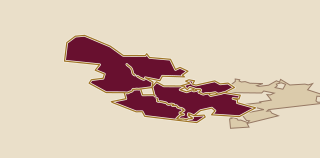
Atlas locationSaint-Émilion · Bordeaux · France44.91° N · 0.19° W

At A Glance

Field
Detail
Region
Bordeaux
Appellation
Saint-Émilion
Main grapes
Cabernet Franc, Cabernet Sauvignon and Merlot
Signature wine
Château Figeac
Defining feature
Three gravel knolls of quartz and flint over iron rich blue clay

The Producer

Three gravel knolls of quartz and flint sit beneath Château Figeac's Saint-Émilion vines. The estate works with Cabernet Franc, Cabernet Sauvignon and Merlot, making Château Figeac as its grand vin and Petit-Figeac as its second label.

The property is also defined by the way its wines move from vineyard to bottle. Each plot and grape variety is fully expressed before blending. The approach keeps the three grape varieties present in the final wine through their individual contributions, including the charm of Merlot, the elegance of Cabernet Franc and the mineral texture of Cabernet Sauvignon.

Place

Château Figeac is in the Saint-Émilion appellation of Bordeaux. In 2022, the Commission for the Classification of the Saint-Émilion Grand Cru appellation, under the aegis of the INAO, elevated the estate to Premier Grand Cru Classé A.

Premier Grand Cru Classé A is a formal classification attached to the estate's Saint-Émilion status. It belongs to the classification of the property, while Saint-Émilion remains the appellation carried by the wine.

Soil And Site

The estate's ground consists of three Günzian gravel knolls made from quartz and flint, with iron rich blue clay below. Gravel creates open spaces that allow excess water to drain away. Clay is denser and can hold more water. The site therefore combines a freely draining upper layer with a more water holding subsoil.

Story

Thierry Manoncourt took full leadership of Château Figeac in 1947 and led the estate until 2010. As Saint-Émilion moved toward Merlot dominance after 1956, he sustained a Cabernet heavy blend of Cabernet Franc, Cabernet Sauvignon and Merlot. Marie-France Manoncourt was involved in the family's stewardship during this long tenure, and Thierry earned the nickname Pharaoh of Saint-Émilion for his lasting influence.

Vineyards And Cellar

In 2021, Château Figeac inaugurated a new 5,000 m² winery built partly below ground, equipped with custom made stainless steel and wooden vats and designed to meet High Environmental Quality standards.

The winemaking approach allows each plot and each grape variety full expression before blending. The cellar's vessels and layout belong to a modern production building, while the blending decision follows the individual expression of the vineyard and grape variety.

Wines

Château Figeac is the grand vin, made from the estate's three principal grape varieties with Cabernet in the majority. Petit-Figeac is the second label, a red wine from the Saint-Émilion appellation.

The two bottles occupy different positions in the range. Château Figeac carries the estate's principal wine, while Petit-Figeac offers the named second label with its own soft palate, powdery tannins and saline finish.

In The Glass

Château Figeac brings Merlot's charm and Cabernet Sauvignon's mineral texture. The palate has a long, taut and vibrant backbone with very pure mineral notes. With bottle age, tobacco leaf and black truffle appear while fresh fruit remains over decades.

Petit-Figeac opens with black cherry, mocha, espresso, sweet tobacco and milk chocolate. Its palate is ultra soft and supple, with plush powdery tannins, vibrant cherry pith, hints of cola and liquorice. A subtle saline finish follows, and the wine can be enjoyed now or cellared for 5 to 8+ years.

A Bottle To Understand It

Choose Petit-Figeac as the first bottle. It is Château Figeac's second label and a red Saint-Émilion wine, placing the estate name, appellation and second wine status together on one bottle.

Château Figeac itself remains the grand vin. Petit-Figeac gives the range a separate bottle with a defined position before moving to the estate's principal wine.

Anecdote

In 1906, Robert Villepigue created Château Figeac's estate label. An estate label is the visual mark placed on the bottle beside the producer's name. Villepigue's design supplied Figeac's visual mark during the early twentieth century.

Final Word

Château Figeac joins Saint-Émilion gravel, Cabernet Franc, Cabernet Sauvignon and Merlot with a grand vin and a second label, Petit-Figeac.

Sources

Keep following the thread

Where to go next

placeRead the Bordeaux guideSee Château Figeac in the wider setting of Bordeaux.mapFind Château Figeac on the mapKeep the producer, its region and nearby places together.learningUnderstand Cabernet FrancRead the quick library guide to Cabernet Franc, which is listed with this producer.