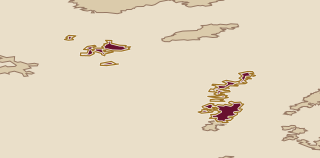
Chablis lies well north of the Côte d'Or, around the small town of Chablis and the Serein river. It is part of Bourgogne, but it is separated from the region's central vineyards by a substantial stretch of countryside. The climate is cool, spring frost is a recurring concern, and Chardonnay is the grape for all four Chablis appellation levels.
The wines are dry whites. At their simplest they can be light, fresh and quick to drink. Other bottlings have more concentration and texture and can develop with age; site and yield are among the differences to look for. Chablis is often described with one word, mineral, but that does little to explain the differences made by slope, exposure, vintage and winemaking.
Slope and exposure matter as much as the tier
What changes here
The classic vineyards sit on limestone and marl, a mix of clay and limestone, formed in the Jurassic period. The most discussed is Kimmeridgian, which contains small fossilised oyster shells and is closely associated with Chablis, Premier Cru and Grand Cru sites. Petit Chablis is commonly found on higher ground with younger Portlandian limestone, although the vineyard map is more complicated than a clean soil boundary.
The direction a slope faces matters in this northern setting. Slopes with useful sun exposure can ripen Chardonnay more reliably, while frost-prone hollows create another challenge. Cellar choices also change the result. Some producers favour stainless steel and old vessels; others use a greater share of oak. Neither choice alone tells you the quality of the wine.
The four Chablis appellation levels
Names to know
Petit Chablis is the broadest starting level and usually the most direct. Chablis covers a larger and more varied group of sites. Chablis Premier Cru is followed by the name of a recognised climat, or named vineyard area, such as Montée de Tonnerre, Fourchaume or Vaillons. Chablis Grand Cru occupies one south-west-facing hillside above the town and is divided into seven named climats.
A Premier Cru or Grand Cru name identifies a site, not a producer. Two growers working the same climat can make notably different wines. The vintage also matters because the balance between ripeness and acidity changes from year to year.
Choosing a Chablis and comparing vineyards
First bottle
Choose a Chablis for a dry Chardonnay that is usually less concentrated and less expensive than a Premier Cru or Grand Cru. If you want to compare sites, try a Chablis and a Premier Cru from the same producer and a similar vintage. Notice their acidity, texture, weight in your mouth and how long the flavour lasts.
The producer's use of oak and choice of vineyard can affect the wine at any level. Check the full producer name and vintage. For an older bottle, storage history matters alongside the vineyard name.
Continue through the region
Elsewhere in Bourgogne
- Côte Chalonnaise9 producersSouth of the Côte d'Or, the Côte Chalonnaise includes the wine villages of Mercurey, Givry, Rully, Montagny and Bouzeron. Its grapes include Pinot Noir, Chardonnay and Aligoté.
- Côte de Beaune66 producersCôte de Beaune continues Bourgogne's central slope south, bringing major Chardonnay villages and important Pinot Noir appellations into one compact area.
- Côte de Nuits36 producersCôte de Nuits is Bourgogne's compact northern slope, where Pinot Noir and a close chain of villages account for most of the region's red Grands Crus.
- Mâconnais47 producersThe Mâconnais is southern Bourgogne's Chardonnay area, centred on Mâcon, Pouilly-Fuissé and Saint-Véran.
Producers in Chablis
Start with these
- Domaine Billaud-SimonDomaine Billaud-Simon makes Chardonnay-led Chablis with a light, crystalline, iodized style, pairing crisp mineral character with a clear contrast between unoaked standard Chablis and the rounder, oak-touched Tête d'Or.
- Domaine William FèvreChablis domaine with hand harvested village, Premier Cru and Grand Cru wines.
- Jean-Marc BrocardFamily owned Chablis domaine in Préhy, with organic and biodynamic farming and Premier Cru Fourchaume.
- La ChablisienneChablis cooperative whose members deliver unfermented must for wines spanning Petit Chablis, Chablis, Premier Cru and Grand Cru.
- Domaine Louis Michel & FilsChablis Chardonnay from a 25 hectare estate with eight Premier Cru vineyards and stainless steel vinification.
Browse 29 more
- Cellier du Château de la ChaumeCorgoloin négociant with white wines spanning Bourgogne Chardonnay, Petit Chablis and Chablis.
- Domaine Alain GautheronSix-generation Chablis family domaine in Fleys, now led by Cyril Gautheron across 25 hectares of Chardonnay in Petit Chablis, Chablis and Chablis Premier Cru.
- Domaine Alice et Olivier De MoorCourgis domaine making Chablis, Saint-Bris and Bourgogne wines from Chardonnay, Aligoté, Sauvignon Blanc and Sauvignon Gris.
- Domaine Antoine et Laurent RobinA Chablis domaine that began with 70 ares of Premier Cru Vaillons in 1990 and now bottles a focused range from Petit Chablis to Grand Cru Blanchot.
- Domaine Baudouin MilletDomaine Baudouin Millet is a Bourgogne Chardonnay estate that grew from a cereal farm in Tonnerre into an approximately 16 hectare range of Petit Chablis, Chablis, Chablis 1er Cru Vaucoupin, and Bourgogne Chardonnay.
- Domaine Benoit CantinIndependent Irancy domaine known for La Grande Côte, a vineyard specific red aged in oak.
- Domaine Christophe CamuChablis family domaine spanning all four appellation tiers, from 100% Chardonnay Chablis to Grand Cru Les Clos.
- Domaine Clotilde DavenneA Chablis domaine with natural viticulture, hand harvesting, stainless steel vinification, and wines from Saint Bris to Irancy.
- Domaine De La MotteA three-generation Michaut family domaine in Beine, making Chablis with old-vine depth, mineral freshness and a rounded palate.
- Domaine de Oliveira LecestreChablis domaine with Lutte Raisonnée farming, an all stainless steel cellar, and Premier Cru Fourchaume.
- Domaine des MalandesFamily-owned Chablis estate with roots in a frost-marked 1949 Fourchaume harvest, now farming 29 hectares across Petit Chablis, Chablis and Premier Cru sites.
- Domaine FournillonDomaine Fournillon comes from Bourgogne, France.
- Domaine Jean-Paul & Benoît DroinChablis domaine making Chardonnay village and Premier Cru wines with terroir tailored vinification.
- Domaine Jean-Pierre & Alexandre EllevinChichée domaine making dry Chardonnay across Petit Chablis, Chablis and Premier Cru.
- Domaine LarocheDomaine Laroche is a Chablis estate working with Chardonnay across 90 hectares, from precise Chablis Saint-Martin to Grand Cru wines and the limited La Réserve de l’Obédience.
- Domaine Louis MoreauDomaine Louis Moreau makes Chardonnay wines from Petit Chablis through Chablis Grand Cru, including Premier Cru Les Fourneaux.
- Domaine Nathalie & Gilles FèvreChablis domaine with Chardonnay on Kimmeridgian limestone, ranging from Petit Chablis to Grand Cru Les Preuses.
- Domaine Olivier MorinChitry-le-Fort domaine pairing Bourgogne Pinot Noir with sparkling Crémant de Bourgogne and solera style ageing.
- Domaine Pattes LoupThomas Pico established Domaine Pattes Loup in Courgis in 2005.
- Domaine Paul CHAVYPuligny-Montrachet domaine with Premier Cru holdings and a Paul Chavy négoce range.
- Domaine PinsonChablis domaine farmed since 1640, with organic vineyards and wines from Premier Cru Mont de Milieu to Grand Cru Les Clos.
- Domaine ServinChablis domaine making Chardonnay from appellation wines to Grand Cru Bougros, with oak and stainless steel vinification.
- Domaine TernynckDomaine Ternynck is a Burgundy producer where Laurent and Marie-Noëlle Ternynck have made wines for approximately 20 years.
- Domaine VerretSaint Bris family domaine with Irancy reds, Chablis Premier Cru Beauroy and Crémant de Bourgogne.
- Domaine Vincent DamptDomaine Vincent Dampt is a Chablis producer associated with Kimmeridgian marl soils and the region’s new generation of winemakers.
- Lamblin et FilsMaligny family producer making Chablis across AC, Premier Cru and Grand Cru levels, plus Bourgogne Pinot Noir and Chardonnay Pays d'Oc.
- Maison Caroline LestiméCaroline Lestimé’s Burgundy venture sources small parcels and vinifies them separately into lees aged whites and oak aged reds.
- Noémie VernauxA Beaune négociant-éleveur founded in 1851, with cellars around the town and a documented Burgundy range spanning Chablis, Bourgogne Blanc and Pinot Noir Bourgogne Rouge.
- SCEV Domaine Du ChardonnayA 34.5-hectare Chablis estate, Domaine du Chardonnay grows and vinifies its own Chardonnay across Petit Chablis, Chablis, Premier Cru and Grand Cru.