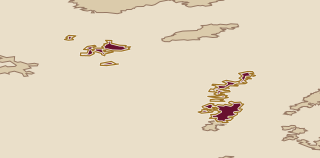
The Côte de Nuits is a narrow vineyard strip running south from the edge of Dijon to Corgoloin. Pinot Noir dominates, and the slope contains most of Bourgogne's red Grand Cru vineyards. Its appellations, the defined origins and their wine rules, range from regional Bourgogne through village wines to classified Premier Cru and Grand Cru vineyards. Côte de Nuits-Villages is another appellation to recognise.
The vineyards occupy an east and south-east-facing limestone escarpment broken by small valleys. Changes in slope, soil depth, stones, exposure and drainage occur over short distances. They help explain why a climat, a defined vineyard area, can carry its own name even when the next parcel is only a few steps away.
Pinot Noir varies along the chain of villages
What changes here
Marsannay and Fixin begin the chain in the north. Gevrey-Chambertin follows, with a large village area, many Premier Crus and nine Grand Cru appellations. Morey-Saint-Denis is smaller but unusually rich in Grand Cru sites. Chambolle-Musigny is commonly associated with fragrance and fine texture. Vougeot is dominated on the map by the large Clos de Vougeot Grand Cru, where many owners make separate wines.
Vosne-Romanée contains several of the most sought-after vineyards in Bourgogne. Nuits-Saint-Georges gives the côte its name and has many Premier Crus but no Grand Cru. The producer, vineyard and harvest year can make wines from the same village taste quite different.
Village, climat and producer share the label
Names to know
On a village wine, Gevrey-Chambertin or Chambolle-Musigny is the appellation. A Premier Cru adds that wording and may add the climat, for example Nuits-Saint-Georges Premier Cru Les Saint-Georges. A Grand Cru usually leads with its own vineyard appellation, such as Clos de la Roche or Echezeaux, followed by Grand Cru. The producer name remains essential at every level.
Côte de Nuits-Villages is a separate appellation covering approved vineyards in several communes. Bourgogne Hautes-Côtes de Nuits comes from higher ground to the west. Both can be valuable introductions, but neither is a declassified version of a famous village.
Choosing a Pinot Noir from the Côte de Nuits
First bottle
Côte de Nuits-Villages, Marsannay, Fixin and Nuits-Saint-Georges offer introductions to the area's Pinot Noir. Choose a producer whose range you can find again if you want to compare villages or vineyards. A pair from the same vintage can help, although vineyard and cellar choices may differ too.
Young wines may benefit from air. For a mature bottle, check how it has been stored. Grand Cru prices reflect scarcity and reputation as well as the wine itself, so the classification alone is a limited guide to what you will enjoy.
Continue through the region
Elsewhere in Bourgogne
- Chablis37 producersChablis is Bourgogne's cool northern Chardonnay country, with four appellation levels arranged around the Serein valley.
- Côte Chalonnaise9 producersSouth of the Côte d'Or, the Côte Chalonnaise includes the wine villages of Mercurey, Givry, Rully, Montagny and Bouzeron. Its grapes include Pinot Noir, Chardonnay and Aligoté.
- Côte de Beaune66 producersCôte de Beaune continues Bourgogne's central slope south, bringing major Chardonnay villages and important Pinot Noir appellations into one compact area.
- Mâconnais47 producersThe Mâconnais is southern Bourgogne's Chardonnay area, centred on Mâcon, Pouilly-Fuissé and Saint-Véran.
Producers in Côte de Nuits
Start with these
- Clos de TartMorey-Saint-Denis Pinot Noir from Burgundy's largest Grand Cru monopole, farmed biodynamically and aged in oak.
- Domaine Anne GrosVosne-Romanée domaine with hand harvested Burgundy wines, indigenous yeast fermentation, and a Minervois partnership behind La Ciaude.
- Domaine DujacDomaine Dujac pairs Morey-Saint-Denis and Puligny-Montrachet Premier Cru whites, including Chardonnay from clay and limestone.
- Domaine FaiveleyNuits-Saint-Georges domaine with Bourgogne Chardonnay, Gevrey-Chambertin Vieilles Vignes and Clos de Vougeot Grand Cru.
- Domaine Jean GrivotVosne-Romanée domaine with 15 hectares, estate bottling history, and holdings in Clos de Vougeot, Échézeaux, and Richebourg.
Browse 26 more
- Domaine Bruno ClairMarsannay-la-Côte domaine with 24 hectares, Bonnes-Mares Grand Cru and Chambolle-Musigny Les Charmes.
- Domaine Comte Georges de VogüéChambolle-Musigny domaine with 7.2 hectares of Musigny, a Les Petits-Musigny monopoly, and red and white Musigny wines.
- Domaine Comtes Georges de VogueDomaine Comtes Georges de Vogüé is a family-owned Burgundy estate centred on Musigny Grand Cru, with Pinot Noir-led reds, the full Petits Musigny subsection, and rare Musigny Blanc from Chardonnay.
- Domaine Confuron-GindreFamily Côte de Nuits domaine spanning six generations, with Vosne-Romanée village wine, premier cru parcels and natural preventive vineyard work.
- Domaine de la VougeraieFounded in 1999 by Jean-Charles Boisset, Domaine de la Vougeraie brings together 37 hectares across 29 Burgundy appellations, split between the Côte de Nuits and Côte de Beaune and farmed biodynamically across the estate since 2011.
- Domaine Drouhin-LarozeGevrey Chambertin family domaine with village, Premier Cru and Grand Cru red wines.
- Domaine du Clos St. LouisA family-run Fixin estate founded in 1918, centred on Pinot Noir from the Clos Entre Deux Velles monopole.
- Domaine Jacques-Frédéric MugnierChambolle-Musigny domaine using reasoned farming and a destemmed, ambient yeast cellar for Musigny Grand Cru.
- Domaine Jean FeryDomaine Jean Fery is an Echevronne Burgundy estate with 32 hectares of certified organic vineyards and wines from 25 appellations across the Côte de Nuits and Côte de Beaune.
- Domaine Michel GrosDomaine Michel Gros makes Vosne-Romanée red wines, including Clos des Réas, a walled site harvested two or three days earlier than the village.
- Domaine Perrot-MinotCôte de Nuits domaine farming five villages, with red wines from village appellations to Grand Crus.
- Domaine Pierre DamoyGevrey-Chambertin domaine centred on grand crus, old vines and Chambertin Clos de Bèze, with partial destemming and long vatting.
- Domaine R. Dubois et FilsPremeaux-Prissey domaine with Pinot Noir reds, a Chardonnay white, 21 appellations and organic certification from 2023.
- Domaine Robert ChevillonDomaine Robert Chevillon is a Burgundy producer known for hearty, characterful wines with a documented capacity to stand the test of time.
- Domaine Robert Groffier Père et FilsBurgundy domaine with indigenous yeast fermentation, whole clusters and Chambolle-Musigny Premier Cru Les Amoureuses.
- Domaine Sandrine HenriotThree hectare Régnié Durette domaine, biodynamically managed since 2010, with Les Charmes, Régnié Lachat 2024 and Morgon 2019.
- Domaine Sylvain Cathiard et FilsFamily domaine in Vosne-Romanée, farming about five hectares of Pinot Noir across Burgundy appellations from generic Burgundy to Premier Cru and Grand Cru wines.
- Domaine Sylvain PatailleMarsannay domaine farming 15 hectares of Aligoté, Chardonnay and Pinot Noir biodynamically, with separate lieu dit bottlings.
- Domaine Taupenot-MermeFamily domaine across Côte de Nuits and Côte de Beaune, with organic viticulture, grand cru parcels and tailored French oak ageing.
- Domaine TrapetDomaine Trapet is a Gevrey-Chambertin domaine with biodynamic viticulture, Pinot Noir at its core, and named Grand Cru reds.
- Domaines Jean FournierMarsannay-la-Côte domaine with less extracted reds, whole cluster fermentation, and wines from Marsannay, Bourgogne Aligoté, and Aloxe-Corton.
- Dufouleur FrèresDufouleur Frères is a Burgundy producer rooted in Nuits-Saint-Georges, carrying forward a family winemaking presence spanning more than 400 years.
- Jean-Claude BoissetNuits-Saint-Georges Burgundy négociant with a former Ursulines convent winery and Clos de la Roche Grand Cru.
- Labouré-RoiBurgundy négociant-éleveur based in Nuits-Saint-Georges, working with local winegrowers across Bourgogne and Chablis.
- Louis BouillotLouis Bouillot is a Nuits-Saint-Georges producer devoted exclusively to Crémant de Bourgogne, established in 1877 and producing three million bottles annually through long-term grower relationships.
- Maison Edouard DelaunayFounded in 1893, Maison Edouard Delaunay is a Burgundy house based at Château de Charmont.