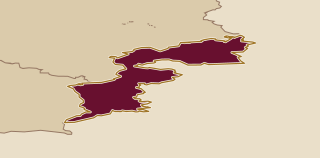
Lake Neusiedl occupies the north of Burgenland, with vineyards on the flatter land to its east and on the Leitha hills to its west. Farther south, the land becomes hillier through Mittelburgenland and Eisenberg. Zweigelt is especially important around the lake, while Blaufränkisch leads many of the central and southern red wines.
Blaufränkisch and Zweigelt
Grapes and styles
In Mittelburgenland, Blaufränkisch makes dry reds with dark fruit, spice, acidity and tannin, the drying grip in your mouth. It is the defining red grape in Mittelburgenland DAC and Eisenberg DAC. DAC identifies a protected Austrian wine origin with rules for grapes and wine style. Leithaberg DAC permits Blaufränkisch for red wine and white grapes including Chardonnay, Pinot Blanc, Neuburger and Grüner Veltliner. Its vineyards include both limestone and schist soils.
East of Lake Neusiedl, Neusiedlersee DAC uses Zweigelt for its red wines, including a fuller Reserve category. Rosalia DAC, north of Mittelburgenland, also works with Blaufränkisch and Zweigelt.
Lake Neusiedl and sweet wine
Background
Lake Neusiedl is shallow and surrounded by reed beds. Warmth and humidity around the lake can favour noble rot in suitable autumns, especially in the Seewinkel to the east and around Rust on the western shore. Producers use the shrivelled grapes for concentrated sweet wines that retain acidity alongside their sugar.
Neusiedlersee DAC can cover sweet wine as well as Zweigelt-based red wine. Ruster Ausbruch DAC is a sweet wine from Rust made from selected shrivelled grapes grown in the city's vineyards. It belongs to the Trockenbeerenauslese category. Welschriesling is important for sweet wine here, though other permitted grapes also appear.
Wines labelled Burgenland
Everyday bottles
A wine can come from Burgenland without meeting the narrower rules of a particular DAC. Producers may use the broader Burgenland name for blends, single-grape wines and other styles. A regional Zweigelt can be fruity and ready to drink young, while Blaufränkisch ranges from fresh regional wines to firmer wines from individual vineyards.
There are dry whites here too, including Chardonnay, Pinot Blanc and Welschriesling. Check the grape and the producer's description when choosing a bottle labelled simply Burgenland.
DAC, Reserve and Ried on the label
Read the label
DAC stands for Districtus Austriae Controllatus. Wines bearing it must meet the regional rules and qualify as Qualitätswein, the officially tested quality-wine category. The full name matters: Leithaberg DAC may be red or white, while Neusiedlersee DAC covers both red and sweet wines.
Reserve adds requirements within a particular DAC; its meaning depends on the appellation, or defined wine area. Ried introduces a single-vineyard name. If the label says only Burgenland, check the grape and sweetness wording, as the broader origin allows a wider range of wines.
Choosing a Burgenland wine
First bottle
For a dry red with dark fruit and a firm grip, try Blaufränkisch from Mittelburgenland. Eisenberg is another place to look for the grape. Try a regional Zweigelt if you want a fruity red to drink young. Leithaberg DAC also offers dry whites.
For something sweet, look for Beerenauslese, a wine made from selected ripe berries, or a more concentrated Trockenbeerenauslese. Ruster Ausbruch is one such wine to try in a small bottle.
5 named areas
Inside the region
Explore the wine-growing areas of Burgenland.
- 01Burgenland1 producerBurgenland grows more red grapes than white. Blaufränkisch, St. Laurent and Zweigelt make reds that are often spicy, with mineral notes, high acidity and moderate tannin.
- 02EisenbergNo producers listed yetEisenberg is a Burgenland wine area known in the DAC structure for Blaufränkisch. Welschriesling joined the DAC in 2023, expanding the official category beyond red wine.
- 03Leithaberg4 producersLeithaberg in Burgenland makes reds from Blaufränkisch and whites from Grüner Veltliner, Pinot Blanc, Chardonnay or Neuburger. Both colours are often described as having mineral notes.
- 04Mittelburgenland2 producersMittelburgenland is a Burgenland wine area closely associated with Blaufränkisch. Its DAC was Burgenland's first and Austria's first to specialise in red wine.
- 05Neusiedlersee8 producersNeusiedlersee is a Burgenland wine area associated with Zweigelt and sweet wine. Its DAC Zweigelt is dry and harmonious, with dark fruit, herbs and velvety tannin.
Producer profiles
Start with these
Meet 5 producers from across Burgenland.
- Weingut HeinrichBiodynamic wines from Gols, Burgenland, spanning named-site reds, Pinot Noir and skin-contact wines.
- Weingut NittnausA Gols family estate where Hans Michael leads cellar style, Andreas handles sales and tastings, and both brothers work in the vineyards.
- Weingut UmathumA Frauenkirchen estate whose Lake Neusiedl vineyards supply dry reds led by Zweigelt, St.
- Weinlaubenhof KracherA Seewinkel family winery whose Beerenauslese and Trockenbeerenauslese turn Lake Neusiedl’s foggy, warm conditions into layered sweet wines.
- Weingut Heidi Schröck & SöhneA 10-hectare family estate in Rust, Burgenland, where Heidi Schröck and her sons Georg and Johannes make dry Weissburgunder alongside Ruster Ausbruch.
Browse 8 more
- BioDyn Weingut HaiderDemeter-certified biodynamic estate in Austria's Seewinkel, 12 hectares farmed without synthetic inputs and bottled with minimal sulfites.
- Gut OggauBiodynamic Burgenland estate farming 35 acres of old vines, with ten wines organised by generation and soil type.
- Weingut CeelA Rust, Burgenland project pairing Blaufränkisch with clay, Syrah with weathered slate and Chardonnay with limestone.
- Weingut SchwarzAndau, Burgenland: ripe, barrel-aged Zweigelt shaped by cold-handled fruit and the Schwarz family’s butcher-to-wine story.
- Weingut Stefanie RennerFamily-run estate in Gols, Burgenland, where Stefanie and Georg Renner farm organically and biodynamically to make low-intervention wines across white, red, orange, rosé and sparkling styles.
- Weingut StrehnA fourth-generation Deutschkreutz winery farming organically and shaping distinct rosés through grape choice, steel and wood.
- Weingut VelichApetlon white wines shaped by Seewinkel warmth, long lees ageing and Chardonnay rooted in a 1959 planting.
- Winery Family StrehnDeutschkreutz winery centred on Blaufränkisch, organic vineyards and a rosé led range.