
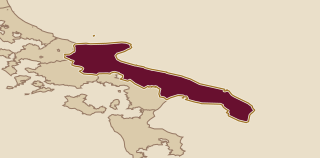
Apulia has five sub-regions and 32 named appellations. Its native red grapes include Primitivo, Negroamaro, Nero di Troia and Susumaniello, used for fruity rosés and rich, velvety reds. Wines labelled Puglia IGP include dry, savoury whites and deeply coloured, fruity reds. Around Castel del Monte, the Bombino Nero grape is used for rosé. Gioia del Colle, on the Murgia plateau, is associated with Primitivo. Primitivo di Manduria wines can be full-bodied and high in alcohol. Tarantino IGP covers Taranto province and permits sparkling wines, wines from dried grapes, young red wines and late-harvest wines. In central Salento, Negroamaro grows between the Ionian and Adriatic Seas. The area has clay soils, mild winters, hot dry summers and cooler night breezes.
5 named areas
Inside the region
Explore the wine-growing areas of Apulia.
- 01Castel del Monte & Alta Murgia (Bari hinterland)No producers listed yetCastel del Monte Bombino Nero is a rosé made with at least 90% Bombino Nero. In this Bari-hinterland area, vineyards can sit at about 400 metres on stony ground, with persistent breezes and stronger winds.
- 02Daunia & Foggia (northern Apulia)9 producersIn northern Apulia, Daunia & Foggia includes the appellations San Severo, Cacc'e mmitte di Lucera, Orta Nova, Rosso di Cerignola and Tavoliere delle Puglie.
- 03Murge Centrale & Valle d'Itria (Trulli country)2 producersGioia del Colle, on the Murgia plateau, is associated with Primitivo. Gravina, Locorotondo, Martina and Ostuni are also listed within this part of Apulia.
- 04Salento Peninsula (Lecce & lower Brindisi)3 producersCentral Salento lies between the Ionian and Adriatic Seas. Its hot, dry summers are moderated by cool night breezes and strong day-to-night temperature swings, while the Terre del Negroamaro territory is associated with clay soils.
- 05Taranto & Ionian Arc1 producerTarantino IGP covers Taranto province and permits sparkling, passito, red-grape novello and late-harvest wines. Primitivo di Manduria is one of the area's listed appellations.
Producer profiles
Producer profiles
Every producer profiled in Apulia so far.
- Cantina Sociale Cooperativa di Copertino SCASalento cooperative founded 1935, producing Negroamaro Copertino DOC Riserva and Aldieri Primitivo from clay-limestone vineyards around Copertino.
- Cantina Sociale CopertinoA ninety-year cooperative in the Salento heel of Puglia, building its range entirely on Negroamaro: a stainless-steel-aged DOC red and a pale sparkling white from the same dark-skinned grape.
- Cantine CoppiPuglian estate farming 200 hectares of indigenous varieties between the Bari hills and Salento, with a flagship Primitivo vinified by carbonic maceration and aged in Slavonian oak.
- Cantine Due PalmeA 1,000-grower cooperative in Cellino San Marco, Puglia, founded in 1989 by Angelo Maci.
Browse 9 more
- Cantine Paolo LeoFamily estate in San Donaci, Salento, building its range on Primitivo and Negroamaro with a cellar signature in vine-dried appassimento Primitivo.
- Cantine PriovanoLombard négociant and bottler sourcing from thirteen Italian regions, founded in 1910 by Antonio and Costantino Pirovano as Pirovano Antonio e F.
- Cantine Sgarzi LuigiA fourth-generation family estate farming 140 hectares of Salento vineyards in Puglia and 40 organic hectares in Abruzzo, producing both a competition-winning Primitivo Susumaniello blend and more than 45 million cans of wine annually.
- Cantine TagaroCantine Tagaro is a family-run Puglia winery where three generations of winemaking meet Michele Lorusso’s modern, dynamic direction.
- Casa MarzoniOrganic appassimento wines from Puglia, made from indigenous southern Italian varieties by a Veneto partnership with nearly a century behind it.
- Casa VinironiaItalian wine label founded in 2012, selecting from producers across multiple Italian regions.
- Femar ViniFemar Vini is a Rome-registered wine company, founded by Felice Mergè in 1995, that sources Primitivo, Negroamaro, Fiano, Nero d'Avola, and Montepulciano from Puglia, Sicily, and Abruzzo.
- L’ArchetipoL’Archetipo presents organic Salento wines, including Verdeca Sette Lune, a white shaped by extended skin maceration and lengthy lees ageing.
- Podere 29Certified-organic family estate on the Tavoliere delle Puglie plain near Cerignola, farming four indigenous Pugliese varieties on clay and sand with biodynamic principles.