
NoleaWorld of Wine

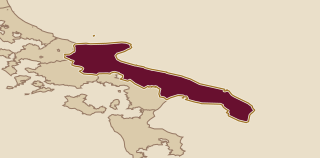
Apulia · Italy

Producer profile

Cantine Sgarzi Luigi

A fourth-generation family estate farming 140 hectares of Salento vineyards in Puglia and 40 organic hectares in Abruzzo, producing both a competition-winning Primitivo Susumaniello blend and more than 45 million cans of wine annually.

Place
Italy
Known for
Selezione di Famiglia Primitivo Susumaniello IGT Salento
Wine context
Lambrusco · Sangiovese · Zinfandel / Primitivo
Editorial basis
World of Wine editorial profile · 4 sources

World of Wine editorial profile · Source list ↓

Atlas locationApulia · Italy44.40° N · 11.62° E

At A Glance

**Country**
Italy
**Region**
Puglia
**Sub-region**
Salento
**Founded**
1933
**Generation**
Fourth
**Vineyards**
140 ha (Salento), 40 ha organic (Abruzzo)
**Key grape**
Primitivo, Susumaniello
**Designation**
IGT Salento
**Signature wine**
Selezione di Famiglia Primitivo Susumaniello

The Producer

Cantine Sgarzi Luigi began in 1933 when Luigi Sgarzi planted his first vines in the Emilian countryside near Castel San Pietro Terme, a small town outside Bologna. The estate he built there still stands. What changed, over ninety years and four generations, is where the family farms: the agricultural and winemaking centre moved south to the Salento peninsula in Puglia, where the estate now manages 140 hectares of vineyards on the flat, sun-baked limestone plain between Brindisi and the Adriatic coast.

Stefano Sgarzi, the fourth generation, leads the operation with his wife Nadia. Their children Luigi Leonardo, Anna, and Francesca work at the winery alongside them. The family also holds 40 certified organic hectares in Abruzzo, near the town of Orsogna, giving the range a second regional dimension.

The estate operates at a scale unusual for a family-run Puglian cantina. Sgarzi produces more than 45 million cans of wine annually. The canned format is central to the business, not a side project, positioning the estate as both a Salento agricultural producer and a large-format packager for modern wine markets. Alongside the canned range, the family bottles the Selezione di Famiglia line, a more considered tier that enters international competition and has won gold at two major events.

Place

Salento is the southern heel of Puglia, a flat to gently rolling limestone peninsula that extends below the port cities of Brindisi and Taranto into the Ionian and Adriatic seas. The climate is reliably warm and dry, with long growing seasons that push Primitivo, Puglia's dominant red grape, to high natural sugar levels and deep colour. Coastal proximity brings temperature swings between day and night that slow ripening and preserve acidity, which would otherwise be difficult to hold in the heat.

The IGT Salento designation covers the whole peninsula and allows producers to blend across varieties and parcels without the stricter grape composition rules of a named DOC or DOCG appellation. For Sgarzi, the Selezione di Famiglia Primitivo Susumaniello blend is labelled Salento rather than under a more narrowly defined wine law zone. The freedom to combine Primitivo's concentration with Susumaniello's acidity and colour without varietal percentage constraints is built into the IGT framework.

Abruzzo, where the family holds its 40 organic hectares near Orsogna, sits further north on the Adriatic side of the Apennines, a cooler and higher terrain than Salento. Those vineyards contribute a different fruit profile and acidity register to the broader range.

Soil And Site

The Salento peninsula sits on a foundation of clay and limestone. The clay fraction retains moisture through the dry Puglian summer, slowing vine stress; the limestone drains excess water and contributes the mineral character associated with southern Italian reds grown on calcareous soils. Old-vine Primitivo and Susumaniello are well adapted to this combination, developing deep root systems that reach moisture without irrigation and produce concentrated, dark-fruited grapes by harvest.

Susumaniello has been historically concentrated in the Brindisi province, at the northern edge of the Salento peninsula, where soils tend toward heavier clay. The variety's reputation as an acidity and colour contributor in blends comes from this terroir: it ripens without losing the acidity that Primitivo, at high sugar levels, can shed in warm vintages.

Story

Luigi Sgarzi planted vines near Bologna in 1933, at a time when Emilia-Romagna was better known for Lambrusco and Sangiovese than for the southern Italian grapes the family would later stake its reputation on. The Castel San Pietro Terme winery served a local market for decades. The southward shift to Puglia came as the family expanded, following the family's move to Salento: deep-coloured, high-sugar Primitivo at scale, on land that could support large vineyard holdings at a cost impossible in the north.

By the time Stefano and Nadia's generation took over, the family had committed to Salento as the core viticultural address. The 2011 winery, built in Puglia using environmentally friendly construction materials and fitted with solar panels capable of supplying nearly the entire energy needs of the facility, marked the clearest statement of that commitment: a permanent, purpose-built production centre designed for both quality bottling and high-volume output.

The canned wine format, which now accounts for more than 45 million units a year, developed in parallel with the estate-bottled range. Rather than separating the two ambitions, the family runs them together, using the same Salento and Abruzzo fruit across tiers.

Vineyards And Cellar

The 140 Salento hectares are farmed using integrated and sustainable agriculture methods, glyphosate-free throughout. Integrated farming at this scale means combining selective approved treatments with careful canopy management, limiting chemical input without adopting full organic or biodynamic certification for the Puglia holdings. The 40 Abruzzo hectares carry certified organic status, a stricter regime that excludes synthetic inputs entirely and requires a multi-year transition period to achieve.

The 2011 winery was purpose-built for both estate bottling and high-volume canning. Solar panels on the roof supply the majority of the facility's energy. The building design used environmentally friendly materials throughout, a deliberate choice that aligned the physical setup with the farming philosophy. For the Selezione di Famiglia Primitivo Susumaniello, the winery handles selection and bottling at the estate level, separating this tier from the broader canned output.

Wines

The Selezione di Famiglia Primitivo Susumaniello IGT Salento is the flagship bottled wine, a red blend of two Puglian grapes with complementary profiles. Primitivo brings the weight: deep colour, high natural alcohol, forward dark fruit, plum, and dried fig. Susumaniello brings acidity and colour, helping prevent the wine from becoming flat or heavy at the warm-climate ripeness levels typical of Salento harvests. The 2019 vintage of this wine won Gold at both Mundus Vini 2020 and Berliner Wein Trophy 2020, two independent international competitions judged blind.

Beyond the Selezione di Famiglia, the broader range runs to high volumes in the canned format. The 45-million-can annual output implies a wide set of labels and varieties across Salento and Abruzzo, though the specific cuvees in that wider range are not detailed in currently confirmed information. The Abruzzo organic holdings near Orsogna likely feed white and red varieties suited to that cooler Adriatic climate, but the wines from those parcels are not yet documented with the same specificity as the Salento bottled tier.

The range architecture is effectively two-speed: an internationally entered, estate-bottled tier anchored by the Primitivo Susumaniello blend, and a large-volume canned range that serves modern retail and hospitality markets.

In The Glass

The Selezione di Famiglia Primitivo Susumaniello opens with ripe, dark fruit: black plum, dried cherry, and a hint of dried fig that comes from Primitivo grown at high ripeness in Salento heat. The nose is full without being cooked, which suggests the coastal acidity cycles and the Susumaniello component are doing their moderating work before the wine reaches the glass.

In the mouth, the Primitivo's natural weight gives body and a rounded, generous mid-palate. Susumaniello's acidity threads through that weight, keeping the wine from reading as jammy or overripe. The finish carries dark fruit and warmth, with enough acid length to prevent the alcohol from flattening the close. It drinks as a southern Italian red with genuine concentration, suited to robust food pairings: slow-cooked meat, aged pecorino, and the heavily seasoned dishes of the Puglian table.

Wines from the broader canned range are built for immediate drinking across a range of varieties and styles, though specific profiles for individual labels in that tier are not confirmed.

A Bottle To Understand It

Selezione di Famiglia Primitivo Susumaniello IGT Salento is the bottle to start with. It is a single bottled red from the estate's 140 Salento hectares, blending Primitivo and Susumaniello, and it won two international gold medals with its 2019 vintage. The wine is full-bodied, dark-fruited, and warm, with Susumaniello's acidity keeping the concentration from becoming heavy. It tastes like Salento: ripe, generous, and direct, without the overworked quality that high-volume southern Italian reds can carry. This is the wine that shows what the family does when they separate the best Salento fruit from the broader canned range and bottle it under the family name.

Anecdote

Luigi Sgarzi built a winery and homestead beside his first vines in Castel San Pietro Terme in 1933. Over the following decades the family expanded, shifted south, and eventually moved the centre of production 1,000 kilometres to the Salento peninsula. They built a new facility in Puglia in 2011, covered the roof in solar panels, and committed to farming 140 hectares of southern Italian vineyards. Through all of it, no one demolished the original building near Bologna. Stefano and Nadia Sgarzi lead an estate that now produces tens of millions of cans a year from Puglian and Abruzzese fruit, and the 1933 building in Castel San Pietro Terme still stands on the property where Luigi planted his first row of vines, ninety years ago and a different Italy entirely.

Final Word

Cantine Sgarzi Luigi is a fourth-generation Puglian estate that operates at an unusual intersection: large-scale canned wine production and a bottled tier that wins blind tastings. The Salento vineyards and the 2011 solar-powered winery give the operation a physical permanence in the south, and the Selezione di Famiglia Primitivo Susumaniello gives it a wine worth seeking out by name.

Sources

Keep following the thread

Where to go next

mapFind Cantine Sgarzi Luigi on the mapKeep the producer, its region and nearby places together.learningHow place shapes wineSee how climate, landscape and local choices become part of a wine.