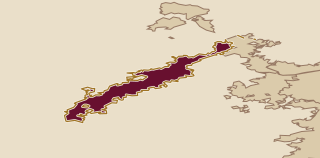
The Mosel river doubles back through a narrow valley before meeting the Rhine at Koblenz. Vineyards climb above it and the Saar and Ruwer, and many of the steepest sites still require hand work because machinery cannot travel safely across them. Farther upstream, the limestone country near Luxembourg supports different grapes, including Elbling.
Riesling from dry to sweet
Grapes and styles
Riesling covers well over half of the Mosel's vineyard area. It ripens late and retains pronounced acidity, the mouth-watering freshness in the wine. That acidity can balance residual sugar, the sugar left after fermentation, even in a sweet wine. Dry Riesling may be light or concentrated enough to age.
Kabinett and Spätlese are categories based on grape ripeness and production rules. They can be dry, though many familiar examples keep some sweetness and relatively modest alcohol. Auslese uses riper, more selected fruit. Beerenauslese, Trockenbeerenauslese and Eiswein are rare sweet-wine categories made only when the harvest allows.
Mosel Riesling commonly has citrus, apple, peach and floral aromas. With bottle age, some examples develop honeyed, nutty or petrol-like notes. Wines from slate vineyards are sometimes described as stony or flinty. These are tasting descriptions, not proof that a soil gives a wine a particular flavour.
The Mosel, Saar and Ruwer valleys
Background
The Middle Mosel around Bernkastel contains many of the region's best-known villages and steep slate vineyards. Farther downstream, the Terrassenmosel between Zell and Koblenz becomes so steep and rocky that terraces are often the only workable form of cultivation. The Saar and Ruwer are cooler tributary valleys with their own villages and sites. Their Rieslings can combine pronounced acidity with a light body, though vintage and producer matter too much for one rule to cover every bottle.
South of Trier, the Upper Mosel approaches Luxembourg. Limestone becomes more important and Elbling has a stronger presence. Elbling makes fresh dry and sparkling wines. Pinot Blanc, Auxerrois and Chardonnay also suit parts of this limestone country.
Regional Riesling, Elbling and Sekt
Everyday bottles
A regional Mosel Riesling usually costs less than a wine from a famous vineyard. Choose one marked trocken if you prefer dry wine. Feinherb often indicates some sweetness, though the term has no fixed legal definition. A Kabinett can be light and gently sweet, but the name alone does not guarantee that style.
Elbling from the Upper Mosel is usually a fresh, dry white. For sparkling wine, look for Sekt made from Riesling or Elbling.
Separate ripeness from sweetness
Read the label
A Mosel label may name the producer, village and vineyard, followed by Riesling and the vintage, or harvest year. Mosel is the official growing region; Saar or Ruwer may appear as part of a more specific origin. Village names include Bernkastel, Piesport, Brauneberg, Traben-Trarbach and Wiltingen.
Keep ripeness and sweetness separate when reading a label. Kabinett, Spätlese and Auslese are Prädikat categories based on grape ripeness and production rules. A Spätlese trocken is dry, while one without the word trocken may retain noticeable sugar. Halbtrocken is a legally defined semi-dry term.
Some producers also classify their wines by estate, village and vineyard origin. GG may appear on dry wines from top classified sites made by members of a growers' association.
Choosing a dry or sweeter Mosel wine
First bottle
Choose Mosel Riesling trocken for a dry white, or a Kabinett or feinherb wine if you would like some sweetness. Check the producer's sweetness description before buying. Upper Mosel Elbling offers a different dry white grape.
If you want to compare dry and off-dry Riesling, look for two wines from the same producer and vintage. Notice how sweetness, acidity and alcohol affect each wine; vineyards and winemaking may also differ. A mature Spätlese is an option for exploring the changes that come with bottle age.
Producer profiles
Start with these
Meet 5 producers from across Mosel.
- Weingut Dr. LoosenA family-owned Mosel estate producing dry Red Slate Riesling and residual-sweetness Erdener Treppchen Kabinett.
- Weingut Fritz HaagMosel Riesling from Brauneberg’s Juffer and Juffer Sonnenuhr slate slopes, made dry and fruity-sweet.
- Weingut Van VolxemSaar Riesling and long-aged sparkling wine from Wiltingen, shaped by named vineyards, manual vineyard work and patient cellar ageing.
- Weingut Markus MolitorA Mosel estate led by Markus Molitor since 1984, working steep slate vineyards across the Mosel, Saar and Ruwer through hand harvesting, repeated selection and a wide Riesling-led range.
- Weingut Carl LoewenThree-person Mosel estate producing Riesling only from 18 hectares of ungrafted old vines, anchored by a single parcel planted in 1896 that Stuart Pigott called one of the best dry white wines in the world.
Browse 29 more
- Ewald Theod. DrathenMosel wine business with Untouched White, a three grape blend, and Königsmosel Riesling made from Riesling alone.
- MosellandA Bernkastel-Kues winegrowers’ cooperative whose Mosel Rieslings make German sweetness levels and regional character easy to taste.
- S.A. PrümA Bernkastel-Wehlen Mosel estate centred on Riesling, with dry, mineral Blue at estate-wine level and spontaneously fermented Grosses Gewächs matured in traditional Fuder barrels.
- Schmitt SöhneSchmitt Söhne is a fifth-generation, family-owned wine company based in Longuich on the Mosel.
- Weingut Axel PaulyA Lieser estate in the Central Moselle, where Axel Pauly turns Riesling from steep, weathered slate slopes into dry and off-dry wines with citrus, peach and lively acidity.
- Weingut BlesiusA small Graach estate making site-designated Mosel Riesling from steep, weathered Devonian-slate slopes.
- Weingut Daniel FriesDaniel Fries makes dry Riesling and Pinot Noir in Winningen on the Terrassenmosel, drawing on steep slate terraces, a cool northern climate and a family wine history that reaches back to the mid-18th century.
- Weingut DeutschherrenhofFamily-run Trier estate led by sixth-generation winemaker Sebastian Oberbillig, with 12 hectares and a Riesling-led range from dry wines to Prädikat bottlings.
- Weingut Dr. HermannMosel Riesling from steep, old-vine sites around Ürzig and Erden, where dry GG, Kabinett and Spätlese show vineyard and ripeness in distinctly different forms.
- Weingut HainA family-run Piesport estate where clay slate, steep Mosel slopes and Riesling shape wines from dry Goldtröpfchen to feinherb Kabinett.
- Weingut Hoffmann-SimonA Piesport family estate making Riesling-led Mosel wines from six sites across four villages, with organic farming and a clear focus on named Riesling bottlings.
- Weingut Julius TreisA Reil estate on the Middle Mosel, where Tobias Treis shapes hand-worked Riesling from steep slopes.
- Weingut KerpenA 9.5-hectare, Riesling-led family estate in Bernkastel-Wehlen, shaping dry and feinherb Mosel wines from Devonian-slate sites including Wehlener Sonnenuhr and Graacher Himmelreich.
- Weingut KlosterhofA family-run Brauneberg estate making slate-grown Mosel Riesling from a former monastery cellar.
- Weingut KnebelWinningen Riesling from Terrassenmosel terraces so steep that vineyard work relies on hand labour and, in places, monorail access.
- Weingut Leo FuchsA family-owned Pommern estate, working steep south-facing Mosel vineyards and dry Riesling led by Vom Grauen Schiefer.
- Weingut Martin MüllenA small family estate in Traben-Trarbach, making dry Mosel Riesling with hand-picked fruit, historic basket pressing, spontaneous fermentation and traditional wooden-cask ageing.
- Weingut Nik WeisMosel and Saar Riesling from a 1947 estate whose vineyards run for about 60 kilometres along both rivers.
- Weingut Nik Weis -St.UrbanshofA family Riesling estate in Leiwen, founded in 1947, with vineyards running along the Mosel and Saar.
- Weingut PaulinshofA family-owned Mosel estate in Kesten, where Oliver Jüngling makes dry Riesling from steep vineyards in Kesten and Brauneberg.
- Weingut Reuscher-HaartA Piesport, Middle Mosel Riesling estate whose dry and fruity-sweet named-site wines pair acidity with lees-aged texture.
- Weingut Schloss SaarsteinA family estate in Serrig on the Saar, where hand-worked slate slopes and Riesling shape a focused Kabinett range.
- Weingut SchmitgesAn Erden estate in the Central Moselle, Weingut Schmitges works mainly with Riesling from grey and red clay slate.
- Weingut Sybille KuntzLieser Mosel Riesling from steep slate sites, farmed without herbicides or pesticides since 1990 and Demeter biodynamically since 2016.
- Weingut TrossenA Kindel Riesling estate in the middle Mosel, where Rita and Rudolf Trossen pair biodynamic farming with slow, low-intervention cellar work.
- Weingut WernerA small, Riesling-led Mosel estate in Leiwen, where Bernhard Werner turns steep-slope fruit into dry and feinherb wines with citrus, weight and brisk acidity.
- Weingut Willems-WillemsA six-hectare Saar estate making dry and feinherb Riesling from sheltered, south-facing vineyards above Konz-Oberemmel.
- Weingut Wwe Dr H Thanisch Erben ThanischA twelve-generation Mosel Riesling estate, founded in 1636, with long-held Berncasteler Doctor parcels and wines from dry to sweet.
- Weingüter WegelerFamily-run since 1882, Weingüter Wegeler makes Riesling across the Mosel and Rheingau, with Bernkasteler Doctor at the heart of its Mosel holdings.