
NoleaWorld of Wine

Mosel · Germany

Producer profile

Weingut Kerpen

A 9.5-hectare, Riesling-led family estate in Bernkastel-Wehlen, shaping dry and feinherb Mosel wines from Devonian-slate sites including Wehlener Sonnenuhr and Graacher Himmelreich.

Place
Mosel · Germany
Known for
Site-led Mosel Riesling, from dry Blauschiefer to feinherb Graacher Himmelreich Kabinett.
Wine context
Riesling
Editorial basis
World of Wine editorial profile · 9 sources

World of Wine editorial profile · Source list ↓

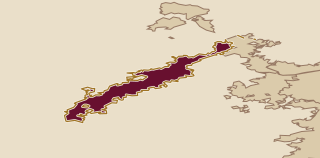
Atlas locationMosel · Germany49.94° N · 7.04° E

At A Glance

The Producer

Weingut Kerpen is a family estate in Bernkastel-Wehlen, where Riesling accounts for 95% of the 9.5-hectare planting. That concentration matters because the range is built around how named Mosel slopes shape one grape: a Wehlen or Graach vineyard name on the label points to a particular holding, while trocken or feinherb tells you whether the Riesling will finish dry or carry a measured sweetness.

The family dates its winegrowing history to 1803 and nine generations. Matthias Kerpen returned in 2022, took over in January 2024, and now runs the estate with Vivien Kerpen. Spätburgunder, planted since 2018, is the smaller counterpoint: it occupies 5% of the vineyards, leaving Riesling as the main way to read the estate’s slopes and slate.

Place

Kerpen’s base, Bernkastel-Wehlen, sits in the Central Moselle, but its vineyard names reach across nearby villages. Wehlener Sonnenuhr and Wehlener Rosenberg belong to Wehlen; Graacher Himmelreich and Graacher Domprobst belong to Graach; Bernkasteler Bratenhöfchen lies in Bernkastel. A bottle labelled Graacher Himmelreich therefore narrows the origin beyond the broader Mosel region and ties its Riesling to a named Graach slope.

That distinction gives the range useful shape. Rather than treating every Riesling as interchangeable, the labels move between village names, vineyard names and sweetness styles. Graacher Himmelreich Riesling Kabinett feinherb combines a named site with Kabinett’s lighter-bodied Mosel frame and feinherb’s off-dry balance, while Blauschiefer Riesling trocken places dry Riesling at the other end of the palate.

Soil And Site

The vineyards face south to southwest and sit on mineral, heat-retaining Devonian slate. In a cool river-valley region, slope exposure and stored warmth help grapes ripen; Riesling can keep its acidity while developing more complete fruit. In the glass, that combination supports dry wines with a firm, stony line and feinherb wines whose sweetness can sit against citrus-like freshness rather than turning heavy.

Wehlener Sonnenuhr is the estate’s largest holding at 5.2 hectares, followed by 2.1 hectares in Graacher Himmelreich. Those figures make the vineyard names more than decorative label language: a substantial share of Kerpen’s Riesling comes from these slate sites, giving the estate repeated opportunities to bottle Wehlen and Graach separately.

Story

Martin Kerpen took over the estate in 1988 after studying oenology in Geisenheim. His period at the helm joined a long family history to a Riesling estate spread across Wehlen, Graach and Bernkastel, where vineyard names could become the working structure of the range rather than a single generic Mosel bottling.

The present estate remains compact enough for those site names to stay legible. Its 9.5 hectares are largely Riesling, with a small Spätburgunder planting added from 2018. That scale concentrates attention on the differences between dry and feinherb Riesling, and between a broadly named slate wine and a wine carrying a specific vineyard on its label.

Vineyards And Cellar

Kerpen’s steep, slate vineyards are worked with hand harvesting. Picking by hand puts selection in the vineyard, where ripeness can be judged bunch by bunch on slopes whose exposure and heat-retaining stone affect how Riesling develops. The resulting fruit is the starting point for wines that can retain Mosel acidity while carrying dry or off-dry finishes.

The estate’s documented cellar work includes fermentation vessels and maturation, but the supplied record does not support a detailed vessel-by-vessel account. What is clear in the bottles is the useful contrast between a dry Riesling such as Blauschiefer and the lighter, feinherb Graacher Himmelreich Kabinett: sweetness level and vineyard designation do much of the work in setting texture, body and finish.

Wines

Riesling is the range’s main current. Blauschiefer Riesling trocken offers the dry end: a slate-named Riesling where acidity, mineral character and a dry finish are the structural focus. It is the bottle for seeing how the estate handles a leaner, more direct shape without moving away from the Mosel’s lightness.

The named-vineyard wines add a more specific origin. Graacher Himmelreich Riesling Kabinett feinherb carries the Graach site on the label and pairs its lighter Kabinett body with feinherb sweetness. Wehlener Sonnenuhr, Graacher Domprobst, Bernkasteler Bratenhöfchen and Wehlener Rosenberg extend that site-led architecture. Spätburgunder is present, but its 5% share means it is a smaller branch beside the Riesling wines.

In The Glass

Across the Rieslings, expect freshness to be the first structural impression: Riesling’s acidity is held in place by the Mosel’s slope-grown fruit, while Devonian slate contributes a mineral, dry-edged feel. In a trocken wine, the palate should move from fruit into a dry, stony finish; the absence of added sweetness leaves acidity and texture in the foreground.

Graacher Himmelreich Riesling Kabinett feinherb changes the sequence. Its lighter body keeps the wine agile, while feinherb sweetness rounds the middle of the palate before acidity refreshes the finish. The result is not simply sweet Riesling: fruit, softness and acidity work together, with the named Graach vineyard supplying the origin behind the label.

A Bottle To Understand It

Start with the 2024 Graacher Himmelreich Riesling Kabinett feinherb. It is Riesling from one of Kerpen’s principal Graach holdings, named on the label and made in a feinherb style, so it brings vineyard, grape and sweetness level into one bottle. Its lighter Kabinett body, off-dry texture and acidity make the Mosel combination easy to feel: fruit at the centre, a soft sweep across the palate, then a fresh finish rather than weight.

Anecdote

Matthias Kerpen returned to the family estate in 2022. The property he came back to was a 9.5-hectare, Riesling-led operation in Bernkastel-Wehlen, with vines in Wehlener Sonnenuhr, Graacher Himmelreich and other named Mosel sites. In January 2024, he took over from his father, Martin Kerpen, who had led the estate since 1988 after studying oenology in Geisenheim. Matthias now runs Weingut Kerpen with Vivien Kerpen. The handover placed the current work of the couple inside a family winegrowing history that the estate dates to 1803 and nine generations.

Final Word

Kerpen is easiest to approach through the way its labels narrow the view: Mosel Riesling becomes Wehlen or Graach, then dry or feinherb, then a particular bottle. Graacher Himmelreich Riesling Kabinett feinherb makes that progression tangible through a named slope, light body, gentle sweetness and refreshing acidity.

Sources

Keep following the thread

Where to go next

placeRead the Mosel guideSee Weingut Kerpen in the wider setting of Mosel.mapFind Weingut Kerpen on the mapKeep the producer, its region and nearby places together.learningUnderstand RieslingRead the quick library guide to Riesling, which is listed with this producer.