
Who makes it
Weingut Fritz Haag is a family estate in Brauneberg whose vineyards are planted entirely to Riesling. Oliver Haag took over in 2005 and serves as both owner and cellarmaster, so the same hand that directs the estate also directs its fermentations and bottling decisions. Its labels centre on Brauneberger Juffer and Juffer Sonnenuhr: two names that locate a Mosel Riesling on steep slate rather than simply describing a style.
The estate was first documented in 1605, when Brauneberg was still called Dusemond, and it still uses Dusemonder Hof as a supplemental designation. Wilhelm Haag returned in 1957 after his father fell ill, expecting to work only one harvest, but stayed at the estate. His work brought him Gault Millau’s 1994 Winemaker of the Year recognition. Oliver Haag succeeded him in 2005 after study at Geisenheim and cellar experience elsewhere, continuing the family focus on Riesling from the same Brauneberg slopes.
Where it grows
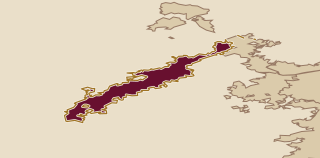
Brauneberger Juffer runs for almost two kilometres along the Mosel opposite the village of Brauneberg and covers roughly 32 hectares. Juffer Sonnenuhr is a smaller, roughly 10.5-hectare section at the steep centre of that larger vineyard. The distinction matters in the glass: the warmer Sonnenuhr site is associated with a finer, more layered expression, while Juffer supplies the wider frame for dry and fruity-sweet Rieslings bearing the Brauneberg name.
The slopes face south and are built from fine, weathered Devonian slate, with gradients reaching 80 percent. Sun exposure helps Riesling ripen in this cool river valley; slate contributes a stony, saline character and the steep ground demands careful work by hand. In dry Juffer wines, those conditions appear as citrus fruit held by high acidity, herbal notes and a finish with a chalky, stone-like edge rather than broad sweetness.
How it is made
The cellar
The estate describes its vineyard work as natural and sustainable, with selective hand harvesting on the steep sites. Hand selection lets fruit be picked in passes when ripeness differs across a slope, an important choice for Riesling that can become either dry Grosses Gewächs or a Prädikat wine with retained sweetness. In the cellar, grapes are handled gently and may receive a short pre-press maceration. Fermentation is spontaneous in both traditional fuder casks and stainless-steel tanks, allowing the estate to shape texture while keeping the grape and slate at the centre.
What they make
Fritz Haag’s range is best read as a Riesling spectrum. At the dry end, Brauneberger Juffer Riesling Trocken Grosses Gewächs is a site-led wine with pronounced acidity, saline mineral notes, herbal spice and firm length. The 2024 bottling was fermented 80 percent in fuder and 20 percent in stainless steel, combining a woven palate with bright fruit and a dry, stony finish.
Kabinett and Spätlese place the same grape and named sites on a different part of the scale. Their fruity sweetness softens the immediate impact of acidity without removing it, so apple, citrus and yellow fruit can feel lighter on the palate than the ripeness level suggests. Juffer Sonnenuhr wines bring the smaller, warmer slope into focus; its dry Grosses Gewächs is generally presented as finer than the Juffer GG rather than simply heavier.
Wines to try
First bottle
Start with Brauneberger Juffer Riesling Trocken Grosses Gewächs. It puts the larger Juffer vineyard, south-facing slate and Fritz Haag’s dry style in one bottle. Expect citrus, grapefruit, apple and yellow fruit, followed by herbal notes, lively acidity and a saline, chalky finish. The partial fuder fermentation gives the mid-palate a little weight, while stainless steel keeps the fruit direct. It is the most useful first step for seeing how Brauneberg Riesling can be dry, structured and still light on its feet.