NoleaWorld of Wine

Mosel · Germany

Producer profile

Weingut Carl Loewen

Three-person Mosel estate producing Riesling only from 18 hectares of ungrafted old vines, anchored by a single parcel planted in 1896 that Stuart Pigott called one of the best dry white wines in the world.

Place
Mosel · Germany
Known for
Old ungrafted Mosel Riesling on slate, low-intervention fermentation, Fuder barrel ageing, single-parcel 1896 bottling
Wine context
Riesling
Editorial basis
World of Wine editorial profile · 7 sources

World of Wine editorial profile · Source list ↓

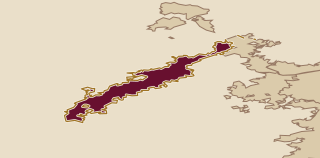
Atlas locationMosel · Germany49.82° N · 6.88° E

At A Glance

Producer: Weingut Carl Loewen Village: Leiwen, Mosel, Germany Grape: Riesling Style: Dry and off-dry Riesling, low-intervention, Fuder-aged Flagship: Riesling 1896 Black Label

The Producer

Christopher Loewen runs an 18-hectare Riesling estate on the Mosel with his father Karl-Josef and one full-time employee. Three people, one grape, and a parcel of ungrafted vines planted in 1896 that wine writer Stuart Pigott placed among the best dry white wines in the world.

The estate is based in Leiwen, with vineyards spread across four villages: Leiwen, Longuich, Detzem, and Thörnich. More than half of those 18 hectares are ungrafted vines between 60 and 120 years old, grown on steep slate slopes without chemical additives, mechanical pumping, or temperature control in the cellar. The anchor of the range is the Maximin Herrenberg parcel in Thörnich, planted on its own rootstock in 1896 before phylloxera reached the Mosel at scale. That parcel gives the estate its name wine: Riesling 1896 Black Label.

Place

The Mosel cuts a long switchbacking valley through the slate hills of Rhineland-Palatinate in western Germany. The river bends create south- and southwest-facing exposures that allow Riesling to ripen slowly on some of the steepest vineyard slopes in Europe, some exceeding 60 degrees. Loewen's four-village footprint follows this pattern across a long stretch of the middle Mosel: each village sits on slate bedrock, and each parcel faces the sun at an angle that extends the growing season into October and often beyond.

Slate holds and radiates heat overnight, keeping vine roots warm during cool Mosel nights. Old ungrafted vines send roots deeper into that rock than younger grafted vines can, drawing from a different mineral register. The consequence in the glass is a pronounced saline minerality on the finish, and an acid line that cuts through the fruit rather than framing it from a distance.

Soil And Site

Slate is the consistent soil across all four villages. The Maximin Herrenberg parcel in Thörnich sits on steep blue slate, and the ungrafted Riesling vines planted there in 1896 have had 130 years to root through it. More than 50% of Loewen's holdings are ungrafted vines aged 60 to 120 years. Ungrafted vines on slate are the physical fact behind everything the estate does: low yields, concentrated fruit, slow ripening, and a mineral quality on the finish that younger vines on the same soil rarely match.

Story

The estate traces to 1803, when Napoleon's government dissolved the Benedictine monasteries of the Mosel and forced their properties to auction. Nikolaus Loewen, then vineyard manager of the Abbey of St. Maximin, bought the monastery's best parcels when they came up for sale. That purchase founded the family estate and brought the Maximin Herrenberg into Loewen hands.

Nearly a century later, in 1896, the family planted the Herrenberg parcel with ungrafted Riesling vines on their own rootstock. Phylloxera, the aphid-like pest that destroyed most of Europe's vineyards by forcing growers to graft onto American rootstock, arrived in the Mosel after the planting was established. The Herrenberg vines survived without grafting and have been farmed continuously since.

Christopher Loewen took over the winemaking and redirected the estate toward radical simplicity in the cellar: no additions, no temperature control, no mechanical pumps. He also made a naming decision that changed how the estate is read internationally. The apex wine, drawn from the 1896 ungrafted parcel, was bottled simply as Riesling 1896 Black Label, with the planting year on the label as its only name. That choice gave a very small estate one of the most legible labels on the Mosel.

Vineyards And Cellar

Loewen's steep-slope parcels are harvested by hand. On the evening of the harvest, grapes go into a basket press over 100 years old. The press runs without mechanical pumps: juice falls by gravity through the cellar floor into the tanks below. No pumping, no transfer lines, no oxidation risk from mechanical handling.

Fermentation is spontaneous, driven by wild yeasts naturally present on the grape skins. No temperature control is applied. No chemical additives are used at any point. The wines age in old Fuder barrels, the traditional Mosel wooden cask format at around 1,100 litres, with the estate's barrels averaging 25 years old. At that age, Fuder contribute no oak flavour to the wine; they allow very slow micro-oxygenation and preserve the primary fruit and mineral character of the grape.

The ungrafted old vines produce small, concentrated clusters. Low-intervention winemaking preserves that concentration from the vineyard through to the bottle without additions that would alter the mineral or acid profile.

Wines

Riesling is the only grape. The range moves from village-level Rieslings through named-vineyard bottlings from parcels across Leiwen, Longuich, Detzem, and Thörnich, then to the Riesling 1896 Black Label at the top.

The village and vineyard-level Rieslings are dry or close to dry, fermented with wild yeasts and aged in old Fuder. They carry the same low-intervention cellar approach as the flagship: no additions, gravity-fed, spontaneous ferment. On the palate they show the lean, high-acid profile of Mosel slate Riesling: citrus-forward, light-bodied, with a stony finish and long acid line. Yields from ungrafted old vines are lower than the regional average, so even the entry bottles carry more concentration than their price level suggests.

The Riesling 1896 Black Label comes from a single parcel on its own rootstock. It is bottled dry. The palate is more concentrated and dense than the vineyard-level wines: deeper fruit weight, longer mineral finish, and an acid backbone built to carry the wine for a decade or more. The 1896 parcel's age and rootstock depth produce a different register from anything else in the range.

In The Glass

The Riesling 1896 Black Label opens discreetly in the glass. The nose needs a few minutes: faint hints of spontaneous fermentation lift first, then the wine moves toward citrus, lemon, lime, and ripe pineapple. The colour is deep lemon-yellow.

On the palate it is clear, dense, and focused. A mouthwatering freshness lifts the mid-palate, and citrus-driven acidity runs from the first sip to the finish. The finish is long, saline, and mineral, the kind that asks for another sip rather than completing the last one. No sweetness remains. No oak character. The wine is taut and built for age.

The vineyard-level Rieslings from the slate parcels across the four villages are lighter in concentration but carry the same high-acid profile. They show the same mineral finish at a lower intensity: bright citrus, clean line, stony close.

A Bottle To Understand It

Start with the Riesling 1896 Black Label. It comes from one parcel, planted in one year, on its own rootstock, vinified by three people without additions or temperature control. The wine is dry, high-acid, and mineral, with concentrated lemon and lime fruit, a dense mid-palate, and a long saline finish. It is built to age, but it already delivers at release: everything that defines what Loewen does is present in the glass from the first pour. Stuart Pigott described it as one of the best dry white wines in the world after only its fifth vintage.

Anecdote

In 1803, as Napoleon's government moved through the dissolution of church properties along the Mosel, the Benedictine Abbey of St. Maximin lost its vineyards at public auction. Nikolaus Loewen was the abbey's vineyard manager. When the Maximin Herrenberg parcels came up for sale, he bought them. One administrator, one auction, one transaction during a forced dispersal, and the Loewen family had a vineyard. Nearly a century later, in 1896, the family planted that same Herrenberg parcel with ungrafted Riesling vines before phylloxera had fully swept the Mosel. The vines survived without grafting. Five generations of the family have farmed them since, and the wine carries the planting year on the label as its only name.

Final Word

Weingut Carl Loewen is a three-person estate that produces one grape from old ungrafted vines on Mosel slate. The founding goes back to a Napoleonic auction in 1803. The apex wine carries the year its vines were planted. The cellar adds nothing and takes nothing away. What arrives in the glass is the direct result of a 130-year-old parcel and a deliberate decision to leave it alone.

Sources

Keep following the thread

Where to go next

placeRead the Mosel guideSee Weingut Carl Loewen in the wider setting of Mosel.mapFind Weingut Carl Loewen on the mapKeep the producer, its region and nearby places together.learningUnderstand RieslingRead the quick library guide to Riesling, which is listed with this producer.