
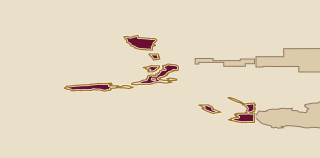
Around Adelaide, Barossa and Clare lie to the north, the Adelaide Hills rise to the east and south-east, and McLaren Vale sits to the south beside Gulf St Vincent. Coonawarra lies much farther south-east, on the Limestone Coast. Vineyards range from warm valley floors to cooler hills and sites influenced by the sea.
Wine regions around Adelaide and the Limestone Coast
Shiraz, Riesling and Cabernet Sauvignon are among the grapes to look for across South Australia’s different growing areas.
The state contains several different growing environments
Four regional examples
The names below refer to regions within South Australia. Each grows more than the example grape shown.
Barossa Valley
North-east of Adelaide
Warm valley vineyards and cooler surrounding hills; Shiraz is a prominent red grape.
Look forShiraz · Grenache
Adelaide Hills
Elevated country east and south-east of Adelaide
Cooler conditions suit Chardonnay and Pinot Noir, with Shiraz among the region’s other wines.
Look forStill or sparkling · Chardonnay · Shiraz
Clare Valley
North of Adelaide
Warm summer days are tempered by cooling breezes. Dry Riesling is one of the region’s established styles.
Look forDry Riesling
Coonawarra
The Limestone Coast
The sea influences this cooler region, associated with Cabernet Sauvignon and reddish terra rossa soils.
Look forCabernet Sauvignon
Read origin and grape before comparing cellar choices
Reading an Australian bottle
Find the origin and grape, then check the harvest year and how the wine was made.
Find the complete place name
South Australia is broad. Barossa Valley and Eden Valley identify separate regions within the Barossa zone.
Read the grape variety
A region can grow several grapes. A Barossa Valley Shiraz and Grenache are different starting points.
Check the style and harvest
Look for still or sparkling, any sweetness description and the vintage, or harvest year.
Compare the making
The producer’s notes can explain barrels, blending and other decisions that the origin name cannot.
The place and grape answer different questions
Australian label names
These label terms identify a place, grape or harvest year.
South AustraliaPlaceHide explanationRead explanation
A broad Australian wine origin covering the state.
It may encompass grapes from several regions.
BarossaBarossa ValleyEden ValleyPlace hierarchySeparate label excerptsHide explanationRead explanation
Barossa is a zone; Barossa Valley and Eden Valley are its two regions.
Keep the complete name when comparing bottles.
SyrahShirazGrapeSeparate label excerptsHide explanationRead explanation
Two names for the same grape variety.
The spelling alone does not guarantee a particular style.
RieslingGrapeHide explanationRead explanation
A white grape associated with Clare Valley and Eden Valley, among other places.
Check the sweetness description separately.
CoonawarraPlaceHide explanationRead explanation
A defined wine region within the Limestone Coast zone.
Cabernet Sauvignon is a useful introduction.
HarvestVintage · Year position shown emptyHide explanationRead explanation
The harvest year shown for the wine.
Compare it with the producer’s notes for that harvest.
Barossa includes two distinct wine regions
Grapes and styles
Barossa is a wine zone containing Barossa Valley and Eden Valley. The names overlap in everyday conversation, but they are not interchangeable on a label. Barossa Valley has warm vineyards on the valley floor and cooler sites in its surrounding hills. Shiraz is prominent, with Grenache and Cabernet Sauvignon also important. The Shiraz often has ripe fruit and substantial body, the weight of the wine in your mouth, although individual producers take different approaches.
Eden Valley lies to the east and is generally cooler during the growing season. Riesling is an important white grape there, while Shiraz remains part of the region too. A bottle labelled Barossa may draw on a wider origin than one labelled Barossa Valley.
McLaren Vale gives you another setting for Shiraz, between the Mount Lofty Ranges and Gulf St Vincent. Proximity to the sea helps moderate temperatures, with differences between sites. Grenache is also worth exploring here. Try its Shiraz alongside a Barossa Valley wine, or explore Grenache from both regions.
Adelaide Hills, Clare Valley and Coonawarra
Everyday bottles
The Adelaide Hills owe much of their cooler climate to elevation. Valleys, slopes and their exposure create considerable variation, so Chardonnay, Pinot Noir, Sauvignon Blanc and Shiraz can all have a place. Some Chardonnay and Pinot Noir goes into sparkling wine.
Farther north, Clare Valley combines warm summer days with cooling breezes. Dry Riesling from Clare often has citrus flavours and firm acidity, the freshness that makes your mouth water. Shiraz and Cabernet Sauvignon also grow here. Riesling’s fragrant fruit does not by itself mean the wine is sweet.
Coonawarra offers another climate and landscape on the Limestone Coast. Cabernet Sauvignon is central to its reputation. Its well-known terra rossa is reddish soil over limestone; other soils occur in the region as well. Terra rossa describes the ground beneath the vines; it does not establish how a particular bottle will taste.
Place names on Australian labels
Read the label
A geographical indication, usually shortened to GI, defines a wine-growing origin. Australia’s system includes broad names, zones, regions and some subregions. A label need not show every level.
South Australia is a broad origin; Clare Valley or Coonawarra names a more specific area. The broader wording allows grapes from several regions, although it does not prove that a particular bottle blends them. Read the grape variety alongside the origin, and look in the producer’s notes for vineyard and winemaking details.
A first Shiraz or Riesling
First bottle
Barossa Valley Shiraz is a good choice if you enjoy a full-bodied red with ripe fruit. For a dry white with citrus flavours and firm acidity, look for Riesling from Clare Valley or Eden Valley. Coonawarra is a place to try Cabernet Sauvignon.
If you want to compare wines, try a Barossa Valley Shiraz beside one from the cooler Adelaide Hills, or a Clare Valley Riesling beside one from Eden Valley. Choose a similar harvest year and check the alcohol and oak information. Producer choices vary within each region, so the wines may differ from the regional descriptions.
5 named areas
Inside the region
Explore the wine-growing areas of South Australia.
- 01Adelaide Hills7 producersHigh, cool and wet by Australian standards, Adelaide Hills has varied altitudes and aspects. Its Sauvignon Blanc often shows grapefruit and tropical notes, with crisp acidity.
- 02Barossa Valley13 producersWarm, dry Barossa Valley in South Australia is known for full-bodied Shiraz and old vineyards, some dating to the nineteenth century. Cooler Eden Valley rises beside it within the wider Barossa zone.
- 03Clare Valley1 producerClare Valley Riesling is restrained when young, with lime and mineral notes, and can develop over decades. Its Shiraz is fuller, with ripe blackberry, spice and mint.
- 04Coonawarra2 producersCoonawarra's narrow strip of terra rossa over limestone is closely associated with Cabernet Sauvignon. The wines are medium to full-bodied, with cassis and dark fruit, firm plush tannins, and ageing potential.
- 05McLaren Vale10 producersMcLaren Vale's maritime Mediterranean setting and varied soils give Shiraz and Grenache room to vary. Its Shiraz often combines fruit with spice and, sometimes, an earthy note.
Producer profiles
Producer profiles
Every producer profiled in South Australia so far.
- Amadio Vineyard KersbrookThird-generation Italian-Australian Cabernet estate at Kersbrook in the Adelaide Hills; their Sebastien's Reserve 2021 took the Trophy for Best Cabernet Sauvignon at AWC Vienna, beating entries from more than 40 countries.
- Bird in HandAdelaide Hills estate producing four-tier Shiraz and Chardonnay from a 29-hectare Woodside vineyard, led by Master of Wine Kym Milne.
- Byrne VineyardsThree-generation South Australian family estate farming Clare Valley and Riverland, best known for barrel-fermented White Hut Shiraz.
- Cirillo Estate WinesLight Pass family estate built around ancestor vine Grenache and Semillon, with single vineyard Shiraz, Mataro and Rosato.
- d'ArenbergFourth-generation family winery in McLaren Vale, South Australia, farming Shiraz, Cabernet Sauvignon, and white Rhône varieties through pre-industrial cellar methods: foot-treading, basket pressing, and concrete open fermenters built in 1927.
- Dandelion VineyardsSouth Australian producer drawing old-vine Shiraz from the Barossa Valley, McLaren Vale, and Eden Valley, built on a founding philosophy of acidity and tannin over ripeness and alcohol weight.
Browse 27 more
- First Drop WinesNuriootpa producer of Barossa Shiraz, Adelaide Hills Chardonnay, and Spanish, Portuguese, and Italian variety wines.
- Gemtree VineyardsCertified biodynamic McLaren Vale estate farming 93 hectares of Shiraz, with two distinct cuvees and a bulk-supply arm that dwarfs its own-label production.
- Glaetzer WinesBoutique Barossa Valley estate producing concentrated Shiraz reds under Ben Glaetzer.
- HardysThomas Hardy's South Australian wine brand, now within Vinarchy, with red, white and rosé wines including HRB Chardonnay.
- Heirloom VineyardsAdelaide Hills producer conceived in 2000, making minimal intervention Chardonnay near Balhannah and Pinot Noir called The Velvet Fog.
- Jim Barry WinesClare Valley's largest family-owned estate, producing single-vineyard Shiraz from ancient sandstone at Armagh and benchmark Riesling from calcareous siltstone at Florita.
- Kingston Estate WinesRiverland-based South Australian producer farming 3,100 hectares, making over a million cases a year with a premium small-batch track alongside commercial volume.
- Langmeil WineryLangmeil Winery in Tanunda, Barossa Valley, is home to the Freedom Vineyard: Shiraz vines planted in 1843 by Prussian settler Christian Auricht and still producing today.
- Longview VineyardsMacclesfield estate pairing Adelaide Hills fruit with Northern Italian grape varieties.
- Ministry of CloudsFood-minded South Australian wines built around McLaren Vale Grenache, Mataro, Shiraz and Tempranillo, with estate fruit from Seaview and older regional vineyard sources.
- Overland VineyardsSouth Australian producer behind Camden Park, with a 2024 Shiraz Grenache red in an accessible, generous Australian style.
- Paracombe Premium WinesOn an ancient plateau in the Adelaide Hills, Paracombe turns hand-pruned estate and local-grower fruit into fresh Sauvignon Blanc, structured Cabernet and oak-spiced Shiraz.
- Paxton VineyardsMcLaren Vale family producer with six vineyards, Shiraz led wines, and organic and biodynamic certification.
- PenfoldsAustralian producer founded at Magill Estate in 1844, known for Shiraz shaped through regional blending, seasoned vats and French oak.
- Penley EstateCoonawarra Cabernet Sauvignon from a family estate that has made its own wines since 1988.
- Penny's Hill EstateMcLaren Vale Grenache and Shiraz rooted in old vines, named vineyard ground and an 1855 homestead.
- S.C. PannellA South Australian producer matching Nebbiolo, Aglianico, Grenache and Shiraz to four named vineyards.
- Schild Estate WinesSouthern Barossa wines shaped by family-grown fruit, from stainless-steel Chardonnay to full-bodied Shiraz.
- SeppeltsfieldA Barossa estate where Shiraz, Grenache and Cabernet share the address with flor-aged Apera and Tawny stocks held across generations.
- Sigurd WinesSouth Australian wines shaped by cross-region sourcing, earlier-picked fruit and a cellar that moves between stainless steel, old oak and large foudres.
- Spinifex WinesBarossa and Eden Valley wines shaped by old vines, southern-French varieties and contrasting vineyard sites.
- Thistledown WinesOld-vine South Australian Grenache from McLaren Vale and Eden Valley, sourced with MW-level care and a consistent preference for texture over warmth.
- Thorn-Clarke WinesFamily estate in the Barossa Valley and Eden Valley, farming four named vineyards across both subregions since 1987, with old Shiraz vines thought to date to around 1854 still in production.
- VinarchyGlobal wine company with Hardys, Campo Viejo and Jacob's Creek, spanning regional production across seven countries.
- Wirra Wirra VineyardsMcLaren Vale estate rebuilt from two walls in 1969, farming biodynamically and sourcing cool-climate Chardonnay from Adelaide Hills.
- Wynns Coonawarra EstateCoonawarra Cabernet Sauvignon shaped by cool-climate ripening, terra rossa soils and parcel-by-parcel cellar work.
- Yangarra Estate VineyardA single-vineyard McLaren Vale estate centred on old-vine Grenache, named blocks and ceramic-egg winemaking.