Who makes it
Colin Glaetzer had already made some of the Barossa Valley's most recognised Shiraz labels before he put his own name on a bottle. Trained at Roseworthy College in agriculture and then oenology, he arrived in the Barossa in 1985 to run Barossa Valley Estate, where he created the E and E Black Pepper Shiraz and the Ebenezer range, wines that went on to define a certain style of full-weight, spice-driven South Australian red. The community later named him Baron of the Barossa, a title awarded for winemaking skill and contribution to the valley's cultural traditions.
Colin founded Glaetzer Wines with his wife Judith and their three sons. The first vintage followed in 1996. His son Ben now makes the wines, and the ambition set from the beginning has held: boutique quantities, Barossa Valley Shiraz at the centre, and a house style aimed at concentration and depth without sacrificing what the estate calls elegance and balance.
Where it grows
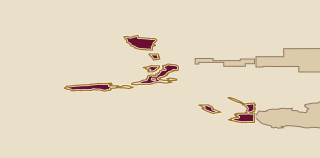
Glaetzer Wines draws its fruit from Ebenezer, a sub-district of the Barossa Valley appellation in South Australia. The Barossa Valley sits roughly sixty kilometres north-east of Adelaide in a warm, low-rainfall basin. Its heat accumulation through the growing season pushes Shiraz toward deep colour, full body, and ripe, fleshy fruit with natural tannin weight. The Barossa Valley appellation appears on all Glaetzer labels, anchoring the wines legally and stylistically to one of Australia's most clearly identified red-wine regions.
Ebenezer lies in the northern end of the valley floor, an area associated with old-vine Shiraz and Grenache. Old vines here concentrate their fruit naturally, reducing yield and amplifying flavour density. The label choices follow: every wine in the range declares the Barossa Valley, and the bottles are built around the weight and warmth the place reliably delivers.
How it is made
The cellar
Fruit comes from Barossa Valley vineyards, with Ebenezer as a source for the listed wines. Old vines supply the listed labels; their naturally low yields mean intense, concentrated fruit arrives at the cellar without needing corrective intervention to build density. The house style is achieved in the vineyard first.
In the cellar, Ben Glaetzer works toward wines with full palate weight and layered aromatic complexity. Cedar and vanilla notes in the Amon Ra point to oak contact, though specific ageing durations are not established and the character reads as integrated support rather than dominant flavour. The Anaperenna blend uses Cabernet Sauvignon to sharpen the Shiraz base: Cabernet brings firmer tannin and a darker, more angular mid-palate to complement the softness and body of the Barossa Shiraz. The Wallace blend works in the opposite direction, adding Grenache to Shiraz for lift and juiciness.
What they make
The range has four main labels organised by grape composition and concentration level.
Wallace is the most approachable bottle: a Barossa Valley Shiraz and Grenache blend in which the Shiraz provides backbone, flesh and body while the Grenache contributes soft, vibrant fruit and a lighter, juicier mid-palate. It carries less density than the upper labels and makes the house style accessible without the full weight of the single-variety Shiraz.
Wines to try
First bottle
Start with Amon Ra Shiraz. It is a single-variety Barossa Valley Shiraz from old-vine Ebenezer fruit, the wine Ben Glaetzer builds the entire house around. On the nose it opens with blackberry and warm spice, backed by cedar and vanilla from oak contact. The palate has real weight, the kind that comes from concentrated old-vine fruit rather than extraction, and the tannins are ripe and even rather than dry or angular. It is not a delicate wine, but it is not blunt either: there is layered depth in the mid-palate and the finish stays with you.