
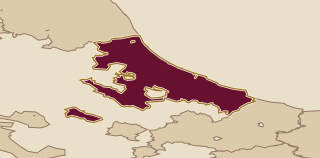
Barely fifty kilometres separate the Gran Sasso massif from the Adriatic beaches, and vineyards climb the hills in between. Higher sites have cooler air; coastal sites are warmer. Much of the region is protected parkland. The local food includes arrosticini, small skewers of grilled lamb, and sheep's cheeses.
Montepulciano, Trebbiano and Pecorino
Grapes and styles
Montepulciano accounts for more than half the region's plantings. It makes generous reds with plum and black-pepper flavours and a firm texture that suits grilled meat. The grape has no connection with the Tuscan town of Montepulciano. Cerasuolo d'Abruzzo is a dry rosé with a deep cherry colour and enough body to serve with a meal.
Trebbiano d'Abruzzo ranges from simple young whites to wines that can age for years. Pecorino is another local white grape; its wines can have herbal flavours and a salty impression.
Young wines and bottles to age
Everyday bottles
Abruzzo makes reds for drinking young alongside wines intended for longer ageing. Trebbiano d'Abruzzo varies too: some bottles are ready to open on release, while others can develop for years. The producer's description and drinking advice will help you choose between them.
DOC and DOCG names identify different growing areas
Read the label
Montepulciano d'Abruzzo, Trebbiano d'Abruzzo and Cerasuolo d'Abruzzo are DOC names covering wider parts of the region. DOC and DOCG are Italian designations defining a wine's origin and production rules. Colline Teramane Montepulciano d'Abruzzo DOCG identifies the northern hills around Teramo. Abruzzo also has the Terre Tollesi or Tullum and Casauria DOCGs. Read the full denomination alongside the producer's name to see which origin the bottle carries.
Choosing a red, white or rosé
First bottle
Try Cerasuolo d'Abruzzo for a dry rosé or a young Montepulciano d'Abruzzo for a red with plenty of fruit. For white wine, look for Trebbiano d'Abruzzo or Pecorino. If you want a bottle to keep, check the grower's drinking advice for its Colline Teramane red or old-vine Trebbiano.
3 named areas
Inside the region
Explore the wine-growing areas of Abruzzo.
- 01Abruzzo — Region-wide9 producersAcross Abruzzo, wines include dark Montepulciano reds, Cerasuolo rosato and whites from Pecorino and Trebbiano. Higher inland sites tend to give fresher wines, while warmer coastal sites bring fuller, mellower fruit.
- 02Colline Teramane (Teramo province)4 producersColline Teramane lies in the Teramo hills between the Gran Sasso and the Adriatic. Its Montepulciano wines follow DOCG rules requiring lower yields and longer ageing than the wider regional appellation.
- 03Costa Teatina & Chieti hillsNo producers listed yetThe Chieti hills and coast grow Trebbiano, Montepulciano d'Abruzzo, Merlot, Passerina and Pecorino. Both the sea and nearby mountains influence the vineyards in this part of Abruzzo.
Producer profiles
Producer profiles
Every producer profiled in Abruzzo so far.
- Antica Cantina PietramoreAntica Cantina Pietramore cultivates more than 70 hectares biodynamically, producing wines from Trebbiano, Montepulciano, Pecorino, Passerina and Cerasuolo.
- Azienda Agricola Chiusa Grande di Franco d'EusanioFamily estate in Nocciano, Abruzzo, founded by agronomist Franco D'Eusanio in 1991.
- Azienda Agricola CiavolichAbruzzese estate founded in 1853, now led by Chiara Ciavolich; native varieties, amphora-aged whites, and Montepulciano grown near a natural lake in Pianella.
- Azienda Agricola CirelliAbruzzo mixed farm near Atri, with biodynamic certification and Montepulciano and Trebbiano made by spontaneous fermentation.
- Azienda MarramieroFamily estate in Rosciano, Pescara, making Montepulciano d'Abruzzo DOC and Trebbiano d'Abruzzo from native Abruzzo grapes on a 270-metre hillside with more than a century of family vine cultivation behind it.
- Cantina ZaccagniniBolognano winery founded by Marcello Zaccagnini, making Tralcetto Pecorino and Montepulciano d’Abruzzo with a vine twig on each bottle neck.
Browse 7 more
- Chiusa GrandeOrganic Abruzzo estate farming three sites from Nocciano to 880-metre Capestrano, led by Franco D'Eusanio and family since 1991.
- Ciavolich Azienda AgricolaA family estate at Loreto Aprutino in the province of Pescara, Abruzzo, farming Montepulciano, Trebbiano, Cococciola, and Pecorino across fifty hectares split between two properties, with a winery history going back to 1853.
- Fattoria Giuseppe SaviniFourth-generation family estate in the Marche with 600 hectares of mixed farmland, producing Shedar Frizzante, a coast-influenced sparkling blend of Chardonnay and Pecorino.
- Fattoria La ValentinaAbruzzese family estate in Spoltore, Pescara province, farming only indigenous varieties under ICEA organic certification and building its range entirely around Montepulciano d'Abruzzo.
- Soc Coop Ag Olearia Vinicola OrsognaLarge Abruzzese cooperative with 300 member-growers farming 1,500 hectares entirely under organic certification, half under Demeter biodynamic, between the Maiella massif and the Adriatic.
- Tenuta AntoniniA four-generation family estate in Ancarano, Teramo, farming 30 hectares inside the Colline Teramane DOCG zone with Montepulciano d'Abruzzo and Pecorino.
- Valle RealeFamily estate near Popoli in Abruzzo farming five named mountain vineyards with Montepulciano and Trebbiano under spontaneous fermentation since 2007.