
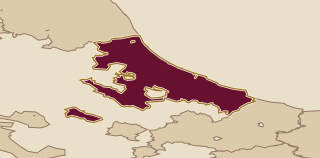
At A Glance
- **Estate:** Masseria Sant'Andrea
- **Village:** Rosciano, province of Pescara
- **Region:** Abruzzo, central Italy
- **Elevation:** 270 metres
- **Founders:** Dante and Enrico Marramiero
- **Core grapes:** Montepulciano, Trebbiano d'Abruzzo
- **Key appellation:** Montepulciano d'Abruzzo DOC
The Producer
The Marramiero family has been growing vines on the same Pescara hillside for more than a century. For most of that time the grapes left the estate in bulk. Dante Marramiero changed that. He built a commercial winery at Masseria Sant'Andrea, the hilltop farm that sits at 270 metres above the Abruzzo plain, and directed it toward estate-bottled wine. His son Enrico carried the project forward, adding a modern cellar and raising the ambition of what a family winery in Rosciano could produce.
The signature bottle is Montepulciano d'Abruzzo DOC: a red wine from the native Montepulciano grape, oak-aged, tannic, and built around the characteristic acidity the variety carries from this part of central Italy. Trebbiano d'Abruzzo, the native white grape of the region, anchors the white side of the range. Both varieties have grown on this land across the full span of the family's vine-growing history.
Place
Rosciano sits in the province of Pescara, roughly between the Gran Sasso massif to the north and west and the Adriatic coast to the east. At 270 metres, the Masseria Sant'Andrea hillside catches enough altitude to slow ripening compared to the low coastal strip. That delay matters for Montepulciano: the grape has high natural acidity, and cooler nights on elevated ground preserve that acidity through to harvest rather than burning it off in late summer heat.
The Pescara hills belong to the broader Abruzzo DOC geography. Montepulciano d'Abruzzo DOC covers the Montepulciano grape grown across the region; the label names both grape and origin, though the Montepulciano grape has no connection to the Tuscan town of the same name. It is an Abruzzo native, and Rosciano has been one of its natural addresses for generations.
Soil And Site
The Masseria Sant'Andrea occupies a hilltop position in the Pescara province. The confirmed elevation is 270 metres. Specific soil composition at this address is not documented in verified sources; the hillside character and the altitude-driven ripening profile are the physical facts available from the sourced record.
Story
The Marramiero family grew grapes in Rosciano long before they bottled wine under their own name. For over a century the vines were tended as a farming enterprise rather than a winemaking one. Dante Marramiero made the decisive break: he moved from supplying grapes to building an estate, establishing the infrastructure to vinify and bottle at Masseria Sant'Andrea. Enrico Marramiero continued that work, extending both the cellar and the range.
The philosophy that emerged from that transition is unusually direct about its own logic. The estate commits to using modern tools while keeping the environment intact, treating technology not as a contradiction of tradition but as its continuation by other means. That thinking shaped the cellar choices that followed, including the adoption of optical sorting equipment that most small family estates do not use.
Vineyards And Cellar
Montepulciano and Trebbiano d'Abruzzo are the two native Abruzzo grapes at the centre of the estate's range.
In the cellar, Marramiero uses an XTRI optical berry sorter, a machine that passes individual grapes under fluorescence and infrared light to identify and discard any impurity before fermentation begins. The sorting happens grape by grape, not cluster by cluster. The practical consequence is that what enters the fermentation vessel is cleaner fruit: fewer broken skins, no leaves or under-ripe berries that would otherwise add bitter or herbaceous notes to the wine. For a tannic grape like Montepulciano, where the difference between coarse and well-integrated tannin often comes down to the quality of the raw material, that level of selection at intake matters.
Montepulciano d'Abruzzo is aged in oak. The barrel ageing adds depth and rounds the grape's firm tannin without erasing the wine's characteristic acidity.
Wines
The core of the range is built on two DOC designations: Montepulciano d'Abruzzo DOC for the red wines and Trebbiano d'Abruzzo DOC for the whites. Both appellations link grape to region directly on the label, so the bottle name itself identifies what is in the glass and where it comes from.
Montepulciano d'Abruzzo is the main red wine: spiced cherry and plum on the nose, a palate where firm tannin and the grape's natural acidity hold together rather than pulling against each other, and oak-derived depth from barrel ageing. The wine has enough grip to stand beside food but enough fruit and acid to keep it from feeling locked.
The Trebbiano d'Abruzzo white offers a different register: the Trebbiano grape in Abruzzo tends to produce wines with body and weight rather than the lean, neutral style associated with Trebbiano plantings elsewhere in Italy, particularly when the vines are old and yields are low.
In The Glass
Montepulciano d'Abruzzo from Marramiero opens with spiced cherry and dark plum, the aromatics the grape carries naturally from Abruzzo's warm growing season. On the palate the tannin is firm but not rough: it falls into alignment with the wine's acidity rather than dominating it, giving the wine a structured feel that holds its shape through the mid-palate. Oak ageing adds a layer of depth without turning the wine sweet or obscuring the grape's character. The finish is long enough to leave the fruit and a trace of spice behind.
The Trebbiano d'Abruzzo presents differently: fuller in body than the name might suggest to drinkers who know the grape only from its lighter expressions elsewhere in Italy, with a texture that comes from the vine's age and the hillside position.
A Bottle To Understand It
Start with the Montepulciano d'Abruzzo DOC. It is the bottle where the estate's full logic is visible: native Abruzzo grape, elevated vineyard position, optical berry sorting for clean fruit intake, and oak ageing that adds depth without changing the wine's character. In the glass it delivers spiced cherry and plum, firm tannin sitting alongside the grape's natural acidity rather than overwhelming it, and a finish with enough length to confirm that this is a wine built for the table. The Montepulciano grape is Abruzzo's most important red variety, and this bottle is an honest account of what it produces at 270 metres on the Pescara hills.
Anecdote
The machine works grape by grape, passing each berry under fluorescence and infrared light. Anything that does not meet the threshold, a broken skin, an under-ripe berry, a fragment of leaf, falls out before fermentation begins. For the family that had spent over a century growing Montepulciano on this hillside and selling the grapes to others, the machine represented the inverse logic: keep the fruit, control what enters the cellar, own the outcome. The sorter sits in a cellar built by the same family that once had no cellar to speak of. The century of vine-growing stayed; what changed was what happened to the grapes afterward.
Final Word
Marramiero is an Abruzzese family estate that made the transition from grape-growing to wine production without abandoning the native varieties that defined the hillside. The Montepulciano d'Abruzzo is the bottle that carries that history forward: tannic, structured, and honest about where it comes from.