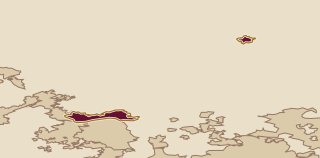
The Rhine normally travels north, but near Wiesbaden it turns west for roughly 30 kilometres before bending north again at Rüdesheim. That turn gives much of Rheingau a long bank of south-facing vineyard slopes. The Taunus hills rise behind them and provide shelter from cold winds. Most vineyards begin above the riverside towns and climb towards the forest.
Dry, off-dry and sweet Riesling
Grapes and styles
Dry Rheingau Riesling often combines firm, mouth-watering acidity with citrus and stone-fruit flavours. Some vineyard wines become more open in fruit and texture with time in bottle. Off-dry wines retain a little sweetness; at the intensely sweet end, Beerenauslese and Trockenbeerenauslese depend on rare harvest conditions.
The region has a long association with late harvesting. At Schloss Johannisberg in 1775, permission to begin harvest arrived after a delay. The ripe grapes were picked, and the resulting wine became part of the estate's account of how Spätlese developed. The modern term has legal requirements based on grape ripeness and production rules, but it does not guarantee that the wine is sweet. A Rheingau Spätlese trocken is dry.
Rüdesheim, Assmannshausen and Lorch
Background
From Hochheim and the vineyards near Wiesbaden, the region continues through Eltville, Hattenheim, Oestrich, Winkel and Johannisberg towards Rüdesheim. The central slopes have varied soils, including loess, the fine material deposited by wind, as well as clay, sand, gravel and limestone.
Near Rüdesheim, the river turns north and the valley narrows. Quartzite and slate become more visible as the vineyards rise towards Assmannshausen and Lorch. Assmannshausen is best known for Spätburgunder. Its steep sites sit behind the village on the Rhine's northward course. Pinot Noir also grows elsewhere in the region, although Riesling is much more widely planted. Around Lorch, Riesling grows on steep, stony sites close to the boundary with Mittelrhein.
Regional Riesling and Spätburgunder
Everyday bottles
Regional Rheingau Riesling trocken is a dry wine from the wider region. Village wines locate the grapes more closely and often cost less than single-vineyard wines. Kabinett and Spätlese with residual sugar, the sugar left after fermentation, can combine moderate alcohol with enough acidity to feel fresh.
Spätburgunder is less common and often more expensive, particularly from Assmannshausen. A regional bottling is another option for trying it. Rosé and Sekt, German sparkling wine, are also made here.
Read sweetness and origin separately
Read the label
Rheingau identifies the official growing region. A village name such as Rüdesheim, Johannisberg, Kiedrich, Erbach or Lorch may be followed by an individual vineyard. Trocken means dry. Feinherb often suggests some sweetness, but has no fixed legal definition. Kabinett, Spätlese and Auslese are Prädikat categories based on grape ripeness and production rules; check the sweetness description separately.
GG may appear on dry wines from top classified sites made by members of a growers' association. Read it alongside the full origin, grape, sweetness wording and vintage, the harvest year.
Riesling or Spätburgunder
First bottle
For a dry white, choose Rheingau Riesling trocken. For some sweetness, look for a Kabinett or Spätlese and check the producer's description. If you want red wine, try a regional Rheingau Spätburgunder or one from Assmannshausen.
An eastern Rheingau Riesling beside one from the steeper western sites around Rüdesheim or Lorch can introduce the region's different growing areas. Choose similar sweetness levels and bear in mind that producer and winemaking choices also affect the wines.
1 named area
Inside the region
Explore the wine-growing areas of Rheingau.
Producer profiles
Start with these
Meet 5 producers from across Rheingau.
- Schloss JohannisbergA Rheingau estate on the Johannisberg slopes, defined by centuries of Riesling cultivation and the 1775 harvest linked to Spätlese.
- Kloster EberbachKloster Eberbach spans the Rheingau and Hessische Bergstrasse, making Riesling and Pinot Noir through sustainable, gentle production.
- Weingut Georg BreuerA Riesling-led Rheingau estate in Rüdesheim, where Theresa Breuer turns steep, named vineyards into dry wines ranging from brisk Sauvage to Berg Schlossberg and Nonnenberg.
- Weingut Robert WeilA Kiedrich, Rheingau estate devoted entirely to Riesling, from dry village wine to sweet Kabinett.
- Weingut Eva FrickeEva Fricke farms contrasting Rheingau sites for dry Riesling, from regional blends to village and single-vineyard wines, with old Lorch parcels bringing slate and quartzite into the range.
Browse 12 more
- Bischöfliches WeingutRheingau estate in Rüdesheim am Rhein farming Berg steep slopes and Assmannshausen for Riesling and Pinot Noir in cellars from 1683.
- HenkellGermany's first industrial Sekt house, producing sparkling wine in Mainz since 1856 and filling three million bottles a year by 1906.
- Weingut August EserA family-run Rheingau estate in Oestrich, August Eser makes Riesling from 17 named sites across eight villages, alongside a small oak-aged Spätburgunder range.
- Weingut August KesselerA Rheingau estate in Assmannshausen, pairing slate-grown Pinot Noir with dry Riesling from classified vineyards across the region.
- Weingut Balthasar Ress KGA Hattenheim estate founded in 1870, making Riesling-led Rheingau wines from dry estate bottlings to site-named Kabinett.
- Weingut Bernhard MehrleinA third-generation Oestrich-Winkel estate with more than 60 hectares, built around dry and off-dry Riesling.
- Weingut Familie AllendorfA Rheingau family estate whose dry Riesling range moves from estate wine to Winkel and Hasensprung, with structured Pinot Noir alongside.
- Weingut JohannishofTenth-generation Eser family estate in Johannisberg, where 99% Riesling plantings feed a Rheingau range from dry estate wines to Kabinett, Spätlese, Charta, Erstes Gewächs and noble-sweet bottles.
- Weingut LeitzRüdesheim Riesling from steep Rheingau slopes, where named vineyards and long lees ageing shape dry wines with acidity, texture and grip.
- Weingut Peter Jakob KühnA long-established Oestrich-Winkel estate making Rheingau Riesling from estate fruit to named sites, with native fermentation, gentle pressing and patient cellar ageing.
- Weingut Prinz von HessenA Johannisberg, Rheingau estate founded in 1957, where Riesling makes up 92% of plantings and named vineyard sites shape a dry, white-wine-led range.
- Weingut SolveigsA two-hectare organic Rheingau estate making only Spätburgunder, or Pinot Noir, from steep red-slate sites around Assmannshausen and Lorch.