NoleaWorld of Wine

Rheingau · Germany

Producer profile

Kloster Eberbach

Kloster Eberbach spans the Rheingau and Hessische Bergstrasse, making Riesling and Pinot Noir through sustainable, gentle production.

Place
Rheingau · Germany
Known for
Riesling and Höllenberg reds
Wine context
Pinot Noir · Riesling
Editorial basis
World of Wine editorial profile · 7 sources

World of Wine editorial profile · Source list ↓

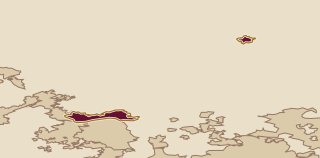
Atlas locationRheingau · Germany50.04° N · 8.05° E

At A Glance

Field
Detail
Domains
Rheingau and Hessische Bergstrasse
Main grapes
Riesling, Pinot Noir and Frühburgunder
Dry white
Rauenthaler Baiken Riesling trocken VDP.ERSTE LAGE®
Red wines
Pinot Noir Trocken, Auktion Réserve Pinot Noir and Höllenberg Frühburgunder
Defining practice
Sustainable and gentle production

The Producer

Kloster Eberbach is a wine estate with domains in the Rheingau and Hessische Bergstrasse. Its name reaches back to a monastery founded in 1136, while the present operation covers approximately 200 hectares of vineyards. Riesling and Pinot Noir form the clearest threads through the range, alongside Frühburgunder from Höllenberg.

Christine Müller manages the estate, Bruno Nagele makes the wines and Kathrin Puff works as oenologist. The range moves from Riesling Kabinett and Spätlese to dry named site wines, Pinot Noir and auction selections.

Place

Kloster Eberbach has domains in both the Rheingau and Hessische Bergstrasse. The two regional holdings give the estate a wider geographic range than a producer tied to one district, while the bottle names narrow the focus to places such as Rauenthaler Baiken and Höllenberg.

Rauenthaler Baiken appears as a dry Riesling classified VDP.ERSTE LAGE. Höllenberg appears in both Pinot Noir and Frühburgunder wines, giving the red range a named site alongside the broader Pinot Noir bottling.

Story

The monastery was founded in 1136. After the Second World War, the estate became property of the federal state of Hesse. A new cellar outside Steinberg was inaugurated in 2008, adding a modern production facility to the estate's long history.

The current team gives the operation defined roles. Christine Müller manages, Bruno Nagele makes the wines and Kathrin Puff serves as oenologist. Their work covers still wines and sparkling wines produced sustainably and gently.

Vineyards And Cellar

Wine and sparkling wine are produced sustainably and gently. Riesling is matured almost exclusively in stainless steel tanks, keeping the grape's acidity and fruit profile in a vessel associated with clean, controlled ageing.

The 2024 Rauenthaler Baiken Riesling received equal parts Stückfass and stainless steel tank maturation. The combination joins the broader texture of a large wooden cask with the directness of steel. Pinot Noir Trocken underwent traditional vinification in steel tank followed by bottle ageing.

Wines

The white range includes Riesling Kabinett, Riesling Spätlese and the dry Rauenthaler Baiken Riesling trocken VDP.ERSTE LAGE. These bottles move from named German Riesling categories to a dry classified site wine.

The red range includes Pinot Noir Trocken, Auktion Réserve Pinot Noir and the Höllenberg Frühburgunder. Pinot Noir provides the broad red address, while Höllenberg names the site on the more specialised bottles.

In The Glass

Baiken shows vineyard peach, Granny Smith apple and elderflower, followed by cool petrichor like minerality, a balanced palate, integrated acidity and a persistent finish. Equal parts Stückfass and stainless steel give the wine both cask shaped breadth and a clear finish.

Pinot Noir Trocken brings raspberry, strawberry, cherry and a hint of black pepper. Its palate is juicy and fruit driven, with concentration and fresh acidity. Auktion Réserve Pinot Noir combines ripe cherry and blackberry with tannin and refreshing acidity. Höllenberg Frühburgunder is delicately fruity, full bodied and long finishing.

A Bottle To Understand It

Riesling Kabinett is the bottle to open first. Gentle pressing and careful preclarification lead into fermentation in temperature controlled stainless steel tanks. In the glass, juicy sweetness meets crisp acidity in a slim, light bodied palate, with lemon, lime, grapefruit, peach, mirabelle, apricot, slate and salty stone. The bottle places the estate's core grape beside the dry Baiken and Riesling Spätlese wines.

Anecdote

In 2021, Kloster Eberbach offered the Höllenberg Frühburgunder exclusively through its auction. The wine was delicately fruity, full bodied and long finishing, with harmony and complexity across the palate.

Final Word

Kloster Eberbach brings together two German wine regions, a Riesling range that includes Kabinett, Spätlese and dry Baiken, and Höllenberg reds in Pinot Noir and Frühburgunder.

Sources

Keep following the thread

Where to go next

placeRead the Rheingau guideSee Kloster Eberbach in the wider setting of Rheingau.mapFind Kloster Eberbach on the mapKeep the producer, its region and nearby places together.learningUnderstand RieslingRead the quick library guide to Riesling, which is listed with this producer.