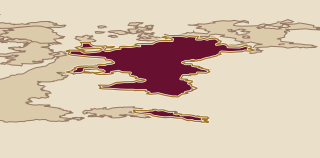
Württemberg had 10,694 hectares under vine in 2025, making it Germany's fourth-largest winegrowing region. Vineyards extend along the Neckar and through the sheltered valleys of the Rems, Enz, Kocher, Jagst and Tauber, reaching Lake Constance. Württembergisches Unterland lies on the middle Neckar, with Remstal-Stuttgart to the south. Many of the region's 210 listed single vineyards are steep and divided into small plots. Red grapes cover about 65 percent of plantings. Trollinger and Lemberger, the local name for Blaufränkisch, are widely grown. Spätburgunder, or Pinot Noir, and Schwarzriesling are also important. Riesling accounts for about half of white-wine production. A wine called Schillerwein combines red and white grapes. Keuper marl, a clay-rich sedimentary soil, is widespread. Steep slopes of Muschelkalk, or shell limestone, have narrow terraces supported by natural-stone walls. More than 50 cooperatives market about 80 percent of Württemberg wine.
1 named area
Inside the region
Explore the wine-growing areas of Württemberg.
Producer profiles
Producer profiles
Every producer profiled in Württemberg so far.
- Weingut Albrecht SchweglerFounded in the early 1990s in Korb, Weingut Albrecht Schwegler farms organically and makes Beryll 2018.
- Weingut SeegerA family-run Baden estate in Leimen near Heidelberg, founded in 1707 and centred on dry Weißburgunder and other Burgundy-family grapes.