
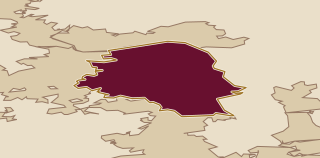
Most of Rheinhessen lies inland from the Rhine. Vineyards spread through rolling agricultural country around Alzey and across limestone-rich areas in the south. Along the river, the steep slopes around Nierstein and Nackenheim give a different setting for Riesling.
Riesling, Silvaner and the Pinot grapes
Grapes and styles
Dry Riesling commonly has firm acidity, the mouth-watering freshness in the wine, and clear fruit flavours. It is grown on the Rhine slopes and through the inland hills. Silvaner is quieter in aroma and often broader in texture, giving you a different style of white to try.
Pinot Gris, Pinot Blanc and Chardonnay supply another large group of dry whites. Müller-Thurgau is also widely grown. Dornfelder remains important among the reds, alongside Pinot Noir.
The Rhine slopes and inland vineyards
Background
On the Rhine terrace around Nackenheim and Nierstein, steep river-facing vineyards include the red-coloured soils known as Rotliegendes. Inland, limestone and loess, a fine soil deposited by wind, become more important through Wonnegau and the hill country. Wonnegau in the south includes limestone-rich areas around Westhofen and neighbouring villages. Near Bingen in the northwest, quartzite and slate appear where Rheinhessen approaches the Nahe.
A Rheinhessen Riesling may come from a warm inland slope, a limestone plateau or a steep site above the Rhine. A village or vineyard name helps locate it more closely.
Pinot whites and everyday reds
Everyday bottles
Grauburgunder is the German name for Pinot Gris, and Weissburgunder means Pinot Blanc. These wines and Chardonnay can feel rounder than Riesling. Silvaner offers quieter aromas and a broader texture.
For red wine, Dornfelder tends to be fruity. Spätburgunder, the German name for Pinot Noir, ranges from light regional wine to oak-aged bottles from individual vineyards.
Reading grape, place and sweetness terms
Read the label
Rheinhessen is the broad origin. A village such as Nierstein, Westhofen or Flörsheim-Dalsheim identifies a smaller area, and an individual vineyard is more precise again. Trocken means dry. Kabinett, Spätlese and Auslese are Prädikat terms tied to grape ripeness and production rules, not automatic sweetness levels.
GG may appear on a dry wine from a top classified site when the producer belongs to the relevant growers' association.
Choosing a Rheinhessen white or red
First bottle
Try a Rheinhessen Riesling trocken for a dry white with pronounced acidity, or Silvaner for quieter aromas and a broader texture. Tasting the two from the same producer can help you explore the difference between the grapes, although vineyard and winemaking choices also affect each wine.
For red, choose Dornfelder if you want a fruity style, or look for a regional Spätburgunder.
1 named area
Inside the region
Explore the wine-growing areas of Rheinhessen.
Producer profiles
Start with these
Meet 5 producers from across Rheinhessen.
- Weingut KellerA Flörsheim-Dalsheim family estate built around Riesling, limestone-rich sites, old-vine selection and hand-sorted fruit.
- Weingut WittmannA Westhofen family estate making dry Riesling shaped by biodynamic farming, indigenous yeasts and wooden casks.
- Battenfeld SpanierBiodynamic estate in Hohen-Sülzen, Rheinhessen, farming limestone vineyards for dry Riesling and Spätburgunder fermented exclusively with native yeasts.
- Weingut DreissigackerA Bechtheim estate in Rheinhessen’s Wonnegau, led by Jochen Dreissigacker and centred on dry Riesling shaped by manual vineyard work, gravity handling and lees ageing.
- St Antony WeingutNierstein’s Roten Hang, worked through dry Riesling, Blaufränkisch and Pinot Noir.
Browse 23 more
- Bergkloster WineryWesthofen family winery making white wines from limestone vineyards, with Cuvée Weiss shaped by skin contact, oak ageing and no filtration.
- Estate GrohBechtheim producer with limestone soils, a Chardonnay flagship and dry Grauburgunder made in steel with lees ageing.
- J.Neus Weingut seit 1881 GmbH & Co. KGA Rheinhessen estate in Ingelheim am Rhein farming fossilized shell limestone vineyards since 1881, producing dry Chardonnay and unfiltered Pinot Noir from one of the region's largest nineteenth-century vaulted cellars.
- Niklas RückrichEckelsheim’s fourth generation winegrower makes spontaneous, lees aged wines from Riesling, Silvaner, Chardonnay and Burgundy grapes.
- Weingut BeckerA Spiesheim family estate in Rheinhessen, organised from estate wines to village and named-vineyard bottles.
- Weingut BergklosterA fifth-generation Westhofen family estate where Jason Groebe makes low-intervention wines, including the dry, lightly cloudy Super Lecka red.
- Weingut Eckehart GröhlA thirteenth-generation Weinolsheim estate where Spätburgunder becomes either a wood-aged red or a pale, stainless-steel Blanc de Noir.
- Weingut FreyFourth-generation family winery in Ober-Flörsheim making mineral-driven Rheinhessen Riesling and structured Pinot Noir.
- Weingut GrohA fourth-generation family estate in Bechtheim, Rheinhessen, where Axel Groh makes a broad varietal range shaped by early Chardonnay planting and selected low-yield vineyards.
- Weingut GyslerA 12-hectare organic, Demeter-certified estate in Alzey-Weinheim making dry Riesling, Pinot varieties, Scheurebe, sparkling wine and unfiltered Vin Vivant bottlings.
- Weingut HauckA multigenerational Rheinhessen estate pairing dry, limestone-grown Riesling with smoky, barrique-aged Spätburgunder.
- Weingut JuliusA third-generation Gundheim estate making dry, site-named Riesling with organically farmed vines.
- Weingut Karl MaySeventh-generation family estate in Osthofen, where Peter and Fritz May make dry, limestone-shaped Rheinhessen Riesling.
- Weingut Katharina WechlslerWesthofen dry Riesling from limestone, alongside Pinot Noir, sparkling rosé and skin-contact wines from an organically certified Rheinhessen estate.
- Weingut Katharina WechslerA Westhofen family estate reshaped by Katharina Wechsler from bulk wine into dry Riesling, Pinot wines and small-run styles with vivid fruit and freshness.
- Weingut KlieberA 21-hectare family estate in Hangen-Weisheim, Rheinhessen’s Wonnegau, led by Martin Klieber since 2009.
- Weingut KnewitzAppenheim family estate working more than 100 Welzbachtal parcels for dry, limestone-linked Riesling and Chardonnay.
- Weingut SanderA Mettenheim estate in Rheinhessen where Stefan Sander makes dry Riesling, Silvaner, sparkling Riesling and Spätburgunder from vineyards on loess soils.
- Weingut Sebastian ErbeldingerA certified-organic, Riesling-led family estate in Bechtheim-West, southern Rheinhessen, working under the name Bastianshauser Hof.
- Weingut SteitzA family estate in Stein-Bockenheim making dry Riesling from western Rheinhessen’s volcanic edge, alongside Silvaner and Burgundy varieties.
- Weingut Tobias BeckerA 20-hectare Mommenheim estate in Rheinhessen, led by cellar master Tobias Becker and centred on Burgundy varieties, with Spätburgunder at the heart of the red range.
- Weingut WeinbachA multigenerational Ober-Flörsheim family estate making dry, barrique-aged Spätburgunder from southern Rheinhessen sites.
- Weinmanufaktur FreyA family-run Rheinhessen estate working limestone sites for Riesling, Sauvignon Blanc and Pinot wines.