
At A Glance
Type: Cooperative federation Location: Santo Tirso, Vinho Verde, northwest Portugal Grapes: Alvarinho, Loureiro, Azal Scale: 7 to 8 million bottles annually, 30-plus countries First Bottle: Via Latina Alvarinho
The Producer
Vercoope does not fit the usual idea of a wine estate. There is no founding family, no single domaine, no château on a hill. It is a federation of cooperatives from seven municipalities across the Vinho Verde region, bottling through one shared facility in Santo Tirso. The member cooperatives draw their fruit from between 4,000 and 5,000 wine growers, and the bottles they produce reach more than 30 countries across five continents.
That scale is real. So is the varietal commitment. Where a producer of this volume might reasonably pivot to international grapes that are easier to sell in export markets, Vercoope has built its range around Alvarinho, Loureiro, and Azal: three indigenous Vinho Verde varieties that require local knowledge to grow well and local context to sell. The sustainability pillar that names indigenous grape preservation is not a marketing line; it describes the architecture of the range.
Place
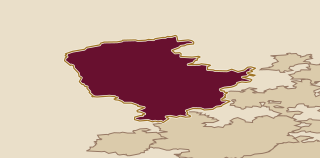
Vinho Verde is a Denominação de Origem Controlada (DOC) in northwest Portugal, stretching across a broad Atlantic corridor between the Douro river to the south and the Spanish border to the north. The region is wet, green, and granite-heavy, with a landscape and this landscape lends the DOC its name: wines labelled Vinho Verde come from vines grown in this green country, where high rainfall and cool Atlantic air slow ripening and preserve acidity in the grapes.
The region divides into distinct sub-zones with different climates and soils. Monção e Melgaço, in the far north along the Minho river, is the home of Alvarinho, where longer dry summers and granitic soils produce a grape with more body and aromatic weight than the Alvarinho grown further south. Loureiro dominates the Lima valley. Azal concentrates around Felgueiras, further inland. Vercoope draws fruit from seven municipalities spread across this patchwork, which means the range is implicitly a regional blend rather than a single-sub-zone expression.
Labels in Vinho Verde follow the DOC rules: a wine may name the grape variety if that variety accounts for 85 percent or more of the blend, or it may carry a sub-zone designation if the fruit qualifies. Via Latina Alvarinho names both the brand and the grape, placing it within the broader Vinho Verde DOC.
Soil And Site
The soils across Vercoope's seven source municipalities share a granite base, the underlying geology of most of northwest Portugal. Granite drains freely, retains little water, and provides the mineral underpinning that runs through Alvarinho and Loureiro grown in this part of the world. The region's granite slopes encourage natural drainage even in the high-rainfall climate, keeping vine roots searching deep rather than sitting in surface moisture.
No specific plot-level or sub-zone soil breakdown for the individual cooperative vineyards is confirmed in available sources.
Story
Cooperative winemaking in Portugal has a complicated history. Through much of the twentieth century, cooperatives dominated rural wine production, collecting fruit from smallholders who lacked the equipment and capital to vinify independently. The relationship between cooperative scale and wine quality was often poor. Volume and price competed with variety and place.
Vercoope represents a later model. Seven separately governed municipal cooperatives from Amarante, Braga, Guimarães, Famalicão, Felgueiras, Paredes, and Vale de Cambra agreed to pool their bottling and export operations through a single facility in Santo Tirso. That is not a simple organisational decision. Each cooperative carries its own membership, its own governance obligations, and its own history of local agricultural politics. Arriving at a shared commercial infrastructure required a consensus that most cooperative federations in Portuguese wine have not achieved.
The consequence is visible in the range. Instead of competing on price in bulk markets, Vercoope built a named label system around indigenous varieties and an export operation that now reaches five continents. The preservation of Alvarinho, Loureiro, and Azal is written into the sustainability framework not as an afterthought but as the core of what justifies the operation at scale.
Vineyards And Cellar
The vineyards feeding Vercoope are farmed by 4,000 to 5,000 individual growers across seven municipalities. The Atlantic climate means canopy management matters: without careful vine training and pruning, the wet northwest Portuguese summers encourage disease pressure and dilute the fruit. The traditional pergola training systems common in the region lift the canopy away from the damp ground, improving airflow and helping grapes ripen cleanly despite the rainfall.
Cellar protocols are not detailed in confirmed sources. No barrel ageing, extended lees contact, or malolactic fermentation practices are documented for the range. The wines in the range, particularly the Alvarinho, show the character of grapes harvested for aromatic clarity and natural acidity rather than for extraction or oak development.
Wines
The range is built on three indigenous grapes. Via Latina Alvarinho is the anchor: a monovarietal white from Alvarinho, the grape most associated with the Monção e Melgaço sub-zone, though the labelling here falls under the broader Vinho Verde DOC. In its youth it is floral and citric, with a mineral thread running through fresh lime and jasmine. The wine has enough weight and acidity to change over time, and with a few years it moves from that citric brightness toward honey, almond, and pine nut.
A Loureiro-Alvarinho blend balances the two varieties at roughly 70 to 30. Loureiro brings floral aromatics and a lighter, more transparent body. Alvarinho fills out the mid-palate and deepens the aromatic register. The blend is designed to be approachable earlier than a straight Alvarinho and broader in its appeal.
Azal appears in at least one sparkling Pét Nat expression under the Felgueiras sub-zone name, using the indigenous grape associated with that inland municipality. The Via Latina Grande Escolha and Via Latina Escolha Branco are separate cuvées in the range, though detailed sensory notes for these wines are not confirmed.
In The Glass
Via Latina Alvarinho opens with jasmine and fresh citrus, the characteristic aromatic signature of Alvarinho grown in northwest Portugal's Atlantic climate. The mineral thread underneath lifts the wine and keeps it from sitting heavily. In the mouth, the acidity is the frame: it is bright without being sharp, and it lends the wine its forward, clean line on the finish.
Loureiro adds a softer floral register in the blended version, with a lighter body and leaves the wine lighter than the straight Alvarinho. Where the Alvarinho rewards patience, the Loureiro blend rewards early opening.
The aging note on the Alvarinho is the most informative taste detail in the range: the shift from citric freshness to honey, almond, and pine nut over two to three years is Alvarinho doing what the grape does when it has enough material. The citrus does not disappear; it integrates. At three years, the wine tastes more complete than it does at one.
A Bottle To Understand It
Via Latina Alvarinho is the right first bottle. It is a monovarietal Alvarinho white from the Vinho Verde DOC, opening with jasmine, fresh lime, and a mineral underpinning that defines the grape in this part of northwest Portugal. The acidity is clean and forward, the body light enough to drink young but with enough weight to carry the wine through two or three years of bottle development. Buy one for now and one to keep: the wine that opens citric and floral will close into something honeyed, waxy, and quietly complex. No other bottle in the range shows the Alvarinho grape's range of motion as clearly.
Anecdote
Seven separately governed municipal cooperatives from Amarante, Braga, Guimarães, Famalicão, Felgueiras, Paredes, and Vale de Cambra each carried their own membership obligations, their own local agricultural histories, and their own boards. At some point those seven bodies agreed to send their grapes through a single shared bottling facility in Santo Tirso and to export the resulting bottles under one commercial operation. In a country where cooperative fragmentation is the rule, that kind of consensus is rare. Each municipality gave up the independence that comes from controlling your own bottling line in exchange for access to markets in thirty countries and five continents. Seven sets of governance committees, one roof.
Final Word
Vercoope is not a producer you visit for the story of a single family or a famous vineyard. It is a cooperative federation that demonstrates what happens when seven separate institutions decide that shared infrastructure is worth more than independent bottling lines. The indigenous varieties it has chosen to defend, Alvarinho, Loureiro, and Azal, are not the easiest grapes to sell at volume. The scale at which Vercoope sells them suggests the choice was the right one.