
NoleaWorld of Wine

Provence · France

Producer profile

Maison Edme de Rohan Chabot Saint Martin

Côtes de Provence family estate making red, rosé and white wines, with a Cru Classé red from four grape varieties.

Place
Provence · France
Known for
Cru Classé Provence red blends
Wine context
Cabernet Sauvignon · Grenache / Garnacha · Mourvèdre · Syrah / Shiraz
Editorial basis
World of Wine editorial profile · 5 sources

World of Wine editorial profile · Source list ↓

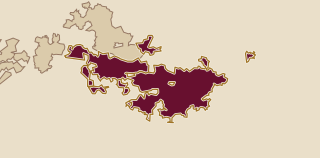
Atlas locationProvence · France43.45° N · 6.44° E

At A Glance

Field
Detail
Producer
Maison Edme de Rohan Chabot Saint Martin
Appellation
Côtes de Provence
Range
Red, rosé and white wines
Classification
Cru Classé
Signature wine
Château de Saint Martin Cru Classé Grand Réserve Rouge 2019

The Producer

Château de Saint Martin is a family owned Côtes de Provence estate. The property spans approximately 100 hectares, with half under vine. Its work covers vineyard practice, wine maturation and bottling on the property. The estate pursues HVE certification, with sustainable and low carbon viticulture and soil biodiversity among its stated aims. Wine maturation uses acacia barrels with fine grain. The range includes red, rosé and white wines, alongside a named Cru Classé red.

Place

Côtes de Provence is the appellation carried by the estate's red, rosé and white wines. The place reaches the label through three wine colors under one regional name. The Cru Classé red narrows the range to a defined grape composition, while the appellation remains constant across the estate's wines.

Story

Château de Saint Martin entered the Cru Classé roll in 1955, when a ministerial decree honored 23 Provence estates. The designation required direct sales, bottling at the château, at least 18 months of wine storage before release, and an appellation or brand dating from before 1935. Adeline de Barry has directed the estate since 1984. The current property pursues HVE certification and sustainable, low carbon viticulture, with soil biodiversity included among its environmental aims.

Wines

The estate's range has three color categories: Côtes de Provence red, rosé and white wines. The named red is Château de Saint Martin Cru Classé Grand Réserve Rouge. It is a blend of Cabernet Sauvignon, Grenache, Syrah and Mourvèdre. The bottle carries the Cru Classé designation, while the other wines are presented through their color and Côtes de Provence appellation.

In The Glass

The Cru Classé red is garnet with ruby hues. Its nose is vibrant, combining red and black fruit with figs, cinnamon and clove. On the palate, the fruit stays supple, and black pepper and spice mark the finish. The wine carries 13% alcohol by volume.

A Bottle To Understand It

Choose Château de Saint Martin Cru Classé Grand Réserve Rouge. It is the estate's named Cru Classé red, with Cabernet Sauvignon, Grenache, Syrah and Mourvèdre on the label and Côtes de Provence as the appellation. Its place in the range is defined by the classified red label, set beside the estate's rosé and white wines. The bottle also uses the estate's acacia barrel maturation and on property bottling.

Anecdote

In 1740, Joseph, Marquis de Villeneuve Bargemon, built the château that still exists today. Before his construction, the property was a vineyard priory dependent on the Abbey of Lérins. The building marked its transformation into a nobleman's estate. Family ownership has continued for over 280 years. Adeline de Barry has directed the property since 1984, and the estate produces red, rosé and white wines under the Côtes de Provence appellation.

Final Word

Château de Saint Martin is a family owned Côtes de Provence estate with its own vines, cellar and bottling work. HVE viticulture and acacia barrel maturation sit alongside a range of red, rosé and white wines, including a Cru Classé red built from four grape varieties.

Sources

Keep following the thread

Where to go next

placeRead the Provence guideSee Maison Edme de Rohan Chabot Saint Martin in the wider setting of Provence.mapFind Maison Edme de Rohan Chabot Saint Martin on the mapKeep the producer, its region and nearby places together.learningHow place shapes wineSee how climate, landscape and local choices become part of a wine.