Who makes it
Matilde Poggi made her first Le Fraghe vintage in 1984. Before then, the family sold its grapes to her father’s brother, who had his own winery. She kept the grapes and began bottling the wine herself.
The estate’s name comes from the wild strawberries, called fraghe in the local Venetian dialect, that grow among the vines. Poggi later led FIVI, Italy’s federation of independent winegrowers, and CEVI, its European counterpart.
Where it grows
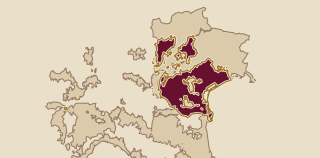
Le Fraghe is in Cavaion Veronese, in the province of Verona. The Bardolino appellation runs along the eastern bank of Lake Garda, with the hills of Valpolicella to the east. It covers the red Bardolino and the pale rosé Bardolino Chiaretto.
The vineyards at Loc. Colombare lie on glacial soils. Lake Garda moderates temperatures during the growing season.
How it is made
The cellar
Poggi farms organically and harvests the estate vineyards by hand. Stainless steel and cement are used throughout the range.
For Ròdon Chiaretto, the grapes are vinified separately. The wine combines direct pressing with saignée, juice drawn from the red-wine fermentation. Skin contact lasts six to eight hours at cool temperatures, followed by ageing on the fine lees in stainless steel until spring.
What they make
Le Fraghe Bardolino blends 80% Corvina and 20% Rondinella. It is a light ruby red for drinking young, with red-cherry fruit, bright acidity and little tannin. It can be served slightly chilled. Ròdon uses the same grapes to make a dry, pale rosé.
Brol Grande is a single-parcel Bardolino. Its name uses the Venetian word brol for a walled vineyard enclosure. The Traccia di Bianco and Traccia di Rosa come from selected estate plots and ferment in cement. Camporengo is the Garganega white, with a full body and aromas that linger through the finish.