
NoleaWorld of Wine

Alentejo · Portugal

Producer profile

Herdade da Mingorra

A 175-hectare family estate in Alentejo producing exclusively from its own vines since 2004, with the four-variety Vinhas da Ira blend at the centre of the range.

Place
Alentejo · Portugal
Known for
Red blends from estate grapes, Alentejo
Wine context
Tempranillo · Touriga Nacional
Editorial basis
World of Wine editorial profile · 3 sources

World of Wine editorial profile · Source list ↓

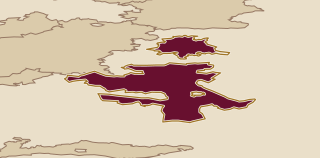
Atlas locationAlentejo · Portugal37.89° N · 7.92° W

At A Glance

The Producer

Herdade da Mingorra is a family estate in Alentejo, the broad sun-baked plateau that stretches across southern Portugal and produces some of the country's most generously built red wines. The estate covers 175 hectares of vines and has bottled exclusively from its own fruit since 2004, when owner Henrique Uva formalised what had begun as an accidental encounter with the land.

The four daughters of the family, Sofia, Vera, Marta, and Maria, now run the operation alongside their father. The range includes a blend called Vinhas da Ira.

Place

Alentejo is an appellation and a landscape at once. It covers roughly a third of Portugal's land mass, sitting south of the Tagus and east of the coastal hills, and its summers are reliably hot and dry. That heat ripens grapes fully, and the wines from here tend toward generous fruit, body, and alcohol rather than the cut and austerity of northern Portugal. Alentejo reds are built for early pleasure but can carry enough tannin and concentration to hold a few years in bottle.

The estate does not publicly name a sub-zone or village address within Alentejo. What is known is that the 175 hectares of vineyard are entirely estate-managed and have been the sole source of fruit since the wine project launched.

Soil And Site

No soil type, altitude data, or named vineyard parcels are in the verified record for Mingorra. What is confirmed is the scale: 175 hectares of vineyard on a single estate, large enough to farm different parcels and exposures but treated as one integrated holding. The continental climate of the Alentejo interior, with warm days and cooler nights during the growing season, gives the grapes their ripe aromatic character while preserving enough acidity to prevent the wines from feeling flat.

Story

Henrique Uva arrived in Alentejo as a hunter, not as a farmer. He was shooting partridges when the landscape caught his attention and held it. He bought an estate that already had old vines in the ground and carried no fixed plan to make wine. The vines, and perhaps the soil, changed that.

In 2004, he formalised the wine project and committed the estate to producing exclusively from its own grapes. The cellar approach that emerged holds traditional winemaking methods alongside modern equipment, without letting either override the other. It is not a boutique producer chasing low yields and fashionable natural methods, nor a factory operation pushing volume. Mingorra sits between those poles: a serious family estate with the scale to be consistent and the commitment to estate fruit that keeps it honest.

The transition from accidental purchase to committed wine estate took whatever time it took after Uva bought the land. The formal start date, 2004, marks not the founding of the estate but the decision to make it a wine project. His daughters are now central to that project.

Vineyards And Cellar

The 175 hectares of vineyard are planted to four varieties: Alfrocheiro, Aragonez, Alicante Bouschet, and Touriga Nacional. All four go into the Vinhas da Ira blend, and their combination is not accidental. Alfrocheiro, native to Alentejo and the Dao, adds dark fruit and floral lift. Aragonez, the Alentejo name for Tempranillo, contributes firm red fruit and mid-palate weight. Alicante Bouschet is a teinturier variety, meaning its flesh as well as its skin carries pigment, and its contribution to the blend is deep colour and body. Touriga Nacional is the fourth variety in the blend.

The cellar balances traditional fermentation practice with modern temperature control and hygiene. No further detail on ageing vessel, time on skins, or élevage is in the verified record.

Wines

The confirmed range includes Vinhas da Ira, Mingorra Reserva Tinto, and a wine called Mulatto. Sensory and grape detail is only available for Vinhas da Ira.

Vinhas da Ira is a red blend of Alfrocheiro, Aragonez, Alicante Bouschet, and Touriga Nacional. It combines the four varieties in one blend. Vinhas da Ira is a full-bodied red with a long finish and very mature red fruit. It is not a delicate wine.

Mingorra Reserva Tinto and Mulatto appear in the range but their grape compositions and tasting character are not in the sourced record. They represent the estate's broader production capacity without displacing Vinhas da Ira as the clearly documented entry into the portfolio.

In The Glass

Vinhas da Ira opens with a concentrated dark fruit aroma: very ripe plum, fig, and black cherry, with the floral undertow that Alfrocheiro and Touriga Nacional tend to contribute. In the mouth it fills quickly, the Alicante Bouschet and Aragonez giving the wine its substantial body and grip. The fruit is forward and generous, with depth from the tannin that Touriga Nacional always brings. The finish is long and warm, with the ripeness of the fruit staying present through to the end. It is a wine for big food or patient cellaring, not for delicate occasions.

The Alentejo climate is visible in the glass: this is a wine made where the sun arrives reliably every summer and the grapes reach full maturity without difficulty. What the estate adds is the combination of varieties that pulls the wine in several directions at once, dark and floral, heavy and lifted, and lands it in balance.

A Bottle To Understand It

Vinhas da Ira is the bottle to start with. It carries all four of the estate's planted varieties and has the most fully documented profile of anything in the range. The blend is what makes it worth understanding: Alfrocheiro and Touriga Nacional pulling the wine toward dark fruit and perfume, Alicante Bouschet giving it depth of colour and body, and Aragonez contributing to the blend. The wine is full-bodied with a long finish and built around very mature red fruit. Open it with lamb or a slow-cooked meat dish; it needs something substantial to meet it.

Anecdote

Henrique Uva drove into the Alentejo with a shotgun, not a business plan. He was there for the partridges, which are plentiful in the scrubland and cork oak country of the southern interior. At some point during one of those trips, the landscape stopped being a backdrop and became something he wanted to own. He bought the estate, found old vines already planted across the property, and made no immediate decision about what to do with them. The vines waited. Eventually Uva decided the estate would become a wine project, and in 2004 he formalised that commitment, establishing a cellar and beginning production exclusively from the estate's own grapes. His four daughters, Sofia, Vera, Marta, and Maria, grew up around that decision and now run the operation alongside him.

Final Word

Herdade da Mingorra is a straightforward proposition: a large family estate in Alentejo producing red wine from four varieties, all estate-grown, since 2004. The bottles are not built for subtlety. They are built for the climate and for the table, with the kind of ripe, full-bodied fruit that the Alentejo plateau delivers when the season runs as it usually does. Vinhas da Ira is the clearest statement of what the estate grows and how it thinks about blending. Start there.

Sources

Keep following the thread

Where to go next

placeRead the Alentejo guideSee Herdade da Mingorra in the wider setting of Alentejo.mapFind Herdade da Mingorra on the mapKeep the producer, its region and nearby places together.learningHow place shapes wineSee how climate, landscape and local choices become part of a wine.