
NoleaWorld of Wine

Vinho Verde · Portugal

Producer profile

Esporão S.A. Herdade do Esporão

Esporão began in Alentejo and makes Bico Amarelo, a Vinho Verde blend of Alvarinho, Loureiro and Avesso.

Place
Vinho Verde · Portugal
Known for
Vinho Verde grape blends
Editorial basis
World of Wine editorial profile · 7 sources

World of Wine editorial profile · Source list ↓

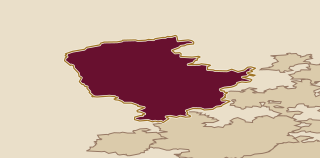
Atlas locationVinho Verde · Portugal38.38° N · 7.56° W

At A Glance

Field
Detail
Origin
Alentejo, Portugal, with activity in the Douro and Vinho Verde
Vinho Verde estate
Quinta do Ameal
Main grapes
Alvarinho, Loureiro and Avesso
Featured wine
Bico Amarelo 2023
Organic vineyard
441 hectares across Esporão

The Producer

Esporão began in Alentejo as a family business and later extended its activity to the Douro and Vinho Verde. Herdade do Esporão is associated with Alentejo, Quinta dos Murças with the Douro and Quinta do Ameal with Vinho Verde.

The group’s farming record differs by estate. The Alentejo vineyards and all vineyards at Quinta dos Murças are certified organic. Bico Amarelo 2023 is the Vinho Verde white, blending Alvarinho, Loureiro and Avesso without added sugar or carbonation.

Place

Quinta do Ameal lies in the Lima Valley within Vinho Verde, an estate dating to 1710. It covers 30 hectares, including 14 hectares of vineyard and 8 hectares of forest. Loureiro is the vineyard’s central white grape, producing white wines from the estate’s Vinho Verde setting.

Soil And Site

Quinta do Ameal’s sites range from 12 to 53 metres above sea level and sit on deep, fertile granite soils. The combination of altitude, climate and granite gives the estate’s wines character and ageing potential. The Loureiro vineyards grow within this varied landscape, where elevation and ground conditions change across a compact estate.

Story

Esporão acquired Quinta do Ameal in 2019, extending its activity into Vinho Verde. At the estate, organic conversion has begun with the first vineyard parcel. The Alentejo vineyards and all vineyards at Quinta dos Murças are certified organic, while Quinta do Ameal remains at the beginning of its conversion.

The wider group’s organic work includes healthier, more balanced grapes that require less intervention in the winery. The farming status therefore differs by estate, even as organic vineyard work becomes part of Esporão’s broader practice.

Vineyards And Cellar

At Quinta do Ameal, an old cowshed was transformed into a winery in 2021, retaining the building’s natural ventilation. Rooftop solar panels were added that year. The cellar uses concrete eggs and tanks, stainless steel tanks and oak foudres, alongside minimal intervention, indigenous yeasts and low sulphur levels.

Bico Amarelo 2023 was harvested by hand. Whole clusters were pneumatically crushed, and the must was cold decanted for 24 hours. Fermentation took place in temperature controlled stainless steel vats at 14 to 16°C, followed by ageing on lees. Lees are the spent yeast cells left after fermentation, and time on them can add texture without adding sweetness.

Wines

Bico Amarelo 2023 is a Vinho Verde white blending Alvarinho, Loureiro and Avesso. It brings together Vinho Verde’s principal grape varieties in one regional blend, with no added sugar or carbonation. The wine is presented as a light, refreshing style with aromatic intensity.

In The Glass

Citrus and tropical aromas lead from the glass. The palate is fresh and lively, with good volume and a long refreshing finish. The wine is genuinely dry and savoury, with a crunchy, saliva inducing feel. At 11.5% alcohol, it is light and lithe.

Total acidity is 5.9 g/l, pH is 3.18 and reducing sugar is 1.5 g/l. Those figures sit alongside the wine’s fresh profile and dry finish.

A Bottle To Understand It

Choose Bico Amarelo 2023. It is a Vinho Verde white made through hand harvesting, whole cluster pneumatic crushing and 24 hours of cold decanting. Fermentation in temperature controlled stainless steel at 14 to 16°C is followed by lees ageing.

The bottle carries the regional blend and the cellar method in one pour. No added sugar or carbonation keeps the production details clear, while the three grape varieties place the wine directly within Vinho Verde’s principal white grape tradition.

Anecdote

In 2010, Esporão planted an ampelographic field at Herdade do Esporão. The field covers approximately 10 hectares and represents 189 grape varieties, making it an open air laboratory inside the Alentejo estate. An ampelographic field is a vineyard collection used to observe varieties side by side. Such collections allow comparison of vine growth, leaf shape, bunch form and ripening, so the names become living material alongside their written records.

Final Word

Esporão links organic farming to healthier, more balanced grapes that require less cellar intervention.

Sources

Keep following the thread

Where to go next

placeRead the Vinho Verde guideSee Esporão S.A. Herdade do Esporão in the wider setting of Vinho Verde.mapFind Esporão S.A. Herdade do Esporão on the mapKeep the producer, its region and nearby places together.learningHow place shapes wineSee how climate, landscape and local choices become part of a wine.