
NoleaWorld of Wine

Vallée du Rhône · France

Producer profile

Domaine du Séminaire

Family Valréas domaine making Grenache led reds from organic vines, native yeasts, concrete vats and safre parcel selections.

Place
Vallée du Rhône · France
Known for
Valréas reds from safre parcels
Wine context
Grenache / Garnacha · Marsanne & Roussanne · Mourvèdre · Syrah / Shiraz
Editorial basis
World of Wine editorial profile · 10 sources

World of Wine editorial profile · Source list ↓

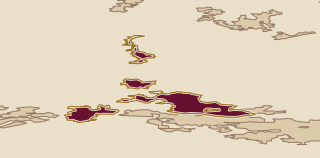
Atlas locationVallée du Rhône · France44.38° N · 5.03° E

At A Glance

Field
Detail
Region
Southern Rhône
Appellation
Côtes du Rhône Villages Valréas
Village
Valréas
Main grapes
Grenache, Syrah, Mourvèdre, Carignan, Viognier, Roussanne, Marsanne, Clairette and Grenache Blanc
Signature wine
Valréas
Defining feature
Organic cultivation, native yeasts and concrete cellar work

The Producer

The concrete vats at Domaine du Séminaire belong to a family estate in Valréas, where Hervé and Mathilde Pouizin farm red and white Rhône varieties. Hervé represents the fourth generation of his family to farm these slopes. The domaine makes wine from its own vineyard fruit and does not buy grapes.

Grenache, Syrah, Mourvèdre and Carignan form the red foundation, joined by Viognier, Roussanne, Marsanne, Clairette and Grenache Blanc among the white varieties. The wines come from a single family property, with farming and cellar work kept under the Pouizins' control.

Place

At Route de Saint Pierre in Valréas, the vineyards lie in the colder foothills of the Alps, close to Grenache's northern ripening limit. Strong Mistral winds sweep the slopes. A cooler position lengthens Grenache's ripening, while moving air helps keep the canopy dry.

Valréas appears in the Côtes du Rhône Villages Valréas appellation, so the village name sits directly on the bottle. The local address is also a climatic marker, with the wines coming from a northern Rhône setting where acidity remains part of the profile.

Soil And Site

Between 300 and 400 metres, the vineyards rest on clay limestone soils and safres. Clay can hold moisture, while limestone contributes a stony component to the root zone. The higher setting brings cooler air than the valley floor and extends the ripening season for Grenache.

Organic cultivation places the vines under Ecocert organic farming. The estate's site combines altitude, clay limestone, safres and strong wind, giving the vineyard a cooler growing setting than the Rhône's warmer southern image suggests.

Story

Hervé Pouizin represents the fourth generation of his family to farm these slopes, and he runs the estate with Mathilde. The domaine does not buy grapes. Its red and white wines therefore come from the family vineyard rather than from an outside fruit supply.

The family continuity reaches into the cellar. The winery uses concrete vats installed by Hervé's forebears, keeping fermentation tied to equipment that has remained part of the estate's working infrastructure.

Vineyards And Cellar

The property covers approximately 100 hectares, with 60 hectares of vines surrounded by woods and lavender. The vineyard includes the Rhône grape varieties grown across the estate, with Grenache, Syrah, Mourvèdre and Carignan among the red plantings.

The winery was built in 1938 and is principally equipped with temperature regulated concrete vats. The Pouizins ferment with native yeasts, add minimal inputs, use no oak, bottle early and apply very light filtration. Concrete provides temperature control without adding oak flavour.

For Valréas, destemmed grapes ferment with native yeast for 21 days with pumping under controlled temperatures, then age in concrete. The standard Côtes du Rhône Rouge is also fermented and raised in concrete with native yeasts.

Wines

The red range includes the Côtes du Rhône Villages Valréas, Les Saffres and the standard Côtes du Rhône Rouge. Valréas is made from 80% Grenache, 10% Syrah and 10% Mourvèdre. It is a village wine built from a Grenache led blend.

Les Saffres is a parcel selection red from safres, composed equally of Grenache and Syrah. The standard Côtes du Rhône Rouge uses 80% Grenache, 10% Syrah and 10% Carignan, placing Carignan in the blend where Valréas uses Mourvèdre.

The labels separate three levels of address: a village appellation, a named parcel selection and a broader regional appellation. The grapes change with that range, as do the cellar details attached to each bottle.

In The Glass

Valréas opens with blackcurrant and jammy cherry. The palate is warm, smooth and balanced, with coated tannins. The 2018 vintage was opulently fruity, with pronounced acidity and a notably vibrant northern character.

The fruit is generous, but the acidity keeps the palate moving. The tannins feel rounded and covered by the fruit, while the brighter line associated with the northern setting gives the wine a fresher finish than its warmth alone would suggest.

A Bottle To Understand It

Open Les Saffres. It is a parcel selection red from safres, made from Grenache and Syrah. The wine shows blackberry and blackcurrant aromas, followed by a velvety palate, melted tannins and persistent fruit.

The bottle keeps the site and the grape varieties close together. Its freshness sits beneath the fruit, while the soft tannin texture gives the red an immediate, rounded shape.

Anecdote

In 2008, Hervé Pouizin chose organic cultivation at Domaine du Séminaire to reveal the terroir. The decision applied to vineyards where Grenache ripens near its northern limit and strong Mistral winds sweep the slopes. Organic cultivation changes the work in the vines by excluding synthetic treatments and requiring closer management of the soil and canopy. The estate has carried an organic label since the 2012 vintage, and its farming is identified as organic under Ecocert.

Final Word

Domaine du Séminaire makes Valréas reds from a cool Grenache position, with fruit, acidity and tannin carried through a concrete cellar.

Sources

Keep following the thread

Where to go next

placeRead the Vallée du Rhône guideSee Domaine du Séminaire in the wider setting of Vallée du Rhône.mapFind Domaine du Séminaire on the mapKeep the producer, its region and nearby places together.learningHow place shapes wineSee how climate, landscape and local choices become part of a wine.