
Who makes it
Family winemaking at Domaine du Monteillet reaches nine generations in Chavanay. Stéphane Montez took over the domaine from his father, Antoine, after working in vineyards in England, Australia, California and South Africa. His time abroad made him more conscious of the distinctive character of the family terroir, a quality he links to balance in the wines.
Montez's philosophy centres on harmony with the environment, respect for the plant, sound cellar practice and collaboration with the team. The estate's work combines manual harvesting and careful sorting with a cellar approach built around temperature control, extraction and large oak casks.
Where it grows
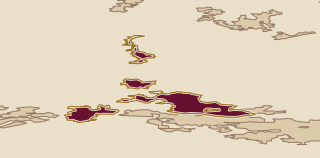
The domaine sits in the heart of the Condrieu appellation and on the northernmost edge of Saint-Joseph. Its terraces lie on the eastern periphery of Mont Pilat, whose 1434 metre elevation shields them from harsh weather.
La combe du Montelier opens into the Rhône corridor and brings regular cool ventilation. This airflow preserves aromatic purity and limits vine disease. The ground is crystalline, with plutonic granite and metamorphic schist, gneiss and migmatite beneath the terraces.
What they make
The range covers five appellations, with Condrieu at the estate's centre and Saint-Joseph on its northern edge. Saint Joseph Le Grand Duc is a white wine from the Saint-Joseph appellation, from the 2017 vintage.
Across the range, the cellar uses temperature-controlled fermentations, careful extraction and demi-muids. Demi-muids are large oak casks whose format changes the proportion of oak to wine compared with a small barrel. The cellar style focuses on power through these controlled fermentations, extraction choices and larger casks.