Who makes it
Château Montrose is a Saint-Estèphe château in Bordeaux. Martin and Olivier Bouygues acquired it in 2006. The grand vin is dense and masculine, with blackcurrant and cherry fruit, minerality, concentration, and ripe tannins.
Etienne Dumoulin created Château Montrose because of its unique hillside gravel terroir. Gravel can provide drainage and stored warmth, while clay can retain water around the roots. These conditions can help red grapes ripen while retaining acidity.
Where it grows
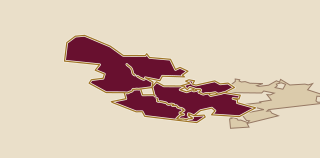
Saint-Estèphe is the appellation on the bottle, and Château Montrose is classified as a Second Growth in the 1855 Bordeaux Classification. The appellation names the wine's regional origin; the classification records the estate's position in the Bordeaux hierarchy.
The vineyard covers 95 hectares on deep gravel with sand and clay in the soil. Gravel drains water and stores heat, while sand and clay affect water retention around the roots. The site is planted with Cabernet Sauvignon, Merlot, Cabernet Franc, and Petit Verdot.
What they make
Château Montrose, La Dame de Montrose, and Tertio de Montrose are the estate's three wines. Château Montrose is the grand vin, La Dame de Montrose the second wine, and Tertio de Montrose the third wine. The grand vin is aged for approximately 18 months in approximately 60% new French oak.
La Dame de Montrose 2016 is 52% Merlot, 35% Cabernet Sauvignon, 11% Petit Verdot, and 2% Cabernet Franc. Its palate brings ripe black fruit, licorice, and vanilla, with balanced tannins and freshness.