
Who makes it
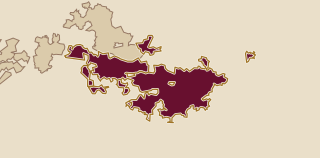
Château des Ferrages turns a specific Provençal address into a range of named bottles. The estate sits in Pourcieux, where 28 hectares of vines feed a cellar operation large enough to handle rosé, red and white wines. Mon Plaisir Rosé is the most place-specific of the named bottles supplied here, carrying the Sainte-Victoire appellation and blending Grenache, Syrah and Rolle, also known as Vermentino.
Roumery Rosé takes a broader regional route under the Côtes de Provence appellation. Its five-grape blend brings together Cinsault, Grenache, Syrah, Rolle and Clairette. The difference between the two labels is easy to follow: Sainte-Victoire names a more specific Provençal appellation, while Côtes de Provence covers the wider regional category.
Where it grows
Pourcieux lies between Aix-en-Provence and Saint-Maximin, beneath Sainte-Victoire mountain. That location gives the estate two useful label readings. Mon Plaisir Rosé carries Sainte-Victoire, while Roumery Rosé carries Côtes de Provence. The appellation changes before the bottle is opened, moving from a more specific mountain-linked designation to a broader Provençal one.
The central geological marker is the limestone of Mont Aurélien. Michel Chapoutier identified that limestone as the reason the location was exceptional when he decided to acquire the estate. Here, geology belongs first to the history of the property, while the wines communicate place through their Sainte-Victoire and Côtes de Provence appellation names.
How it is made
The cellar
The estate farms 28 hectares of vines and works from more than 1,000 square metres of cellars. Modern vinification techniques sit alongside traditional ageing methods, giving the winery separate phases for turning grapes into wine and allowing finished wines time before bottling. The cellar scale supports a range that reaches beyond one rosé, while the named bottles retain clear differences in appellation, grape blend, colour and palate feel.
What they make
Mon Plaisir Rosé comes from Sainte-Victoire and blends Grenache, Syrah and Rolle. It has a pale, crystalline appearance with bright tones. The nose brings red fruit, white flowers, strawberry, peach, grapefruit and hawthorn. On the palate it is fresh, smooth and ethereal, finishing with strawberry fruit.
Roumery Rosé belongs to Côtes de Provence and uses five grapes: Cinsault, Grenache, Syrah, Rolle and Clairette. Its colour is a very pale rose-petal shade. Strawberry, grapefruit, citrus and peach shape the nose, while the palate is fresh, well balanced, smooth and full.
Wines to try
First bottle
Start with Mon Plaisir Rosé. It is a Sainte-Victoire rosé made from Grenache, Syrah and Rolle, with a pale crystalline colour, red fruit, white flowers, peach and grapefruit. Its fresh, smooth palate and strawberry finish make the bottle easy to connect back to its label. One glass brings together the specific appellation, the three-grape blend and the estate’s clearest supplied taste profile.