NoleaWorld of Wine

Vallée du Rhône · France

Producer profile

Château de Saint Cosme

Gigondas estate and Rhône négociant house using whole clusters, native yeasts, and separate labels for estate and contracted fruit.

Place
Vallée du Rhône · France
Known for
Gigondas and Rhône whole cluster wines
Wine context
Grenache / Garnacha · Mourvèdre · Syrah / Shiraz
Editorial basis
World of Wine editorial profile · 6 sources

World of Wine editorial profile · Source list ↓

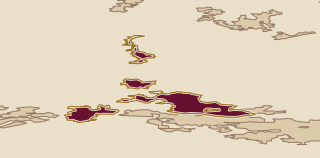
Atlas locationVallée du Rhône · France44.17° N · 5.01° E

At A Glance

Fact
Detail
Estate vineyard
15 hectares in Gigondas
Estate wines
Château de Saint Cosme
Signature wines
Hominis Fides, Le Poste, and Le Claux
Négociant wine
Saint Cosme Côtes du Rhône, 100% Syrah
Defining practice
Native yeasts, whole clusters, unfined and unfiltered bottling

The Producer

Château de Saint Cosme is the label for the Barruol family's estate grown Gigondas wines. Saint Cosme names the négociant wines made from contracted growers across Southern and Northern Rhône appellations. The distinction separates vineyard ownership from purchased fruit on the front of the bottle.

Wine production at the property is documented from 1416. The Barruol family acquired the estate in 1570 and built a residence over existing cellars. Its range now includes estate grown Gigondas, négociant wines, and Château de Rouanne in Vinsobres, acquired in 2019.

Place

Gigondas supplies the estate's home appellation, while the négociant operation reaches across the Southern and Northern Rhône. That division gives the labels different geographic roles: Château de Saint Cosme identifies estate grown Gigondas, while Saint Cosme covers wines made from contracted fruit.

The Vinsobres holdings appear under the separate Château de Rouanne label. Château de Rouanne remains a distinct producer in the same Barruol family, with its wines tied to the Vinsobres appellation rather than Gigondas.

Soil And Site

The Gigondas vineyard sits on Tortonian marl, a clay and limestone formation laid down 11 million years ago. The vines also lose two hours of morning sun as it rises behind the Dentelles ridge. Ripening slows, harvest takes place in October, and the grapes reach mature tannins with lower sugars than nearby Châteauneuf du Pape.

Story

The property moved from a long family history into a wider Rhône operation through a series of decisions by Louis Barruol. He launched the négociant arm in 1997, bringing contracted growers into the Saint Cosme label alongside the estate's own Gigondas wines.

In 2019, the estate acquired Château de Rouanne in Vinsobres. The purchase added a second historic appellation to the family's wines while keeping Rouanne under its own name.

Vineyards And Cellar

Organic farming began under Henri Barruol in the 1970s, and full biodynamic certification followed in 2010. Fermentations use native yeasts and whole clusters. Whole cluster fermentation leaves the stems with the grapes, which can add perfume, spice, and tannin during fermentation.

Estate wines are bottled unfined and unfiltered. Fining removes some suspended material, while filtration clarifies the wine before bottling. Leaving out both steps preserves more of the wine's original suspended matter.

Wines

The estate grown Gigondas range includes three single vineyard cuvées: Hominis Fides, Le Poste, and Le Claux. Hominis Fides and Le Poste were introduced in 2003, followed by Le Claux in 2004.

Saint Cosme Côtes du Rhône 2023 is the négociant line's 100% Syrah bottling. Les Deux Albion 2021 combines Syrah, Grenache, Carignan, Mourvèdre, and Clairette, with whole clusters co fermented in wooden and concrete vats. Château de Rouanne Vinsobres is aged in cement vats for 16 months and contains 1.4 grams per litre of residual sugar.

In The Glass

Saint Cosme Côtes du Rhône 2023 opens with lifted dark raspberry, blackberry, and plum. Its texture is silky, with round tannins and a long, mouthwatering finish. The wine is medium bodied, and salty mineral notes with a waft of alder smoke mark the close.

Les Deux Albion 2021 shows crushed plum and black currant before moving into greater depth. Its five grape varieties give the wine a broader aromatic profile than the single variety Côtes du Rhône, while the wooden and concrete vessels preserve the imprint of whole cluster co fermentation.

A Bottle To Understand It

Choose Saint Cosme Côtes du Rhône 2023. It is the 100% Syrah wine from the négociant line, carrying the Saint Cosme name rather than Château de Saint Cosme and the Côtes du Rhône appellation rather than a named Gigondas vineyard.

That label makes the producer's two bottle categories easy to distinguish. The estate grown wines narrow toward individual Gigondas vineyards, while this bottle presents contracted Rhône fruit through one grape variety and one broad appellation.

Anecdote

In 1992, Louis Barruol was 23 and studying for an MBA in Paris when his father Henri, who had managed the family winery for 35 years, suffered a stroke. The family estate faced an economic slump, and prices for bulk wine had crashed. Barruol took over while continuing to manage the property through that pressure. The estate later moved from bulk wine production to bottled wines, and Louis launched the négociant arm in 1997.

Final Word

Château de Saint Cosme joins biodynamic farming, native yeast fermentation, whole clusters, and unfined and unfiltered bottling across a family estate whose wine production is documented from 1416.

Sources

Keep following the thread

Where to go next

placeRead the Vallée du Rhône guideSee Château de Saint Cosme in the wider setting of Vallée du Rhône.mapFind Château de Saint Cosme on the mapKeep the producer, its region and nearby places together.learningHow place shapes wineSee how climate, landscape and local choices become part of a wine.