
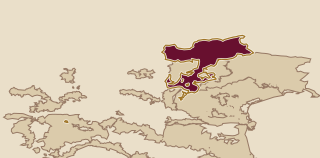
At A Glance
- **Type:** Grower cooperative
- **Founded:** 1960
- **Location:** Valle dei Laghi, western Trentino, near Lake Toblino
- **Denominations:** Trentodoc (sparkling); Trentino DOC (still wines)
- **Key grapes:** Nosiola, Pinot Nero, Teroldego, Chardonnay, Pinot Grigio, Kerner, Moscato Giallo, Lagrein, Gewürztraminer, Sauvignon
- **Organic:** Largest certified organic vineyard area in the Trentino province
- **Entry bottle:** Antares Rosé Brut Millesimato (Trentodoc)
The Producer
Two winds meet every day in Valle dei Laghi. The Ora arrives from the south each afternoon, warm off Lake Garda. By night and early morning, cold air presses down from the Brenta Dolomites. That daily thermal contest is not incidental to Cantina Toblino; it is the condition the cooperative was built to farm.
Founded in 1960, Cantina Toblino draws on member-growers whose parcels run across the valley floor and surrounding hillside slopes near Lake Toblino in western Trentino. Collectively, those parcels make up the largest certified organic vineyard area in the Trentino province, accounting for more than ten percent of the province's total organic vineyard land. That scale of organic conversion, maintained at cooperative rather than boutique-estate level, is the structural fact that defines what this producer is.
The range runs from international varieties to deeply local ones. Nosiola, a white grape nearly extinct outside this valley, sits at the historic centre. The cooperative's sparkling Trentodoc wines, led by the Antares Rosé Brut Millesimato, carry the denomination flag.
Place
Valle dei Laghi is a north-south lake valley in western Trentino, shaped by the proximity of Lake Garda to the south and the Brenta Dolomite massif to the north. That geography creates the thermal rhythm the valley is known for: afternoon warmth from the lake, night cold from the mountains. The diurnal swing keeps acidity in the grapes and makes ripening gradual rather than sudden, which matters across the full grape portfolio but is especially visible in sparkling-wine varieties and in aromatic whites.
Trentodoc, the Champagne-method sparkling appellation covering the Trentino province, is the denomination most directly associated with the valley's altitude and cool nights. Trentino DOC covers the still wines. For Nosiola and Vino Santo, the classification is specific to the valley: the dessert wine is produced only here, with the local grape and the local drying tradition.
Soil And Site
The valley floor and hillside slopes around Lake Toblino carry soils formed from glacial moraine and limestone debris from the surrounding Dolomite ridges. The combination of well-drained glacial material and mineral-rich subsoil supports both the aromatic varieties and the native grapes. Altitude varies across the cooperative's parcels, with higher hillside sites providing cooler temperatures and longer hang time. No specific soil analysis or parcel-level data is available in the source material.
Story
In 1960, growers across Valle dei Laghi pooled their parcels into a single cooperative. The valley had a winemaking tradition considerably older than that date, but the cooperative form gave the member-growers collective commercial reach and shared access to cellar facilities they could not have maintained individually.
Organic conversion followed over subsequent decades. What began as a farming philosophy among individual growers became a cooperative-wide commitment. By the time the cooperative's organic holdings exceeded ten percent of the province's certified organic vineyard land, the conversion had moved from a positioning choice to an operational fact: most of the valley's member parcels were farming without synthetic inputs, at a scale no single estate could match.
In 2016, the cooperative launched the Vènt project, a range of wines explicitly tied to the valley's microclimate. The name is the Trentino dialect word for wind, chosen deliberately over the Italian vento to place the project inside local tradition. The Vènt wines foreground the thermal swing between the Ora and the Alpine cold.
Vineyards And Cellar
Organic farming across the member parcels means no synthetic herbicides, fungicides, or fertilisers. In a valley with the thermal swings Valle dei Laghi produces, that choice requires attentive vine management: the night cold that preserves acidity also creates conditions where vine disease pressure can build if canopy management is neglected. The cooperative's scale means that discipline applies across a large area rather than a single estate's few hectares.
Nosiola, after harvest, goes through one of the most extended natural processes in Italian winemaking. Bunches are laid on arèle, traditional wooden drying racks, from October through Holy Week the following spring. The six months of slow desiccation concentrates sugars and allows noble rot to develop across the bunches. Spring pressing produces a thick, intensely sweet must. That must ferments slowly in small barrels and ages for several years before bottling as Vino Santo. The long cycle ties up cellar space and member-grower commitment across the better part of a decade from harvest to release.
The Antares Rosé Brut Millesimato uses Pinot Nero grown in the valley and produced to Trentodoc specification: secondary fermentation in bottle, disgorgement, and a period of ageing on lees before release. The Trentodoc method requires at least fifteen months on lees for non-vintage and twenty-four for vintage-dated wines; the Antares Rosé is vintage-dated, placing it in the longer category.
Wines
The still white range covers Nosiola, Pinot Grigio, Chardonnay, Sauvignon, Gewürztraminer, Kerner, and Moscato Giallo. Among these, Nosiola is the most historically anchored: it grows almost nowhere outside Valle dei Laghi and carries a quiet, almond-edged character with moderate acidity and body. Kerner, a cross of Riesling and Trollinger widely planted in Alto Adige and Trentino's mountain zones, brings sharper aromatic lift and higher acidity. Gewürztraminer in this valley leans toward floral intensity without the heaviness the grape can produce in warmer sites.
The still red range includes Teroldego, Lagrein, Pinot Nero, Cabernet Sauvignon, and Merlot. Teroldego, a variety native to the Rotaliano plain in Trentino, produces deeply coloured wine with firm tannin, dark fruit, and a slightly bitter finish that integrates with age. Lagrein, the other Trentino-rooted red, runs darker in colour with plum fruit and a velvet-textured mid-palate.
The Vènt project wines sit across both colours, grouped by their emphasis on microclimate character rather than by grape. They tend to foreground the acidity and aromatic clarity the diurnal swing produces.
Vino Santo, made from Nosiola dried on arèle and aged in barrel for years, is among Italy's rarest dessert wines: amber-coloured, concentrated, with dried-fruit and hazelnut character and a long, sweet finish cut by the grape's natural acidity.
The sparkling Trentodoc range is led by the Antares labels, with the Rosé Brut Millesimato as the flagship.
In The Glass
The Antares Rosé Brut Millesimato opens with Pinot Nero's natural pale copper colour and a fine, persistent mousse. On the nose, the Pinot Nero character comes through clearly: red cherry, a hint of strawberry, and a faint earthy undercurrent that keeps it from reading as purely fruity. In the mouth, the bubbles are fine-grained and even, and the acidity from the cold mountain nights gives the wine lift and length. The finish is dry, moderately long, and ends cleanly without the bitterness that can mark lesser Champagne-method wines.
The Nosiola still white is lighter-bodied and quieter on the nose than the aromatic varieties: white peach, almond skin, and a faint herbal note, with mouth-watering acidity and a clean, dry finish. It does not demand attention but holds it.
Vino Santo is the register shift: amber, concentrated, with caramelised hazelnut, dried apricot, and a sweetness balanced by the grape's acid line, which keeps the wine from collapsing into heaviness across its long finish.
Kerner and Gewürztraminer lean toward aromatic intensity: the first with citrus and green herb, the second with rose petal and lychee. Both carry the freshness the valley's nights preserve.
A Bottle To Understand It
Start with the Antares Rosé Brut Millesimato. It is a vintage-dated Champagne-method sparkling wine made from Pinot Nero grown in Valle dei Laghi and produced under the Trentodoc denomination. The Pinot Nero is recognisable in the glass: pale copper, red-fruit nose, earthy depth. The mousse is fine and the acidity is firm without being harsh, reflecting the valley's cold nights and high altitude relative to the Lake Garda plain. It is the wine that pulls together the cooperative's most important facts: the valley's microclimate, the Trentodoc appellation, and the Pinot Nero that the Vènt project treats as the primary vehicle for site expression.
Anecdote
In 2016 the cooperative needed a name for a new range of wines they were grouping by microclimate rather than by grape or colour. The valley's defining physical feature is the daily contest between two air masses: the Ora, warm off Lake Garda, arriving each afternoon from the south; and the cold Alpine current pressing down from the Brenta Dolomites each night. Farmers in Valle dei Laghi had worked with that rhythm for generations without naming it on a label. When it came time to pick a word, the cooperative chose vènt rather than vento. One is the Trentino dialect; the other is standard Italian. The difference is small on paper and considerable in intention: vènt places the range inside a specific valley and a specific local voice rather than in a generic Italian wine register. The Vènt wines carry that dialect choice on every bottle.
Final Word
Cantina Toblino is what a cooperative looks like when the land it farms has a strong enough character to become the organising principle of everything the producer does. Valle dei Laghi is a narrow valley with a specific thermal regime, a rare grape, and a dessert wine that takes the better part of a decade to produce. The cooperative's scale means that local character is maintained at volume, which is rarer in Italian wine than it should be.