
NoleaWorld of Wine

Friuli-Venezia Giulia · Italy

Producer profile

Azienda Agricola Zidarich

Benjamin Zidarich farms 8 hectares on the Carso limestone plateau behind Trieste, ageing his Teran, Vitovska, and Malvasia in a 20-metre underground cellar he cut from the rock by hand.

Place
Friuli-Venezia Giulia · Italy
Known for
Teran red aged in Slavonian oak botti; skin-contact Vitovska and Malvasia whites
Editorial basis
World of Wine editorial profile · 3 sources

World of Wine editorial profile · Source list ↓

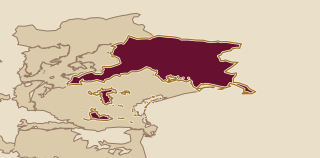
Atlas locationFriuli-Venezia Giulia · Italy45.76° N · 13.69° E

At A Glance

Producer: Azienda Agricola Zidarich Region: Friuli Venezia Giulia, Italy Appellation: Venezia Giulia IGT / Carso DOC Grapes: Vitovska, Malvasia Istriana, Teran Style: Natural; skin-contact whites, indigenous red Production: 20,000 to 28,000 bottles annually

The Producer

Benjamin Zidarich farms 8 hectares of vines on the Carso plateau behind Trieste, a thin-soiled limestone tableland that most of the wine world has never heard of and that shapes everything he makes. He works without chemical inputs, without selected yeasts, and bottles without filtration. His frame for this is vini veri: real wines, made as directly as the land allows.

The range is narrow by design. Three indigenous grapes, one red and two whites, all grown in the commune of Duino Aurisina near the village of Prepotto. The Teran travels furthest, found on wine lists in New York and Copenhagen. The two whites, Vitovska and Malvasia Istriana, are made with skin maceration and carry the plateau's mineral grip in amber-coloured bottles.

Below the cellar door, 20 metres down in the limestone, five floors of ageing space hold everything Zidarich makes.

Place

The Carso is the Italian name for the Karst, the limestone plateau that rises steeply behind Trieste and continues east toward Slovenia. The soil is thin almost everywhere: wind-scoured, full of rock, with almost no water retention. Vines push roots deep into fissures to survive. The result, in both red and white, is naturally low yields and wines with sharp acidity and a mineral quality that comes directly from what the roots are drinking.

The label on Zidarich's Teran reads Venezia Giulia Rosso. Venezia Giulia is the broader geographical indication covering the northeastern corner of Italy where Friuli meets the Adriatic. The Carso DOC exists as a tighter appellation within this zone, but Zidarich bottles his Teran under the wider Venezia Giulia IGT designation. Both names appear on the map; the IGT gives producers more flexibility in grape blending and winemaking choices while still anchoring the wine to the same limestone plateau.

Soil And Site

The Carso's defining physical fact is limestone karst. The plateau is porous and calcium-rich, draining water quickly so the vines are under mild stress through most of the growing season. The red soils that sit between the rock outcrops are iron-rich, locally called terra rossa. Teran is believed to draw part of its iron-forward mineral note from this combination: calcium subsoil and iron-stained surface clay.

The altitude and the bora, the northeastern wind that sweeps off the Adriatic and across the plateau, keep temperatures cooler than coastal Friuli. Grapes ripen more slowly, and acidity stays high at harvest without sacrificing colour or concentration.

Story

Zidarich began farming the Carso when the plateau had almost no wine of its own. The indigenous grapes, Vitovska in particular, were curiosities rather than commercial assets. Around 2000, Zidarich made a shift that changed the character of his whites: he introduced skin maceration without selected yeasts, letting the grape skins remain in contact with the juice through fermentation. This was not yet a category with a name in the English-speaking wine world. Zidarich was working with what the Carso had always had, running the fermentation the way it had to run without laboratory intervention.

The cellar was the next fixed decision. There was no cool stone building on the plateau, no inherited cave, no convenient hillside. Zidarich cut one. Over several years, he excavated five floors of underground space into the limestone, finishing the project in 2009. The cellar runs 20 metres below the surface and covers 1,200 square metres. Temperature and humidity stay constant year-round without mechanical control. Every bottle Zidarich makes ages down there.

Vineyards And Cellar

The 8 hectares are planted across the plateau in the thin, rocky soils typical of Duino Aurisina. No herbicides, no synthetic treatments. The vines are managed to produce low yields: the limestone drainage and wind exposure do much of that work without deliberate crop reduction.

In the cellar, fermentation runs on indigenous yeasts only. The whites, Vitovska and Malvasia Istriana, ferment and macerate on their skins. The skin contact gives the wines amber colour and tannin grip, and it extracts the mineral compounds that the limestone soils concentrate in the grape skins. Bottling happens without filtration, so the wines carry texture and cloudiness rather than a polished commercial clarity.

Teran, the red, goes into large Slavonian oak barrels after fermentation. Slavonian oak, grown in Croatia and cut into large-format botti, is dense-grained and slow to give flavour. After 24 months in barrel, the wine remains light on its feet. The oak functions as a container, not a seasoning.

Wines

Vitovska is the Carso's most distinctive white grape and the wine Zidarich produces that is hardest to compare to anything else. The skin maceration gives it amber colour and a dry grip that is closer to a light red than a conventional white. Exact tasting notes on Zidarich's Vitovska are not fully confirmed in current sources, but the method and the grape's naturally high acidity produce a wine with mineral pull and textured weight.

Malvasia Istriana, grown across the northeastern Adriatic coast from Friuli into Istria, is also made with skin contact at Zidarich. The grape's natural aromatic profile, stone fruit and white blossom in conventional versions, becomes tighter and more structured with extended maceration. Again, specific sensory breakdown for this cuvee is not fully documented in current sources.

Teran is the wine with the most recorded detail and the widest international distribution. The grape is native to the Carso and Istrian peninsula and produces wines with naturally pointed acidity and firm tannin. Zidarich's version adds 24 months in Slavonian oak botti, which softens the tannin grain without adding wood flavour. The result sits in its own category: red fruit wine with enough concentration to age, carrying fresh herbs and red licorice alongside the crunchy fruit, and staying light on its feet despite the acidity and tannin load.

In The Glass

The Teran opens with crunchy red fruit, earthy in register, followed by fresh herbs and red licorice. There is nothing dark or extracted about the colour or the nose: it is vivid rather than brooding. In the mouth, the acidity arrives early and stays pointed throughout, a fiercely sharp line that runs under the fruit without mellowing at mid-palate. The tannins are firm and chewy, but they are refined enough that the wine does not feel coarse. The finish is long and mineral, with the iron edge that the terra rossa soils contribute to Teran on this plateau. Modest alcohol keeps the wine light-on-its-feet: concentration without weight.

The skin-contact whites carry a different register. Where Teran is driven by acidity and red fruit, Vitovska and Malvasia bring mineral grip and textured body from the extended maceration, amber in colour and dry through to the finish.

A Bottle To Understand It

Start with the Venezia Giulia Rosso Teran. It is Zidarich's most widely available bottle and the wine that puts the Carso's character most directly in the glass. Teran grown on limestone karst, fermented on indigenous yeasts, aged 24 months in Slavonian oak botti, bottled without filtration. The flavour is crunchy, earth-tinged red fruit with fresh herbs and red licorice. The acidity is razor-sharp. The tannins are present and chewy but not coarse. The oak leaves no flavour trace, only the tannin grain that comes from a long, slow stay in large-format wood. This is a wine that drinks like nothing from central Italy and nothing from France. It is a Carso wine, from a plateau built for this grape.

Anecdote

Benjamin Zidarich had no cave and no hillside and no cool stone building in which to age his wines. The Carso plateau offered thin soil and wind and limestone and very little else. So around 2005, he began cutting. He excavated by hand and machine into the rock beneath his property in Prepotto, working downward through five floors of limestone until the cellar reached 20 metres below the surface. When the project finished in 2009, the underground space covered 1,200 square metres, entirely carved from the karst. The temperature held steady year-round without refrigeration. The humidity did the same. Zidarich moved his barrels down and started ageing his wines in a room he had made himself, inside the same rock that his vines were pushing their roots through above.

Final Word

Zidarich is a small producer on a plateau that most wine buyers have never looked at. The wines are sourced from three indigenous grapes, made without laboratory inputs, aged underground in a cellar cut from the plateau itself. Teran is the bottle to start with: firm, vivid, mineral, and unlike almost anything else in the Italian red canon. The whites, once you have the Teran, take the skin-contact method deeper.

Sources

Keep following the thread

Where to go next

placeRead the Friuli-Venezia Giulia guideSee Azienda Agricola Zidarich in the wider setting of Friuli-Venezia Giulia.mapFind Azienda Agricola Zidarich on the mapKeep the producer, its region and nearby places together.learningHow place shapes wineSee how climate, landscape and local choices become part of a wine.