
NoleaWorld of Wine

Veneto · Italy

Producer profile

Alpha Zeta

A Veneto producer founded in 1999 by a British Master of Wine and a New Zealand winemaker, sourcing from hillside growers in the Alpone and Valpantena valleys to make fruit-forward wines at everyday prices.

Place
Veneto · Italy
Known for
Pinot Grigio from volcanic hillside parcels in Monteforte d'Alpone, eastern Soave zone.
Wine context
Chardonnay · Pinot Grigio / Pinot Gris · Prosecco · Soave (Garganega)
Editorial basis
World of Wine editorial profile · 4 sources

World of Wine editorial profile · Source list ↓

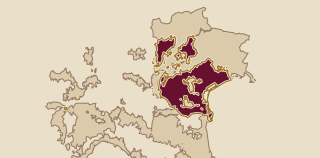
Atlas locationVeneto · Italy

At A Glance

The Producer

In 1999, a British wine importer and a New Zealand winemaker arrived in Veneto not to buy a property but to build a sourcing model from scratch. David Gleave, a Master of Wine based in the UK, and Matt Thomson, a winemaker from New Zealand, had a specific argument: that the Veneto was producing good grapes from good hillside sites and selling most of them into a bulk-production system that rewarded volume over care. Their answer was to go directly to those growers, pay for hillside fruit, and bring cool-chain, fruit-first cellar technique to varieties the commodity trade was treating as interchangeable. Alpha Zeta was the result.

The philosophy has not shifted. The portfolio runs from Prosecco and Soave through Chardonnay and Pinot Grigio to Ripasso and Amarone della Valpolicella. Prices stay accessible. Screwcap closures go on everything, a deliberate choice about freshness rather than tradition.

Place

The Pinot Grigio comes from the Alpone Valley, a narrow corridor in eastern Veneto that sits within the broader Soave zone. The key commune is Monteforte d'Alpone, where the hillside soils are granite and decomposed volcanic rock. Both soil types drain well, limit vine vigour, and force roots to work. On flat, fertile ground, Pinot Grigio yields easily and loses character; on volcanic hillsides it ripens more slowly, holds acidity, and produces a denser, more aromatic fruit. The granite and basalt base also contributes a mineral edge that flatland versions rarely carry.

Soave production draws from the same eastern zone. The Valpantena Valley, northwest of Verona, supplies grapes for the red wines, including the appassimento-based Ripasso and Amarone della Valpolicella DOCG. The two valleys give Alpha Zeta its geographic spread: whites from the volcanic east, reds from the hillside terrain closer to the city.

Soil And Site

Monteforte d'Alpone sits at the eastern edge of the Soave Classico zone, where volcanic activity deposited basalt and then left the rock to break down over centuries into friable, well-drained hillside soils. The decomposed volcanic material is dark, mineral-rich, and low in organic content. Granite appears alongside it, adding further drainage capacity and a harder mineral substrate. Neither soil type retains much water. Vines grown here produce smaller berries with higher skin-to-juice ratios, which concentrates aroma and gives the wine its characteristic mid-palate weight.

Story

The Veneto is one of Italy's largest wine-producing regions by volume, and for much of its modern history the dominant model has been cooperative production and large-merchant blending. Growers sold grapes or bulk wine; the label and the margin went elsewhere. When Gleave and Thomson set up Alpha Zeta in 1999, the established path for a new producer was to buy land and build a cantina. They took a different route: identify hillside growers in the Valpantena and Alpone valleys, contract directly for their fruit, and control the cellar work rather than the farming calendar.

The sourcing model meant Alpha Zeta could access premium hillside parcels without the capital cost of owning them. It also meant the project was built on relationships rather than hectares. Over time, those grower partnerships became the stable centre of the range, with consistent sourcing from the same volcanic and granite sites in Monteforte d'Alpone feeding the Pinot Grigio year after year. The screwcap decision, taken early in the producer's life when cork was still near-universal in Italy, followed the same logic: a closure chosen for what it does to the wine rather than what it signals to the market.

Vineyards And Cellar

Pinot Grigio grapes from the Alpone Valley are hand-harvested. The hillside location limits mechanisation and allows selective picking by maturity. At the winery, grapes go directly into a pneumatic press, a gentle extraction method that avoids breaking seeds or skins and limits the bitter phenolic extraction that can coarsen a Pinot Grigio. The juice is immediately cooled to preserve volatile aromatics, then fermented in temperature-controlled stainless-steel tanks. No oak is used. The approach is designed to keep the peach and pear fruit clean and the flint mineral edge intact rather than adding texture or complexity from wood.

The same stainless-steel, no-oak approach applies across the white wines and Prosecco. Ripasso and Amarone follow the conventional Valpolicella production methods: Ripasso referments the base wine on the partially dried grape skins left over from Amarone production, adding colour, body, and dried fruit depth; Amarone uses fully dried grapes, a process that concentrates sugars, flavour, and alcohol over several months before pressing and fermentation.

Wines

The range moves in a clear arc from light and early-drinking to weighty and structured. Prosecco opens the lineup: Glera grapes from the Veneto, made by the Charmat method with secondary fermentation in tank, producing fine mousse, apple and white flower aromas, and a clean, low-alcohol finish. Soave and Chardonnay sit alongside the Pinot Grigio in the white wine tier, all vinified in stainless steel, all made without oak ageing, all built for drinking within a few years of vintage.

The Pinot Grigio from Monteforte d'Alpone is the white wine with the most defined source character: volcanic and granite soils, hillside sites, hand-picking, and cool fermentation give it a fuller mid-palate than typical flatland versions, with ripe stone fruit and a mineral edge that persists on the finish.

Ripasso della Valpolicella steps up in weight and concentration. The refermenting process on dried grape skins adds body, dried cherry, chocolate, and a warmth that the whites do not carry. Amarone della Valpolicella DOCG sits at the top of the range: dried Corvina-based grapes, full-length appassimento, high alcohol, and dark fruit concentration. Both reds are made for drinking with food, and the Amarone in particular has the extract and warmth to need several years in bottle.

In The Glass

The Pinot Grigio is the most documented wine in the range and the clearest expression of Alpha Zeta's sourcing logic. It opens with ripe peach and pear, both present and specific rather than generic, with a flinty mineral note underneath that comes from the volcanic and granite substrate. On the palate it is fuller than most supermarket Pinot Grigio: the hillside fruit and slow ripening give it a genuine mid-palate weight rather than the neutral, slightly thin texture of flatland versions. Acidity is bright enough to keep the richness from feeling heavy, and the finish is clean and refreshing rather than sharp. No oak, no residual sweetness, no complexity from ageing. It is a fruit-forward, mineral, structurally honest white wine built to be opened young.

Across the reds, Ripasso brings dried cherry, cocoa, and warm spice from the double-fermentation process, with more body and grip than the whites. Amarone, at the top of the range, is dense and dark, with the concentrated dried fruit and high alcohol that the appassimento method always produces.

A Bottle To Understand It

The Pinot Grigio from the Alpone Valley comes from hillside vineyards in Monteforte d'Alpone. It is a single-variety white wine from hillside volcanic and granite soils in Monteforte d'Alpone, hand-harvested, pneumatically pressed, fermented cold in stainless steel, and sealed under screwcap. In the glass it delivers ripe peach and pear with a clear flint edge, a full mid-palate, bright acidity, and a clean finish. Nothing about it is disguised by oak or sweetness. It shows exactly what the sourcing model was designed to produce: hillside character, variety definition, and freshness at an everyday price.

Anecdote

In 1999, David Gleave flew into Verona with a specific brief. He was not looking for a domaine to buy or an estate to lease. He and Matt Thomson had decided to build a producer without owning land: find the growers in the Valpantena and Alpone valleys who were farming the right hillside parcels, agree contracts directly, and bring the cellar work in-house. The local trade had been buying from the same cooperatives for decades. Gleave and Thomson went around them. They described their model as "marrying local grape growers with impeccable winemaking", a phrase that sounds idealistic until you understand the alternative: another grower selling hillside Pinot Grigio into a bulk tank destined for a supermarket blend. The hillside parcels in Monteforte d'Alpone are still the source of the Pinot Grigio today.

Final Word

Alpha Zeta was founded on a clear and testable proposition: that the Veneto's hillside terroir was producing better fruit than the bulk market was willing to pay for, and that outside expertise combined with direct grower relationships could capture that quality at a price most buyers could actually reach. The Pinot Grigio from Monteforte d'Alpone is where that proposition is most directly legible in the bottle.

Sources

Keep following the thread

Where to go next

placeRead the Veneto guideSee Alpha Zeta in the wider setting of Veneto.mapFind Alpha Zeta on the mapKeep the producer, its region and nearby places together.learningHow place shapes wineSee how climate, landscape and local choices become part of a wine.