
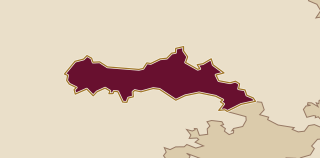
Valle d'Aosta's vineyards follow the valley from Pont-Saint-Martin and Donnas to Morgex, below Mont Blanc. Rainfall is scarce, with steady ventilation and large differences between daytime and night-time temperatures. The Valle d'Aosta DOC, recognised in 1985, covers seven named areas: Blanc de Morgex et de La Salle, Enfer d'Arvier, Torrette, Nus, Chambave, Arnad-Montjovet and Donnas. Around Morgex and La Salle, vineyards commonly lie between 900 and 1,300 metres. The white grape Prié Blanc is associated with these upper-valley sites and makes brisk wines. Chambave and Torrette make reds led by Petit Rouge. Fumin produces dark, savoury reds, while Petite Arvine makes crisp whites. The appellation also permits passito wines from dried grapes and sparkling wines with their second fermentation in the bottle. Labels may use either Valle d'Aosta or Vallée d'Aoste.
1 named area
Inside the region
Explore the wine-growing areas of Valle d'Aosta.
Producer profiles
Producer profiles
Every producer profiled in Valle d'Aosta so far.
- Cave Mont Blanc de Morgex et La Salle soc. CoopAn 80-member cooperative farming ungrafted Prié Blanc on terraced Alpine slopes above 1,200 metres in the Valdigne, at the foot of Mont Blanc.
- Società Agricola Grosjean Vins s.sFamily estate in Ollignan, Quart, farming seven hectares of indigenous Valle d'Aosta varieties since the 1970s under organic principles.