
Who makes it
Weingut Zahel makes its wine inside Vienna rather than beyond the city’s edge. From Maurer Hauptplatz 9, Richard Zahel runs a fourth-generation family estate whose current vineyard holding is reported at 35 hectares; Alexander Zahel makes the wines. The address matters in the glass because the estate draws fruit from several Vienna districts, allowing Gemischter Satz, Burgundy varieties, red wine and small-production varietal bottles to sit within one range.
Zahel’s recent arc is recorded in farming dates. All of its Vienna vineyards were certified organic in 2017 and biodynamic in 2018; early in 2024, the estate became Europe’s first Regenerative Organic Certified winery. The work reaches across 95 vineyard parcels reported as organically and Demeter biodynamically certified, so the change is tied to the fruit supply behind the range rather than a single showpiece plot.
Where it grows
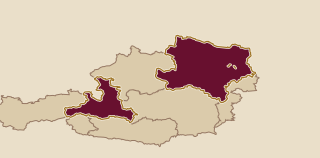
Zahel’s vineyards extend through Mauer, Oberlaa, Neustift am Walde, Sievering and Nussberg, covering Vienna’s major growing regions rather than a single contiguous estate. Falstaff describes the climate as warm Pannonian with cool nights: warmth supports ripening across the white and red grapes, while the night-time drop preserves acidity. That combination helps explain why a Vienna producer can work with mixed-field Gemischter Satz alongside Burgundy varieties, Sauvignon Blanc and Rotgipfler.
The useful site distinction here is not a generic picture of Vienna, but the named places in Zahel’s holdings. Oberlaa is particularly tangible: Zahel has vinified site wines from the Goldberg vineyard since 2008. A Goldberg label therefore narrows the focus from the estate’s city-wide spread to fruit from one Oberlaa vineyard, while the wider range remains built from vineyards across several districts.
How it is made
The cellar
The cellar work is easiest to see in the wines that carry a named method. A new cellar complex opened in July 2010, and the estate has made Goldberg site wines since 2008. In the Ein Kleines Fass series, each selected variety receives only one 225-litre oak barrel. That fixed format keeps the focus on a particular grape and lot, rather than blending it into a larger cuvée.
Rotgipfler 2021 shows the approach in detail. Its fruit came from 80-year-old vines in Ried Sätzen, spent four days on skins, then aged for a year in seasoned French oak. Skin contact brings the grape skins into the white-wine process and adds texture and phenolic grip; seasoned oak gives the wine time in barrel without requiring a dominant new-oak flavour.
What they make
Zahel’s range has two clear scales. Gemischter Satz belongs to Vienna’s mixed-variety wine tradition, while the estate also makes wines from individual varieties and named sites. The climate’s warm days and cool nights provide the fruit-and-acidity balance needed for both broad city blends and more narrowly framed bottles.
Ein Kleines Fass is the small-production end of the portfolio. The 2020 Sauvignon Blanc is a varietal wine made under the one-barrel rule. The 2021 Rotgipfler is more deliberately shaped by its old-vine source, skin contact and oak ageing, giving it a fuller texture and more grip than a straightforward fresh white. Goldberg wines add a third strand: site-specific bottlings from Oberlaa, made since 2008.
Wines to try
First bottle
Start with Ein Kleines Fass Rotgipfler 2021. It is a Rotgipfler from 80-year-old Ried Sätzen vines, made with four days of skin contact and one year in seasoned French oak, then released as the sole 225-litre barrel for that selected variety. Expect a dry white with more texture and grip than a simple young aromatic white: skin contact firms the palate, while the oak ageing adds weight through the finish. It puts Vienna vineyard fruit, an old-vine parcel and Zahel’s small-barrel cellar work in the same glass.