Who makes it
At Leiningerstr. 16 in Grünstadt-Sausenheim, Schenk Siebert works from a family base rather than a brand assembled around one cuvée. The family describes itself as Grünstadt’s oldest winegrowing family and says it has cultivated vines since 1675, so Riesling, Chardonnay and Cabernet–Madeleine Noir bottles arrive with an unusually long local thread behind their labels.
That continuity does not mean one generation works alone. The estate presents its wines as family craftsmanship, with decisions made together; Gerhard and Hildegard’s long experience sits alongside Christoph and Johannes’s work abroad. In practical terms, a bottle carries a shared family approach rather than a single winemaker’s signature.
Where it grows
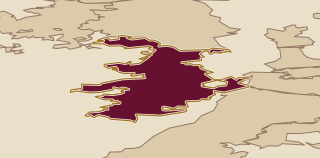
Sausenheim is a small wine-growing area in northern Pfalz, also called Leiningerland. Schenk Siebert describes it as the northernmost and coolest part of Pfalz, placing its dry Riesling and Chardonnay in a part of the region where ripening happens under a cooler frame than much of the Pfalz.
That location helps explain why grape name matters on the label. Riesling brings its own citrus-led, acid-driven frame; Chardonnay can take a broader, creamier shape; Cabernet with Madeleine Noir moves the range into red-wine territory. The place is one setting, but the grapes give it different forms in the glass.
How it is made
The cellar
Sustainable vineyard management is the estate’s stated starting point, so the vineyard comes before any attempt to describe the wines as a cellar style. That matters because the documented range moves from dry Riesling to Chardonnay and Cabernet–Madeleine Noir: fruit from one northern-Pfalz setting must be handled across very different grape varieties.
The family’s collective working method is equally important in the cellar story. There is no supplied evidence for fermentation vessel, barrel regime, lees time or extraction, so those details should not be guessed from a wine’s texture. What is known is that the family treats each wine as shared work, with local experience and overseas winery experience both present in the decision-making.
What they make
The range has three confirmed reference points. Riesling Trocken 2023 is a dry Riesling, the estate’s direct route into Germany’s defining white grape. Chardonnay R appears in 2022 and 2023 vintages, showing that Chardonnay has a continuing place in the range rather than being a one-off bottling.
Kulturpärlor widens the picture further. Its Cabernet–Madeleine Noir composition moves away from the white-wine frame of Riesling and Chardonnay, making the range more than a sequence of classical Pfalz whites. The named wines establish a practical architecture: dry Riesling for grape-led freshness, Chardonnay R for a fuller white-wine texture, and Kulturpärlor for the estate’s documented red-grape combination.
Wines to try
First bottle
Start with Chardonnay R 2023. It is a dry Pfalz Chardonnay whose ripe yellow apple, pear, citrus zest, nutty notes and gentle spice give immediate sensory detail, while its creamy texture and fresh acidity show how body and lift can work together in one white wine.