
Who makes it
Weingut Rudi Pichler is a family estate in Wösendorf whose wines begin with a small, grape-led holding: 15 hectares planted 65% to Grüner Veltliner, 30% to Riesling, with Weissburgunder and Roter Veltliner making up the remaining 5%. The family has worked vines in Wösendorf since 1731, and Rudi Pichler works alongside Rudi Pichler junior. The result is a range built around two white grapes, then divided by Wachau category and vineyard name rather than diluted across many varieties.
The long family history has not left the estate fixed in one generation. Rudi Pichler and Rudi Pichler junior are listed as winemakers, while Theresa and Rudi junior represent the next generation at the estate. Their work continues within a compact Wachau vineyard base, where Grüner Veltliner dominates the plantings and Riesling supplies the second major line. The producer’s stated aim is to preserve the distinguishing character of individual vineyard sites, which explains why the range moves from blended terrace wines to bottles named for Kollmütz, Hochrain and Achleithen.
Where it grows
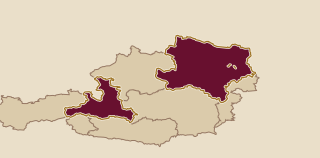
The estate’s vineyards run through Joching, Wösendorf and Weißenkirchen in the Wachau. Grüner Veltliner and Riesling therefore appear on labels in several forms: a blended Terrassen wine can bring together sites, while Kollmütz, Hochrain or Achleithen identifies a more specific vineyard source. Steinfeder, Federspiel and Smaragd are the three Vinea Wachau categories used across the range, so grape, category and site together tell more of the wine’s origin than a grape name alone.
Kollmütz sits on weathered paragneiss with sandy, calcareous soil containing iron, manganese and magnesium. Its Grüner Veltliner is therefore presented as a named-site Smaragd rather than folded into the broader Terrassen bottling. Kirchweg, near St. Michael, has a lower part formed from Danube sediments and is reserved for Grüner Veltliner, keeping a distinct alluvial source within the grape’s vineyard work.
How it is made
The cellar
Site selection matters most when it can survive the journey into the bottle. The estate uses selected maceration times and a shorter fermentation period than in earlier years as part of its work in the cellar. For the 2023 Riesling Terrassen Smaragd, maturation in steel tank kept the wine’s fruit and acidity in view: lemon balm, yellow peach and pineapple arrive without an overt oak layer. Old terraces from different elevations and exposures are brought together, so the finished Riesling carries several sources while retaining a dry, fresh line through the palate.
What they make
Grüner Veltliner provides the range’s broadest framework. Grüner Veltliner Federspiel combines valley vineyards, hillsides and higher terraces; its aromatic, spicy character comes from that spread of elevations. Grüner Veltliner Terrassen Smaragd gathers many small sites into a fuller wine, with subtle fruit, mineral notes, tobacco spice and pepper. The named-site Smaragds—Kollmütz, Hochrain and Achleithen—take the same grape into more narrowly defined vineyard bottlings.
Riesling Terrassen Smaragd performs a different role. It combines old terraces on primordial-rock soils and is documented with white tropical fruit, lemon balm, yellow peach, pineapple and blossom honey. Its freshness and lemony-spicy finish make it less about Grüner Veltliner’s peppery grip and more about citrus-driven acidity, fruit weight and a long dry finish.
Wines to try
First bottle
Choose Riesling Terrassen Smaragd. It is a dry Riesling assembled from old Wachau terraces at differing elevations and exposures, then matured in steel tank. The 2023 shows lemon balm, yellow peach, pineapple and blossom honey, carried by fresh acidity and finishing lemony and spicy. It comes first because it makes the estate’s approach easy to taste: several terrace sites in one bottle, clear fruit without oak, and enough body to balance the brisk citrus line.