NoleaWorld of Wine

Baden · Germany

Producer profile

Weingut Kilian Hunn

A Gottenheim family estate in Baden’s Tuniberg area, where Pinot Noir shares the cellar with a broad white-wine planting.

Place
Baden · Germany
Known for
Fruit-led Pinot Noir and Spätburgunder from Gottenheim, alongside cool-fermented Baden whites.
Wine context
Chardonnay · Pinot Grigio / Pinot Gris · Pinot Noir · Riesling
Editorial basis
World of Wine editorial profile · 6 sources

World of Wine editorial profile · Source list ↓

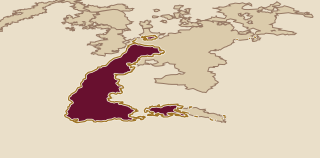
Atlas locationBaden · Germany48.05° N · 7.73° E

At A Glance

Weingut Kilian Hunn is a family estate in Gottenheim, in Baden’s Tuniberg area. Founded in 1982, it is now run by Kilian and Martina Hunn, with Patrick and Jonas Hunn making the plot-focused Patronas wines. Pinot Noir sits beside Pinot Gris, Müller-Thurgau, Pinot Blanc, Chardonnay and Riesling, so the cellar moves between red-fruit reds and cool-fermented whites.

The Producer

The Hunn family works from Rathausstraße 2 in Gottenheim. Felix Hunn and his wife established the estate in 1982; Kilian and Martina took over in 1998. That family continuity runs through the labels: Tugana carries approachable Pinot Noir and Spätburgunder, while Patrick and Jonas make Patronas wines from two named vineyard plots.

Place

Gottenheim lies in the Tuniberg area of Baden, and most of the estate’s vines are reported in the Gottenheimer Kirchberg single vineyard. Kirchberg is therefore more than a place name on a map: it is the central vineyard base behind a range planted to both Pinot Noir and several white varieties.

Soil And Site

Its useful role here is geographic: a substantial share of the estate’s vines is concentrated in one Gottenheim site, while the wine range still spans red and white grapes rather than a single variety.

Story

The estate began with Felix Hunn and his wife in 1982, then passed to Kilian and Martina in 1998. A further family branch now appears in Patronas, where Patrick and Jonas Hunn vinify wines from two plots. The result is a range with different levels of focus: Tugana puts Pinot fruit in a direct, drinkable frame, while Patronas narrows attention to particular parcels.

Vineyards And Cellar

The Hunns describe their farming as controlled, environmentally considerate and near-natural, and allow grapes to remain on the vine until they consider ripeness sufficient. For red wines, ageing in large oak barrels and barriques can add vanilla and wood spice around Pinot’s cherry and raspberry fruit. White wines ferment cool in steel tanks, a method suited to keeping citrus, fruit and fresh acidity clear on the palate.

Wines

Pinot Noir is the estate’s red anchor; Pinot Gris, Müller-Thurgau, Pinot Blanc, Chardonnay and Riesling build the white side. Tugana is the more straightforward line. The documented 2016 Tugana Spätburgunder was 100% Spätburgunder, with cherry and raspberry fruit, sweet vanilla, light body, silky tannin and lively acidity.

The 2021 Tugana Pinot Noir is a separate bottle with its own recorded profile: strawberry, raspberry and sandalwood. Its Swedish release came in an aluminium can, an unusual package for a Pinot Noir whose aromas still point toward fresh red fruit and fragrant wood.

In The Glass

The red-wine picture begins with fruit rather than weight. The 2021 Tugana Pinot Noir has documented strawberry and raspberry notes, followed by sandalwood; the 2016 Tugana Spätburgunder moves toward cherry, raspberry and sweet vanilla. In the latter, light body and silky tannin keep the texture supple, while lively acidity carries the fruit through a dry finish.

Across the estate, Pinot Noir is the clearest route to that red-fruit shape. Barrel and barrique ageing are used for reds at estate level, so wood can bring spice or vanilla without changing Pinot’s basic lighter-bodied profile. The cool steel fermentation used for whites points in the opposite direction: fresher fruit, cleaner aromatics and brisk acidity rather than oak-derived texture.

A Bottle To Understand It

Start with the 2021 Tugana Pinot Noir. It is the Hunn bottle with a specific independent tasting record and a distinctive Swedish aluminium-can release. Expect strawberry and raspberry first, then sandalwood, with the fruit-led profile placing it closer to a fresh Pinot expression than a dense, heavily wooded red. Its packaging is unusual; the wine description remains firmly varietal.

Anecdote

Felix Hunn and his wife established the estate in 1982. Sixteen years later, in 1998, Kilian and Martina Hunn assumed management as the second generation. The handover kept the family’s work rooted in Gottenheim, where the winery remains based on Rathausstraße. Later, the next generation entered the cellar in a more specific way: Patrick and Jonas Hunn began vinifying Patronas wines from two vineyard plots. The family names now appear across several stages of the estate’s history—Felix and his wife at the founding, Kilian and Martina at the 1998 handover, then Patrick and Jonas on the two-plot Patronas project.

Final Word

Kilian Hunn is worth seeking out for a clear Baden family story and a useful contrast within the same estate: fresh, red-fruited Tugana Pinot Noir on one hand, and a smaller two-plot Patronas project on the other. The 2021 Tugana Pinot Noir puts strawberry, raspberry and sandalwood in the foreground.

Sources

Keep following the thread

Where to go next

placeRead the Baden guideSee Weingut Kilian Hunn in the wider setting of Baden.mapFind Weingut Kilian Hunn on the mapKeep the producer, its region and nearby places together.learningUnderstand Pinot NoirRead the quick library guide to Pinot Noir, which is listed with this producer.