
NoleaWorld of Wine

Lower Austria · Austria

Producer profile

Weingut Bernhard Ott

A fourth-generation Grüner Veltliner estate in Feuersbrunn am Wagram, where Bernhard and Maria Ott work named loess sites with hand harvesting, spontaneous fermentation and large Stockinger casks.

Place
Lower Austria · Austria
Known for
Site-led Grüner Veltliner from Wagram and Kamptal, raised with traditional cellar methods in large Stockinger oak casks.
Wine context
Grüner Veltliner
Editorial basis
World of Wine editorial profile · 9 sources

World of Wine editorial profile · Source list ↓

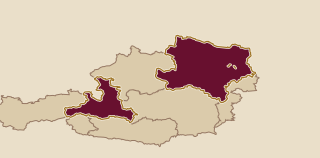
Atlas locationLower Austria · Austria48.44° N · 15.79° E

At A Glance

The Producer

Weingut Bernhard Ott is a Grüner Veltliner specialist in Feuersbrunn am Wagram. With 95 percent of its vineyards planted to the grape, the estate can show how a single variety changes when it is drawn from different named sites, handled by hand, and raised in large oak rather than small barrels. Bernhard and Maria Ott now lead the fourth generation, while the estate’s connection with Hengstberg reaches back to 1889.

The labels bring place into focus through names such as Ried Spiegel. “Ried” identifies a named vineyard site; on Spiegel, that site is paired with Grüner Veltliner and the 1ÖTW Erste Lage designation. The result is a wine shaped as a vineyard expression rather than a generic regional bottling.

Place

Ott works in Wagram and Kamptal, two Lower Austrian areas the estate describes as marked by deep loess. Grüner Veltliner is the thread between them: the grape remains constant while the site name on the label signals a more particular origin. That contrast is useful in a cellar dominated by one variety, because the range can turn attention from grape recognition to vineyard differences.

Feuersbrunn am Wagram is the home base, and Hengstberg is part of the estate’s historical landscape. The Wagram name on a Spiegel label places the wine in that local frame; the vineyard name then narrows the origin further, linking the bottle to a specific Ried rather than to Lower Austria as a whole.

Soil And Site

Deep loess is the estate’s stated ground condition across its Wagram and Kamptal work. Rather than treating the soil as a detached fact, Ott carries site detail into the vineyard record: its vineyard names and parcel numbers are preserved from a map made in 1823. A bottle named for Ried Spiegel therefore sits within a longer system of named parcels, not an invented modern label.

Hengstberg supplies another physical reference point. The estate traces its activity on and around this area to 1889, making the hill part of both its farming history and its present landscape. That continuity keeps Grüner Veltliner tied to particular places even as the estate also works beyond Wagram in Kamptal.

Story

When Bernhard Ott took over from his parents in 1993, he gradually returned the winery to traditional winemaking methods. The decision appears in the working details now used at the estate: grape mills and basket presses, stem maceration, spontaneous fermentation and large Stockinger casks. These choices move the cellar away from a quick, heavily shaped style and toward wines whose fruit, lees and site can remain present through ageing.

The estate also became a founding member of respekt-BIODYN in 2006. Biodynamic preparations, estate-made organic compost and the absence of artificial irrigation place vineyard work before the press; hand harvesting then brings the grapes in without mechanised picking. For Grüner Veltliner, which accounts for nearly every vine here, those vineyard choices are repeated across most of the estate’s output.

Vineyards And Cellar

Ott harvests by hand and works without artificial irrigation, alongside biodynamic preparations and compost made at the estate. Those practices concentrate attention on the fruit arriving from each parcel; hand sorting and picking can keep a named-site wine such as Spiegel connected to its vineyard before fermentation begins.

Fermentation starts spontaneously from the natural yeast population in the vineyard, and the cellar uses stems, grape mills and basket presses. The wine then rests on full lees in large Stockinger oak casks holding 5,000 to 10,000 litres; their oak is air-dried for up to 13 years. Large casks bring oak into the process without making overt wood flavour the main event, leaving room for Grüner’s citrus, herbal notes and mineral character.

Wines

The range is built principally around Grüner Veltliner, with named vineyards including Ried Kirchthal, Ried Spiegel, Ried Stein and Ried Rosenberg. These names direct attention toward site while the grape supplies the common frame: expect the family resemblance of dry Grüner Veltliner—acidity, citrus fruit, herbal lift and texture—rather than a portfolio spread across unrelated grapes.

Ried Spiegel is identified as a 1ÖTW Erste Lage and as one of the estate’s three single-vineyard wines. The producer describes it as the liveliest and most slender member of that group, with meadow herbs, lemon balm, chamomile, lime zest and a dark-mineral note. Its structure is therefore not about broad body or sweet fruit, but about a leaner line of acidity, scent and mineral grip.

In The Glass

Ried Spiegel 2020 opens with lime alongside tropical fruit, meadow herbs, lemon balm and chamomile. The nose moves from citrus to green, floral-herbal detail, while the dark-mineral note keeps the fruit from feeling simple or sweet.

On the palate, the wine begins fresh and vibrant. Lime-led acidity carries the fruit through a slender texture, then a tangy mineral character firms the middle and stretches the finish. Grüner Veltliner supplies the citrus-and-herb vocabulary; Spiegel’s named-site role and large-cask handling leave the finish dry, long and marked more by grip than by oak flavour.

A Bottle To Understand It

Start with Grüner Veltliner Ried Spiegel 2020. It is 100 percent Grüner Veltliner from a named Wagram vineyard and an Erste Lage wine, so it brings the estate’s central grape, site focus and cellar approach into one bottle. Lime, tropical fruit, lemon balm and chamomile arrive first; fresh acidity and a tangy mineral finish keep the palate dry and active. It is a useful first encounter because Spiegel is described as the liveliest, most slender of Ott’s single-vineyard wines, making its herbal perfume and long grip easy to follow.

Anecdote

In 1993, Bernhard Ott took over the Feuersbrunn winery from his parents. Over time he began returning the estate to traditional methods: grapes were worked with grape mills and basket presses, stems were included for maceration, fermentations began spontaneously, and wine rested in large Stockinger casks. The shift did not require a new address or a new grape—Grüner Veltliner already filled most of the vineyards—but it changed the practical route from the hand-picked fruit to the bottle. Bernhard and Maria Ott now run the estate as the fourth generation, with those methods still part of the cellar work.

Final Word

Ott offers Grüner Veltliner with a firm sense of location: deep loess in Wagram and Kamptal, parcel names retained from an 1823 map, hand-picked fruit and large-cask ageing. Ried Spiegel brings those elements into focus with lime, herbs, dry acidity and a mineral finish.

Sources

Keep following the thread

Where to go next

placeRead the Lower Austria guideSee Weingut Bernhard Ott in the wider setting of Lower Austria.mapFind Weingut Bernhard Ott on the mapKeep the producer, its region and nearby places together.learningUnderstand Grüner VeltlinerRead the quick library guide to Grüner Veltliner, which is listed with this producer.