NoleaWorld of Wine

Champagne · France

Producer profile

Matthieu Godmé-Guillaume Champagne

A small Verzenay domaine making Chardonnay-led Champagne from three Montagne de Reims villages, with dry, saline V.V.V. at its centre.

Place
Champagne · France
Known for
Chardonnay-led, low-dosage Champagne from Verzenay, Verzy and Villers-Marmery.
Wine context
Chardonnay · Pinot Noir
Editorial basis
World of Wine editorial profile · 8 sources

World of Wine editorial profile · Source list ↓

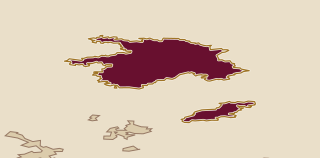
Atlas locationChampagne · France

At A Glance

Matthieu Godmé-Guillaume runs a 5.35-hectare family domaine from Verzenay in Champagne’s Montagne de Reims. Chardonnay covers 3.50 hectares and Pinot Noir 1.85 hectares across Verzenay, Verzy and Villers-Marmery, so the wines bring a Chardonnay-led line of citrus, chalk and salinity together with Pinot Noir’s apple, kernel and dried-fruit notes.

The Producer

Matthieu Godmé-Guillaume took over management of his mother Sabine Godmé’s domaine in 2019. He is the family’s third-generation winemaker, working an estate begun by his great-grandparents; the present range turns that family holding into bottles that move between a three-village blend and wines centred on Verzy or Villers-Marmery.

Place

The domaine is based in Verzenay, with vines also in neighbouring Verzy and Villers-Marmery. Verzenay and Verzy are Grand Cru villages, while Villers-Marmery is Premier Cru; V.V.V. joins fruit from all three, placing Chardonnay’s chalky, citrus-led character beside Pinot Noir’s broader apple and dried-fruit register.

Verzenay, Verzy and Villers-Marmery are not interchangeable names on a label. In this range, V.V.V. is the meeting point between the three villages, while Verzy and Terres de Villers-Marmery let a single village lead the wine’s aroma, body and finish.

Soil And Site

The parcels average 30 to 40 years old. Their vines are grassed and the soil is worked beneath the rows; organic fertilizers are used, without herbicides or insecticides. Those choices keep the vineyard floor actively managed while the older parcels supply fruit for Champagnes with dry structure, fruit weight and a saline close.

Pruning, disbudding and suckering limit yields in the small vineyard. With 5.35 hectares divided among three villages and two grapes, the consequence is not one uniform base wine but separate lots that can retain their village character before blending or bottling.

Story

The domaine’s recent chapter began before the 2019 handover. Matthieu started an independent project in 2017 after returning home to take on production from parcels his father had previously farmed. When he assumed management of Sabine Godmé’s domaine two years later, those parcels became part of a broader three-village estate whose bottles could show both inherited holdings and his own cellar direction.

That direction is clearest in V.V.V., named for Verzenay, Verzy and Villers-Marmery. It is not a village bottling in the narrow sense: Chardonnay and Pinot Noir from the three places are assembled into an Extra Brut Champagne, with reserve wines kept by vintage to carry fruit and texture beyond a single harvest.

Vineyards And Cellar

Indigenous yeasts start fermentation, mainly in French oak barrels from several coopers; steel and cement are also reported among the domaine’s vessels. Oak therefore sits beside fresh fruit rather than replacing it: in V.V.V., vanilla and walnut can appear alongside grapefruit, pear and green apple.

The wines are bottled without filtration or fining, and reserve wines are stored by vintage for village-specific perpetual reserves. For the cited V.V.V. bottling, spontaneous fermentation in selected French oak was followed by about nine months of ageing before tirage and at least 15 months on lees. Lees ageing builds mousse and breadth, while the low Extra Brut dosage leaves acidity, chalk and dry fruit exposed on the finish.

Wines

V.V.V. is the range’s three-village Champagne, joining Chardonnay and Pinot Noir from Verzenay, Verzy and Villers-Marmery. A reviewed release was 74% Chardonnay and 26% Pinot Noir: Chardonnay brings grapefruit, chalk, salinity and mineral lift, while Pinot Noir contributes soft apple, kernel and dried fruit. The result is dry and fruit-led, with supporting acidity rather than sweetness.

Verzy moves toward orange, kernel and candied citrus, finishing with firmer salinity. Terres de Villers-Marmery is described as more vinous and complex, with more marked dried-fruit character. Together, these wines move from a blended balance of citrus, fruit and mousse toward bottles where one village’s texture and aromatic shape sit closer to the surface.

In The Glass

A reviewed V.V.V. opens with grapefruit, pear, green apple and ripe stone fruit. Oak and lees add vanilla and walnut, so the nose moves from fresh citrus into nutty, lightly creamy notes without losing its fruit core.

On the palate, the wine is dry, with fruit weight rather than sugar at the centre. Acidity keeps the apple and grapefruit clean; chalk and salinity pull the mousse into a firmer line, while Pinot Noir’s kernel and dried-fruit notes add breadth. The finish is long, mineral and savoury, carrying citrus, nut and salt after the fruit has receded.

A Bottle To Understand It

Start with V.V.V. Extra Brut. In the reviewed release it was 74% Chardonnay and 26% Pinot Noir, drawn from Verzenay, Verzy and Villers-Marmery and finished at 4 grams per litre dosage. It puts the domaine’s central arrangement in one glass: Chardonnay’s citrus and chalk, Pinot Noir’s apple and kernel, oak’s vanilla and walnut, then lees-derived mousse and a dry saline finish.

Anecdote

In 2019, Matthieu Godmé-Guillaume took over management of the family domaine from his mother, Sabine Godmé. The handover made him the family’s third-generation winemaker at an estate begun by his great-grandparents. He inherited work across Verzenay, Verzy and Villers-Marmery, where the domaine now farms 5.35 hectares: 3.50 hectares of Chardonnay and 1.85 hectares of Pinot Noir. By then, he had already begun his own project after returning home in 2017 to assume production from parcels his father had farmed. The 2019 change joined those parcels and that earlier work to Sabine Godmé’s family domaine.

Final Word

Matthieu Godmé-Guillaume’s bottles begin with a small holding split between three villages, then keep the distinction alive through separate reserves and named wines. V.V.V. is the place to taste the whole estate at once: dry Chardonnay-led Champagne with apple, citrus, oak, mousse and a saline finish.

Sources

Keep following the thread

Where to go next

placeRead the Champagne guideSee Matthieu Godmé-Guillaume Champagne in the wider setting of Champagne.mapFind Matthieu Godmé-Guillaume Champagne on the mapKeep the producer, its region and nearby places together.learningUnderstand ChardonnayRead the quick library guide to Chardonnay, which is listed with this producer.