Who makes it
Maubet Blanc Sec and Tattoo Blanc are the named white wines of Maison Fontan, a family estate that also produces red and rosé wines. The two whites have different grape formulas and are part of the estate's wider colour range.
The current generation at Maison Fontan is Nadège and Sylvain Fontan, sister and brother, who manage the estate as the fourth generation. They are winegrowers and continue the family's wine knowledge across white, red and rosé wines.
Where it grows
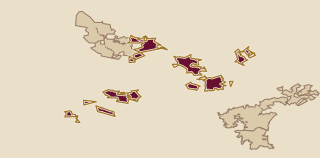
Maison Fontan's vineyards lie in the Gers department, within the Bas Armagnac zone, at 200 metres elevation. The same setting applies to the estate's white, red and rosé wines. Maubet Blanc Sec and Tattoo Blanc are the two named whites, each with its own grape formula.
The Maubet vineyard has clayey soils and boulbènes, a mixture of sand and silt, together with tawny sands reaching two metres deep. Clay retains moisture, while sand and silt let excess water pass more readily. Water therefore moves at different rates through the layers. This affects growing conditions before the chosen grape varieties determine the wine style.
How it is made
The cellar
Maison Fontan has 85 hectares of vineyards for white, red and rosé wines. Maubet Blanc Sec brings Colombard, Ugni Blanc, Gros Manseng and Sauvignon together. Its 2023 composition is 55% Colombard, 30% Ugni Blanc, 10% Gros Manseng and 5% Sauvignon. Tattoo Blanc is made from Sauvignon Blanc and Gros Manseng. Its 2023 composition is 80% Sauvignon Blanc and 20% Gros Manseng. The two formulas produce two separate white labels.
What they make
Maubet Blanc Sec is intended for consumption within one year of vintage. Tattoo Blanc is intended within two years. The two wines therefore have different drinking windows. Tattoo Blanc is the original, daring and audacious white in the pair.
Maubet Blanc Sec is pale yellow with green highlights. Its nose has citrus and white and yellow fruit. The palate is fresh, with grapefruit and lemon, good acidity and length. Tattoo Blanc is brilliant yellow. Its nose has peach, mirabelle, pineapple, exotic fruit and pear, followed by mango and white flowers on the palate. Both are served at 8 to 10°C. The different grape formulas account for the separate fruit and flower profiles.