
NoleaWorld of Wine

Aegean Islands · Greece

Producer profile

Karimalis Winery

Small family estate on the Aegean island of Ikaria, farming a 500-year-old vineyard of indigenous varieties with organic methods and indigenous yeast fermentation, now led by oenologist Iliana Karimalis.

Place
Greece
Known for
Minimal intervention wines from indigenous Ikarian varieties on a 500-year-old organically farmed estate, fermented with indigenous yeasts on volcanic island soils.
Wine context
Xinomavro
Editorial basis
World of Wine editorial profile · 2 sources

World of Wine editorial profile · Source list ↓

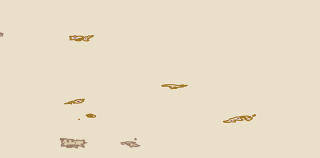
Atlas locationAegean Islands · Greece37.62° N · 26.14° E

At A Glance

**Country**
Greece
**Region**
Ikaria, Aegean Islands
**Appellation**
PGI Ikaria
**Founded**
1999
**Key People**
George Karimalis, Eleni Karimalis, Iliana Karimalis
**Vineyard**
3.5 acres, indigenous varieties, organic farming
**Winemaking**
Indigenous yeast fermentation, minimal intervention

The Producer

In 1999, George Karimalis and his wife Eleni closed their working lives in Athens and sailed back to Ikaria with one clear intention: to farm a piece of land their family had never stopped owning. The vineyard they returned to had been in continuous cultivation for five centuries. It had not been abandoned; it had been waiting.

The estate sits on Ikaria, a mountainous Aegean island roughly halfway between Samos and Mykonos. The vineyard covers 3.5 acres and is planted entirely with indigenous grape varieties. All wines carry the PGI Ikaria designation, a Protected Geographical Indication that covers wines produced from grapes grown on the island. Fermentation uses only indigenous yeasts, and the estate describes its winemaking as minimal intervention.

George and Eleni built two traditional stone guest houses within the vineyard, opening the estate as an agrotourism destination for small groups. Their daughter Iliana, trained as an oenologist and chemical engineer, has since joined them and now leads the cellar.

Place

Ikaria lies in the northeastern Aegean, closer to the Turkish coast than to the Greek mainland. It is a mountainous island with volcanic soils, a maritime climate tempered by altitude, and enough remoteness that its grape varieties have developed independently of the commercial pressures that reshaped wine production elsewhere in Greece.

The PGI Ikaria designation covers wines made from grapes grown on the island and labelled as such. It is not a prestige classification but a geographic signal: these grapes come from one specific Aegean island, from varieties that have grown here rather than varieties imported to fill a commercial gap. Ikaria sits outside the main denominational zones of Nemea, Naoussa, or Santorini. It operates on a smaller, less-known scale, which is precisely why the indigenous grape argument carries weight. The varieties here are not found in broader Greek production.

The island's topography keeps the vineyard exposed to sea winds on one side and shaded by hills on the other. Volcanic subsoil below the thin topsoil contributes mineral conditions that affect both vine vigour and the character fermented from the fruit.

Soil And Site

The Karimalis vineyard lies within the island's mixed volcanic and rocky terrain. Thin soils over volcanic subsoil limit vine vigour and push roots deeper. The maritime influence from the surrounding Aegean moderates summer heat and delivers enough seasonal humidity to sustain the vines without irrigation. The two named microclimates across the estate, Pigi and Kalabele, suggest site variation across the 3.

The estate farms organically and supports its operation with waste recycling and renewable energy production.

Story

The Karimalis family has held this land for generations. By 1999, George and Eleni were professionals living in Athens: the pattern of educated Greeks who had moved to the capital for work and stayed. Walking away from that life was not a symbolic gesture. It meant giving up income, proximity to services, and the rhythms of a city existence in exchange for a mountainous Aegean island and a five-century-old vineyard that needed restoring.

They cleared, rebuilt, and farmed. They converted the estate to organic practices and established the winery infrastructure that turned the family vineyard into a labelled, bottled producer. The two stone guest houses came later, an extension of the estate that placed visitors inside the vineyard rather than beside it.

Iliana Karimalis grew up with this project and then trained formally, earning qualifications in oenology and chemical engineering. When she joined her parents at the estate, she brought the ability to read the vineyard analytically: to track fermentation chemistry, to evaluate indigenous yeast populations, and to work with the scientific rigour that minimal intervention winemaking requires when done without shortcuts. The combination of ancient site and modern analytical method now defines how the cellar operates.

Vineyards And Cellar

The vineyard is planted entirely to indigenous varieties. These are not the pan-Greek commercial varieties found across multiple appellations; they are grapes specific to Ikarian cultivation, including Fokiano and Begleri as candidates, though the full confirmed variety list is not available from current sources. Indigenous varieties on a small island evolve under local selection pressure over centuries and carry flavour and structural signatures absent in transplanted material.

Fermentation is carried out using indigenous yeasts drawn from the vineyard itself. This is not a stylistic preference alone; it is a decision to let the microbial population of the island carry the wine through conversion rather than introducing laboratory strains that would smooth differences away. Indigenous yeast fermentations run less predictably than inoculated ones, require closer monitoring, and produce wines that sit closer to their site of origin in character.

The estate applies minimal intervention across the cellar, meaning fewer additions, less manipulation of the fermenting must, and a preference for allowing the wine to arrive at its form through natural process. Iliana's chemical engineering background means this is managed analytically rather than left to chance.

Wines

All Karimalis wines carry PGI Ikaria and are made from indigenous varieties grown on the estate's 3.5 acres. The range is small by necessity: a vineyard of this scale, farmed organically and vinified without shortcuts, does not produce large volumes. What it produces is specific to the island.

Fokiano is an Ikarian red grape, capable of producing wines with concentrated colour, moderate tannin, and a fruit register that leans toward darker berries rather than the bright, high-acid red fruit profile associated with, say, Xinomavro in northern Greece. Begleri appears as a white or rosé candidate in the range. Both varieties are cultivated on this island in forms not widely seen in broader Greek wine production.

The minimal intervention approach and indigenous yeast fermentation mean that each vintage reflects the growing season directly. There is no technical correction applied to deliver consistency from year to year. The wines are what the island produces in a given year, processed as simply as the cellar can manage.

In The Glass

Karimalis wines are built from island varieties fermented without the smoothing influence of laboratory yeasts, on a vineyard of volcanic and rocky soils in a maritime climate. All wines carry PGI Ikaria and use indigenous yeast fermentation.

Whites and any rosé from Begleri-type varieties would carry the mineral lift that volcanic soils and island air contribute, with moderate body and an acidity shaped more by altitude and sea wind than by cool-climate latitude. Red wines from Fokiano carry colour depth and tannin at a level that indigenous Aegean varieties tend to produce: firm rather than harsh, with fruit that is compact rather than exuberant, and a finish that reflects the stony soil rather than oak or extraction.

The indigenous yeast fermentation adds a complexity to the aromatic profile that commercial yeasts suppress: a slight wildness on the nose, a texture in the mid-palate that is rounder and less linear than technically corrected fermentations, and a finish that trails off with mineral and savoury notes rather than clean fruit alone.

A Bottle To Understand It

The entry point at Karimalis is the Fokiano-based red. Fokiano is the island's principal red variety, it is the grape the estate grows and has grown for generations, and a wine made from it under PGI Ikaria and fermented with indigenous yeasts is the clearest expression of what this producer is doing. It is not a powerful wine in the sense of high alcohol or heavy extract; it is a wine of moderate weight and firm, dry tannin, with dark berry fruit, a mineral thread through the mid-palate, and a finish that stays dry and slightly earthy rather than fruity. Serve it at a temperature where the tannin softens slightly, 16 to 17 degrees, with food rather than without. It is a table wine in the Greek sense: made to accompany a meal, not to perform independently.

Anecdote

George Karimalis had a folder of old land documents that his family had kept across several generations. The vineyard was listed in those records as active, under cultivation, a working piece of Ikarian soil that had changed hands within the family but never left it. In 1999, when George and Eleni left Athens for good and returned to work the land described in those pages, they found the vineyard in a condition that required restoration but not reinvention. The vines were there. The rootstock had survived. Five hundred years of cultivation had left a living vineyard, not a ruin, and the decision to farm it organically, to ferment with the yeasts already present on the island, and to build the estate from what the land had always carried was available to them precisely because the land had never been abandoned in the first place.

Final Word

Karimalis is a small producer on a remote Aegean island, farming fewer than four acres of ancient indigenous varieties with organic methods and indigenous yeasts. The wines are specific to their place in a way that few modern producers can claim without qualification. If you are looking for Ikarian wine from a family who returned to make it from five centuries of inherited ground, this is the address.

Sources

Keep following the thread

Where to go next

mapFind Karimalis Winery on the mapKeep the producer, its region and nearby places together.learningHow place shapes wineSee how climate, landscape and local choices become part of a wine.